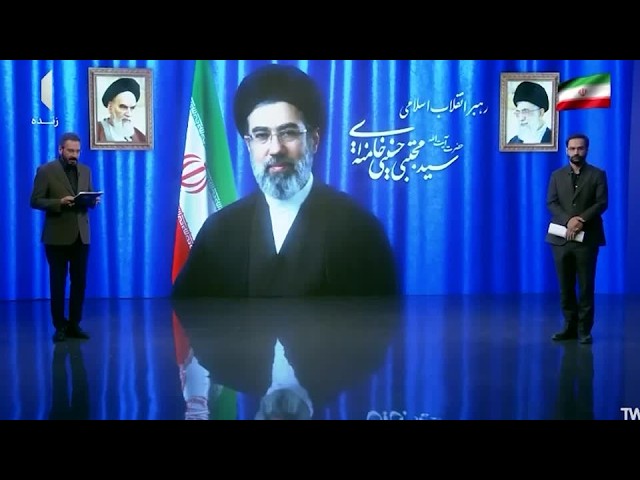
Mojtaba Khamenei Named Iran’s Supreme Leader Following Death of Ali Khamenei
Iran
'%3e%3cg id='e'%3e%3cg id='c' fill='none' stroke='%23fff' stroke-width='2'%3e%3cpath id='b' d='M0 1h26M1 10V5h8v4h8V5h-5M4 9h2m20 0h-5V5h8m0-5v9h8V0m-4 0v9' transform='scale(1.4)'/%3e%3cpath id='a' d='M0 7h9m1 0h9' transform='scale(2.8)'/%3e%3cuse xlink:href='%23a' y='120'/%3e%3cuse xlink:href='%23b' y='145.2'/%3e%3c/g%3e%3cg id='d'%3e%3cuse xlink:href='%23c' x='56'/%3e%3cuse xlink:href='%23c' x='112'/%3e%3cuse xlink:href='%23c' x='168'/%3e%3c/g%3e%3c/g%3e%3cuse xlink:href='%23d' x='168'/%3e%3cuse xlink:href='%23e' x='392'/%3e%3c/g%3e%3cg fill='%23da0000' transform='matrix(45 0 0 45 315 180)'%3e%3cg id='f'%3e%3cpath d='M-.548.836A.912.912 0 0 0 .329-.722 1 1 0 0 1-.548.836'/%3e%3cpath d='M.618.661A.764.764 0 0 0 .422-.74 1 1 0 0 1 .618.661M0 1l-.05-1L0-.787a.31.31 0 0 0 .118.099V-.1l-.04.993zM-.02-.85 0-.831a.144.144 0 0 0 .252-.137A.136.136 0 0 1 0-.925'/%3e%3c/g%3e%3cuse xlink:href='%23f' transform='scale(-1 1)'/%3e%3c/g%3e%3c/svg%3e)
Political
6 min read
Updated By: History Editorial Network (HEN)
Published:
On 08/03/2026, Iran’s Assembly of Experts announced the appointment of Mojtaba Khamenei as the third Supreme Leader of the Islamic Republic, succeeding his father Ali Khamenei after his death in a 28/02/2026 airstrike attributed to the United States and Israel. The decision came during an extraordinary session of the 88-member Assembly of Experts, which is constitutionally responsible for appointing and overseeing the country’s highest religious and political authority. Iranian state media reported that Mojtaba Khamenei, aged 56, was selected after internal deliberations aimed at ensuring rapid succession amid an escalating regional conflict.
According to multiple reports, the Islamic Revolutionary Guard Corps played a significant role in urging a swift decision from the Assembly to prevent a leadership vacuum following the death of Ali Khamenei during the 28/02/2026 strike. Mojtaba Khamenei had long been considered an influential figure within Iran’s political and security circles, although he previously held no formal government position and had not traditionally been recognized as a senior clerical authority. Shortly before the announcement, he was reportedly elevated to the rank of Ayatollah, allowing the Assembly to justify his eligibility under constitutional requirements for the position.
The appointment marks the first time leadership of the Islamic Republic has passed directly from father to son since the country’s founding after the Iranian Revolution. The succession therefore drew attention both inside and outside Iran because the Supreme Leader position has historically been chosen through clerical consensus rather than hereditary transfer. The leadership transition occurred during an active period of military confrontation in the region and amid heightened political pressure inside the country.
On 12/03/2026, Iranian state television broadcast a written message attributed to Mojtaba Khamenei, marking his first public communication since the Assembly’s decision. In the message, he vowed “vengeance for the martyrs” and called for continued resistance against external enemies. As of that date, he had not appeared publicly or on video, leading to speculation in some media outlets that he may have been injured during the same strike that killed his father, though no official confirmation of such reports has been issued.
International reactions to the announcement were mixed. Governments including those of Russia and China acknowledged the new leadership, while officials in the United States and Israel criticized the appointment. Donald Trump described the selection as unacceptable in public remarks, and Israeli officials indicated that the new Supreme Leader could be considered a legitimate military target during the ongoing conflict.
#MojtabaKhamenei
#SupremeLeader
#MiddleEastPolitics
#IranLeadership

Explore the Life Moments of
 AI Twin