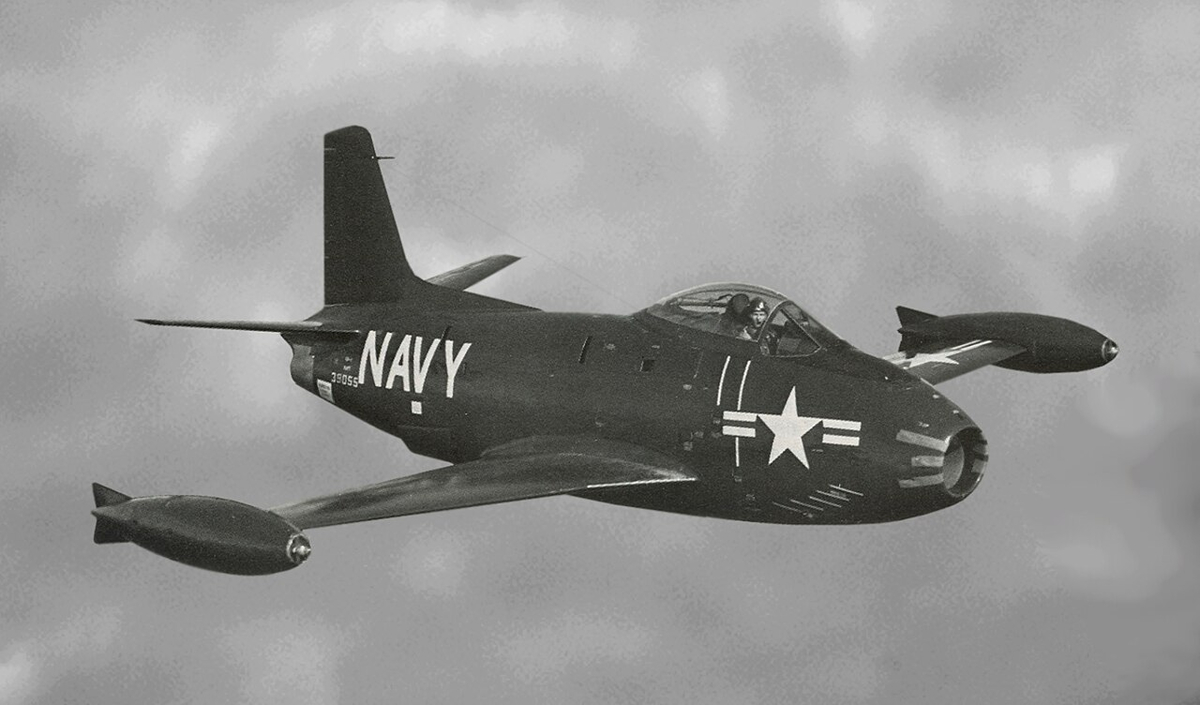
North American FJ-1 Fury: Early U.S. Navy Carrier-Based Jet Fighter
United States
Economy
Technology
5 min read
Updated By: History Editorial Network (HEN)
Published:
The North American FJ-1 Fury was one of the first jet fighters designed for operation from aircraft carriers in the United States Navy. The aircraft made its first flight on 27/11/1946 at Muroc Army Air Field, California, United States. Developed by North American Aviation, the Fury project began near the end of World War II when the U.S. Navy sought to explore jet-powered aircraft capable of operating from carrier decks. The prototype, designated XFJ-1, was powered by a General Electric J35 turbojet engine, one of the early American jet engines developed during the 1940s.
The XFJ-1 prototype was flown by North American test pilot Wallace Lien during its first flight on 27/11/1946. The aircraft had a straight-wing design, nose-mounted air intake, and tricycle landing gear. Unlike later naval jets, the FJ-1 Fury did not include folding wings, which limited the number of aircraft that could be stored aboard aircraft carriers. Its maximum speed was approximately 547 mph (about 880 km/h), placing it among the early generation of jet fighters developed in the immediate postwar period.
Following flight testing, the U.S. Navy ordered production aircraft, and 30 FJ-1 fighters were built. The first operational unit to receive the aircraft was Fighter Squadron VF-5A, which later became VF-51, based at Naval Air Station North Island in San Diego, California. The Fury entered service in 1948, becoming one of the Navy’s earliest operational jet fighters to operate from aircraft carriers such as USS Boxer and USS Princeton during carrier qualification trials.
Although the FJ-1 Fury represented an early step in naval jet aviation, it was soon surpassed by newer designs with swept wings and improved performance. The aircraft remained in frontline service only briefly before being replaced by more advanced fighters. Despite its limited service life, the program provided operational experience with jet aircraft aboard carriers and influenced later naval jet fighters developed by North American Aviation, including the swept-wing FJ-2 and FJ-3 Fury, which were derived from the F-86 Sabre design.
#NorthAmericanAviation #FJ1Fury #NavalAviation #JetFighter #AviationHistory
#NorthAmericanAviation
#FJ1Fury
#NavalAviation
#JetFighter
Primary Reference
North American FJ-1 Fury

Explore the Life Moments of
 AI Twin