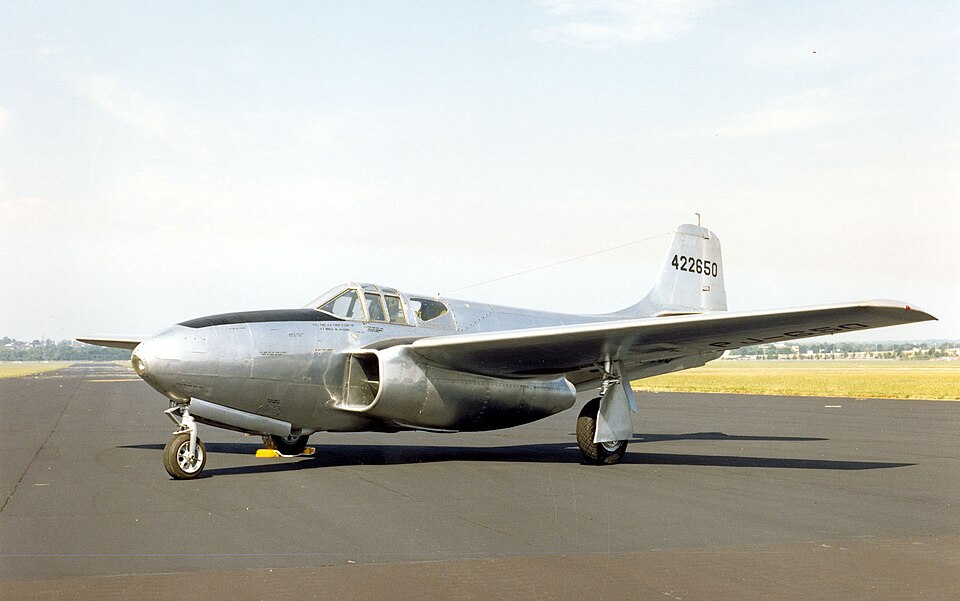
Bell P-59 Airacomet: First American Jet Aircraft Prototype Tested During World War II
United States
Economy
Technology
5 min read
Updated By: History Editorial Network (HEN)
Published:
The Bell P-59 Airacomet, the first jet-powered aircraft built in the United States, began its initial testing phase on 01/10/1942 at Muroc Army Air Field, California, United States. Developed by the Bell Aircraft Corporation, the aircraft was created in response to rapid advancements in jet propulsion technology during World War II. The project began after the United States obtained early information about British jet engine developments, particularly the Whittle turbojet design. Bell engineers designed the P-59 around two General Electric J31 turbojet engines, which were derived from the British Power Jets W.1 engine technology.
The first flight of the XP-59A prototype took place on 01/10/1942, piloted by Robert M. Stanley, Bell’s chief test pilot. The test flight occurred at the remote desert base of Muroc Army Air Field, which later became Edwards Air Force Base. Early tests focused on evaluating jet propulsion performance, engine reliability, and aircraft handling characteristics. The aircraft had a twin-engine layout mounted within the fuselage with side air intakes, tricycle landing gear, and a straight wing design typical of early jet experiments.
During the testing period from 1942 to 1944, several prototypes and evaluation units were built and flown by both Bell and the United States Army Air Forces (USAAF). Although the aircraft represented an important step in American jet aviation, its performance was limited. The P-59 Airacomet had a top speed of approximately 409 mph (658 km/h) and experienced slower acceleration compared with some late-war piston-engine fighters. As a result, the aircraft was not used in combat roles. Instead, it served primarily as a training and experimental platform for pilots and engineers learning to operate and maintain jet-powered aircraft.
Testing of the P-59 provided practical experience in jet engine operation, maintenance, and flight procedures for the USAAF. Lessons from the Airacomet program contributed to later American jet fighter development programs, including aircraft that entered service in the later years of World War II and the early postwar period. By the end of its operational testing and limited production phase in 1944, the P-59 Airacomet had established the foundation for the United States’ transition from piston-driven aircraft to jet propulsion technology.
#BellAircraft #P59Airacomet #JetAviation #WorldWarII #AviationHistory
#BellAircraft
#P59Airacomet
#JetAviation
#WorldWarII
Primary Reference
Bell P-59 Airacomet

Explore the Life Moments of
 AI Twin