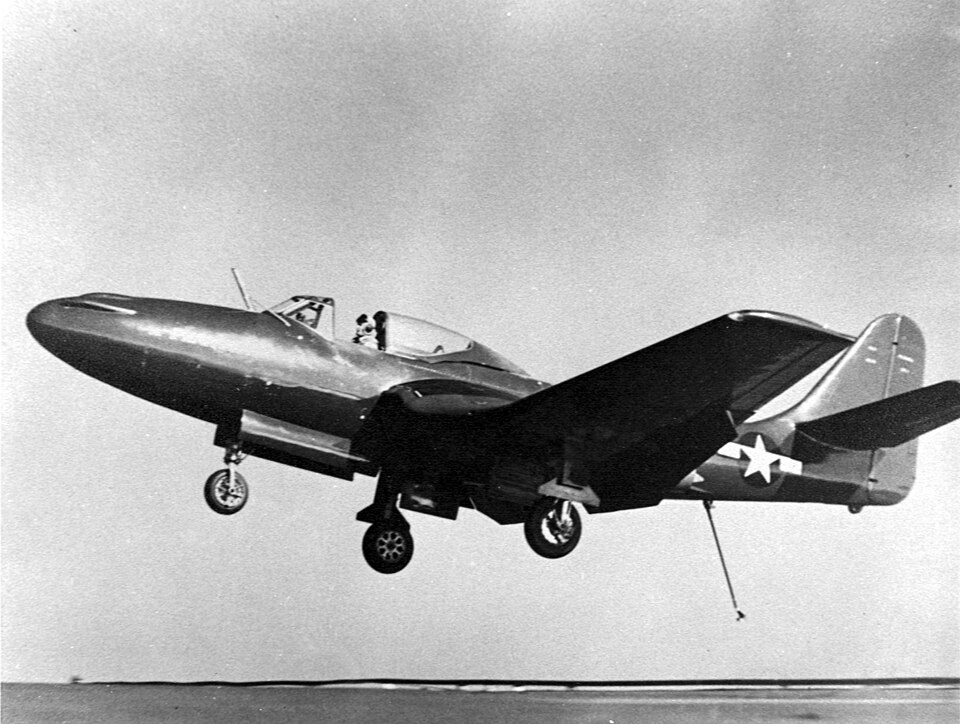
McDonnell FH-1 Phantom: The U.S. Navy’s First Operational Jet Fighter
United States
Economy
Technology
5 min read
Updated By: History Editorial Network (HEN)
Published:
The McDonnell FH-1 Phantom became the first jet-powered fighter to enter operational service with the United States Navy. The aircraft completed its maiden flight on 26/01/1945 at Naval Air Station Patuxent River, Maryland, United States, marking an early step in the transition of U.S. naval aviation from piston-powered aircraft to jet propulsion. The fighter was developed by McDonnell Aircraft Corporation after the U.S. Navy requested proposals in 1943 for a carrier-capable jet fighter during World War II.
The prototype, designated XFD-1 (later redesignated XFH-1 under a revised naming system), was powered by two Westinghouse J30 turbojet engines mounted in the wing roots. The aircraft was flown on its first flight by McDonnell test pilot Robert M. “Bob” Edholm on 26/01/1945. Its twin-engine configuration was selected partly for reliability, since early jet engines had limited thrust and uncertain durability. The aircraft had straight wings, a tricycle landing gear arrangement, and was designed for compatibility with aircraft carrier operations.
Following testing and evaluation, the aircraft entered production as the FH-1 Phantom, with 60 aircraft built between 1946 and 1948. The Phantom entered operational service with the U.S. Navy in July 1947, when Fighter Squadron VF-17A, later redesignated VF-171, became the first Navy squadron equipped with jet fighters. The squadron was based at Naval Air Station Quonset Point in Rhode Island, and the aircraft later conducted carrier operations aboard the aircraft carrier USS Saipan (CVL-48).
The FH-1 Phantom had a maximum speed of approximately 480 mph (about 773 km/h) and was armed with four .50-caliber machine guns mounted in the nose. Although its performance was modest compared with later jet fighters, the aircraft provided the U.S. Navy with practical operational experience in jet aircraft handling, maintenance, and carrier-based jet operations. The lessons learned from the FH-1 Phantom contributed to the development of later naval jet fighters, including the McDonnell F2H Banshee and other early postwar carrier-based jets.
#McDonnell #FH1Phantom #NavalAviation #JetFighter #AviationHistory
#McDonnell
#FH1Phantom
#NavalAviation
#JetFighter
Primary Reference
McDonnell FH Phantom

Explore the Life Moments of
 AI Twin