Unification under Ottoman Rule.
Sudan

Political
Economic
5 min read
Updated By: History Editorial Network (HEN)
Published:
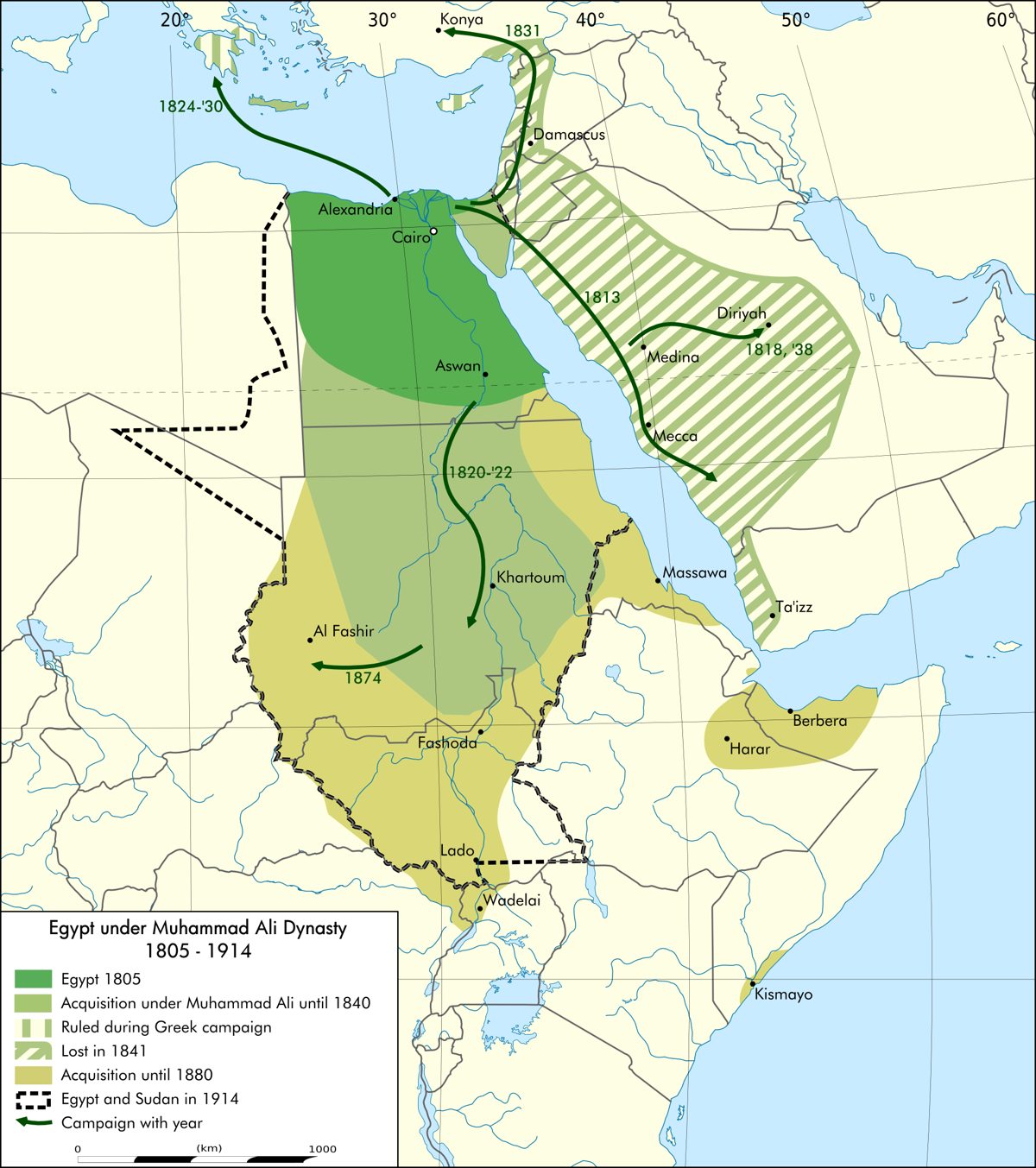
The consolidation of Egypt and Sudan under Ottoman rule marked a pivotal transition. The process began when Muhammad Ali Pasha, the Ottoman viceroy of Egypt, set his sights on the southern regions of Nubia and Sudan, driven by economic interests and the desire for consolidation of power. His ambitions were largely fueled by the agricultural potential of the Nile Valley and the perceived strategic benefits.
Muhammad Ali dispatched an Egyptian army led by his son, Isma'il Kamil Pasha. The military campaign quickly overwhelmed the feuding Nubian and Sudanese territories. The weaker local rulers, lacking a unified defense, found themselves unable to resist the organized and technologically superior Egyptian forces. This resulted in the establishment of Egyptian control over Sudan.
The unification under Ottoman oversight had multiple impacts. Economically, the region saw increased development in agriculture, partially due to the Nile and partially due to the establishment of new irrigation projects. However, the local population faced heavy taxation and conscription into the Egyptian army. The introduction of new agricultural practices and crops such as cotton aimed to integrate Sudan more closely into the international economy.
Politically, the governance structure of Sudan underwent significant changes. The introduction of a centralized administration aligned with Ottoman frameworks, though it faced resistance and occasional uprisings from the local populace. Governance now fell under appointed Egyptian officials, changing the traditional power dynamics in Sudanese society.
The social landscape of Sudan also shifted as Egyptian and, by extension, Ottoman cultural influences began permeating Sudanese life. This period saw the beginning of more pronounced Islamic administrative practices aligning with Ottoman norms. Communication and transport links between Egypt and Sudan improved, facilitating better management but also leading to exploitation and resource extraction.
This unification event was significant in shaping the historical trajectory of Sudan, deeply influencing its socio-economic and political structures and setting the stage for future events in the region.
#OttomanEmpire #MuhammadAliPasha #Egypt #Sudan #ColonialImpact #MoofLife

Explore the Life Moments of
 AI Twin