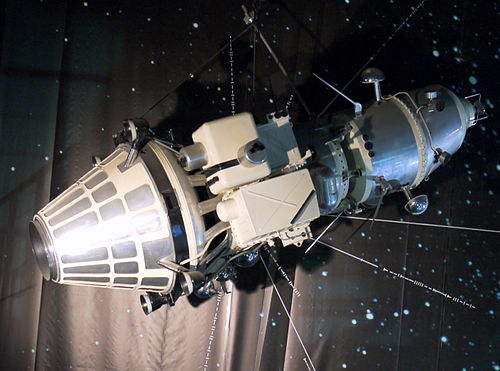
First artificial satellite around another world (Moon)
Lunar Orbit
Space Exploration
Artificial Satellites
Lunar Missions
5 min read
Updated By: History Editorial Network (HEN)
Published:
Updated:
On 03/04/1966, the Soviet Union’s Luna 10 spacecraft became the first artificial satellite to orbit another celestial body when it successfully entered orbit around the Moon. Launched on 31/03/1966 from the Baikonur Cosmodrome, Luna 10 was part of the Soviet Luna program aimed at exploring the Moon through robotic missions.
After a three-day journey, Luna 10 performed a retro-rocket burn to slow down and enter lunar orbit. The spacecraft achieved an elliptical orbit around the Moon, completing its first revolution shortly after insertion. During its mission, Luna 10 transmitted scientific data back to Earth, including measurements of the Moon’s gravitational field, radiation environment, and micrometeorite impacts. It also studied the distribution of mass within the Moon, providing insights into lunar structure.
Luna 10 operated for several weeks, completing over 400 orbits before its mission ended in late May 1966. The spacecraft also carried a symbolic payload, transmitting a recording of the Soviet national anthem during the 23rd Congress of the Communist Party of the Soviet Union.The launch of Luna 10 marked a pivotal achievement in space exploration as it became the first artificial satellite to orbit another celestial body, specifically the Moon. This mission was conducted by the Soviet Union and represented a significant advancement in the understanding of lunar science and technology. Luna 10 was designed to gather data about the Moon's surface, gravitational field, and environment, contributing to the broader knowledge of lunar geology and the potential for future exploration. The spacecraft successfully entered lunar orbit, providing valuable information that would inform subsequent missions and research.
The impact of Luna 10 extended beyond its immediate scientific contributions. It demonstrated the feasibility of sending spacecraft to other celestial bodies and laid the groundwork for future lunar missions, including crewed landings. The data collected by Luna 10 helped refine the techniques used in lunar mapping and exploration, influencing the design and objectives of later missions. The success of Luna 10 also played a role in the space race, showcasing the technological capabilities of the USSR and prompting further investments in space exploration by other nations. Overall, Luna 10's achievement was a crucial step in humanity's quest to explore and understand the universe beyond Earth.
#mooflife
#MomentOfLife
#Luna10
#ArtificialSatellite
#SpaceExploration
#Moon
#Ussr
Primary Reference
Luna 10

Explore the Life Moments of
 AI Twin