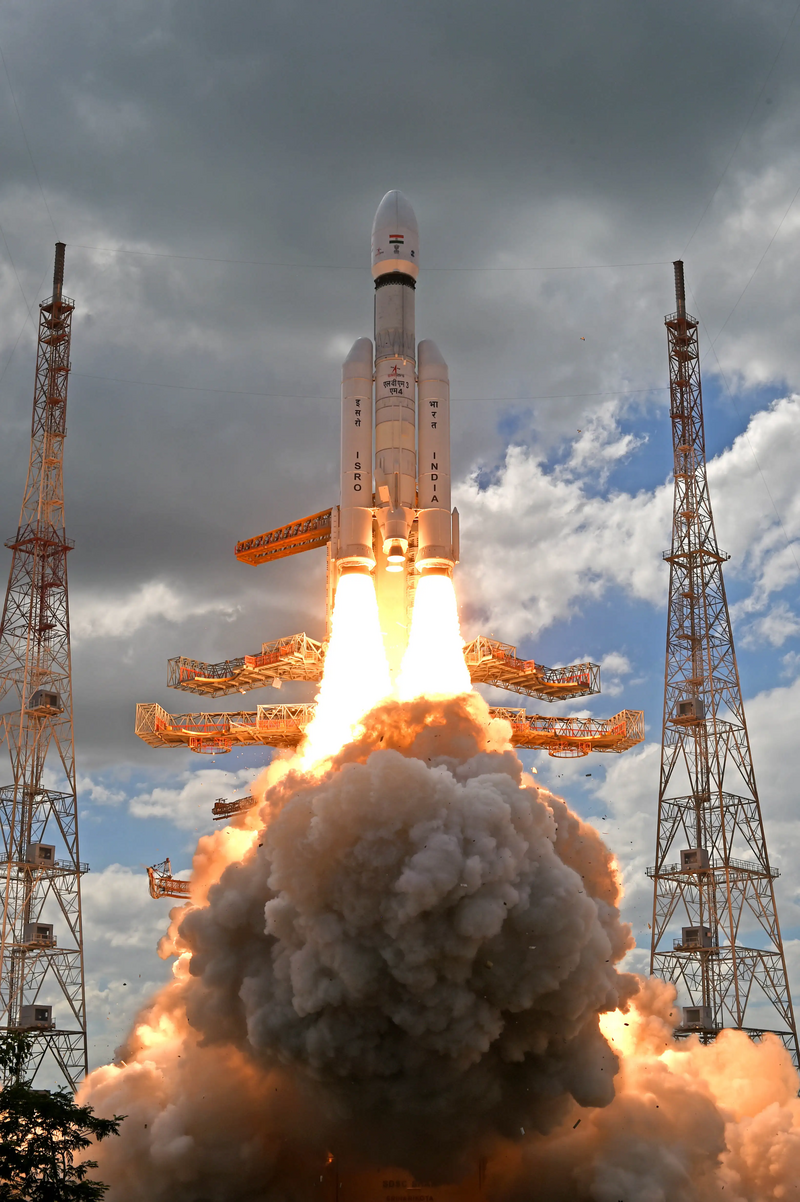
First landing at the lunar south polar region
Statio Shiv Shakti, Lunar South Polar Region, India
Space Exploration
Lunar Missions
Indian Space Research
5 min read
Updated By: History Editorial Network (HEN)
Published:
Updated:
On 23/08/2023, India’s Chandrayaan-3 mission successfully achieved a soft landing near the Moon’s south polar region when the Vikram lander touched down at approximately 18:04 IST (12:33–12:34 UTC). The landing occurred at a high-latitude site later named Statio Shiv Shakti, located near 69.37°S and about 32.3°E between the Manzinus C and Simpelius N craters. With this touchdown, India became the first country to land near the lunar south pole and the fourth nation overall to accomplish a soft landing on the Moon, following the Soviet Union, the United States, and China. The landing took place after Chandrayaan-3 entered lunar orbit on 05/08/2023 and executed a powered descent lasting roughly 11 minutes before touchdown.
Shortly after landing, the Pragyan rover deployed from the Vikram lander using a ramp system and began surface operations. The six-wheeled rover carried instruments to analyze lunar soil composition and measure elemental properties, while the lander hosted experiments to study temperature, seismic activity, and near-surface plasma conditions. Both the lander and rover were designed to operate for approximately one lunar day, about 14 Earth days, before the onset of lunar night. Images captured by Pragyan later confirmed the lander’s position and documented the surrounding terrain near the south polar region.
The mission targeted the lunar south polar region because permanently shadowed craters in this area are believed to contain frozen water deposits. These potential reserves are considered important for future lunar infrastructure, including life support resources and propellant production for deeper space missions. Chandrayaan-3 was also designed to demonstrate India’s capability for safe landing and rover mobility, following the unsuccessful landing attempt of Chandrayaan-2 in 2019. The mission’s experiments focused on understanding surface composition, thermal properties, and local environmental conditions in this previously unexplored high-latitude area.
After landing, the Indian government announced that the touchdown site would be called Shiv Shakti Point, and 23 August was later designated as India’s National Space Day. The rover and lander conducted operations for roughly twelve Earth days before sunset ended surface activity. Data returned from the mission contributed to ongoing analysis of lunar polar terrain and conditions relevant to future robotic and human exploration efforts.
#mooflife
#MomentOfLife
#Chandrayaan-3
#Isro
#LunarExploration
#SouthPoleMoonLanding
#SpaceMissions
Primary Reference
Chandrayaan-3

Explore the Life Moments of
 AI Twin