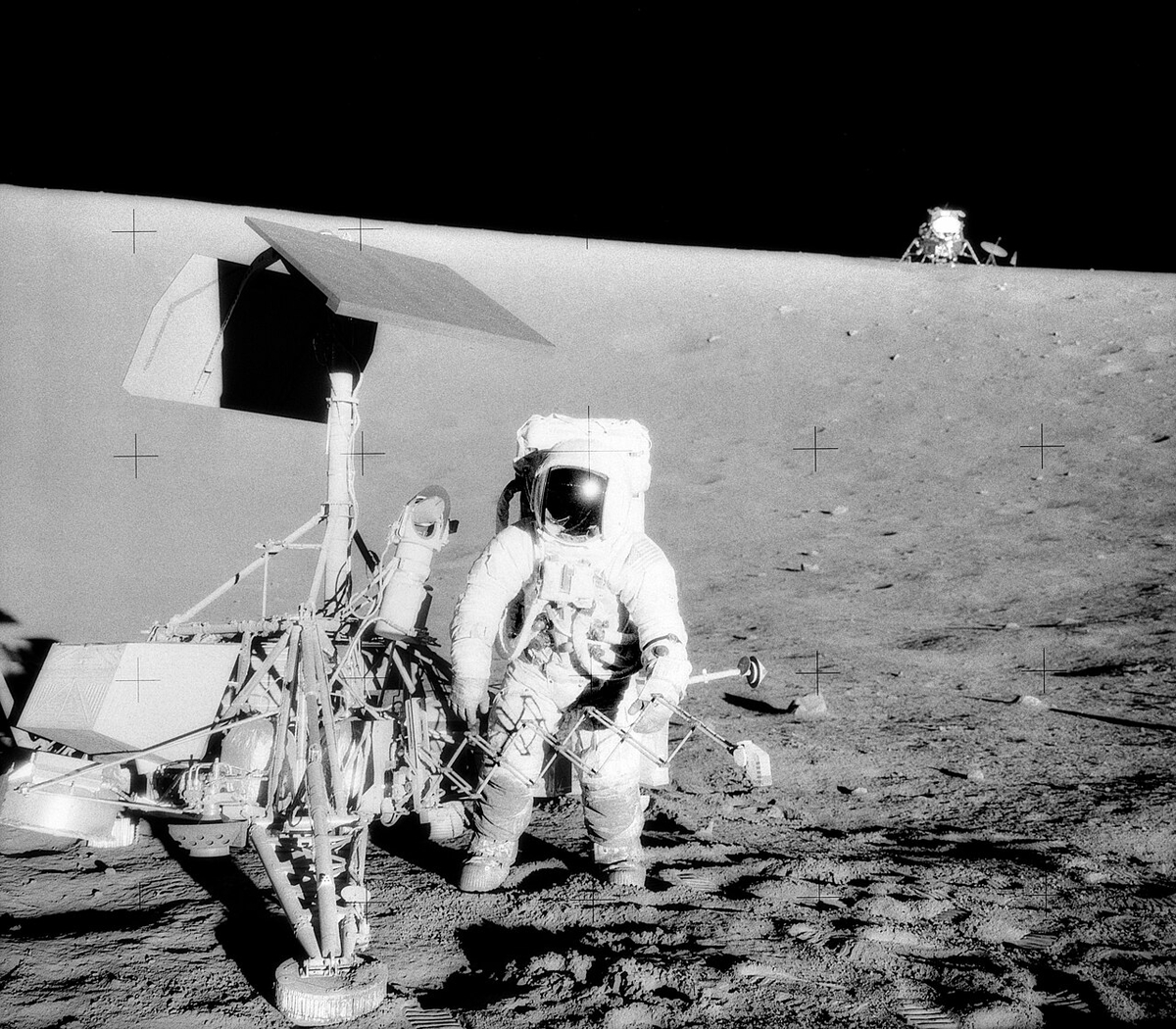
First rendezvous on the surface of a celestial body
Oceanus Procellarum, Moon
Space Exploration
NASA Missions
Lunar Studies
4 min read
Updated By: History Editorial Network (HEN)
Published:
Updated:
On 19/11/1969, NASA’s Apollo 12 mission achieved the first precision landing on the surface of another celestial body, touching down within close proximity of a previously landed spacecraft on the Moon. The Lunar Module Intrepid, carrying astronauts Charles “Pete” Conrad and Alan L. Bean, landed in the Oceanus Procellarum (Ocean of Storms), approximately 160 meters from the robotic Surveyor 3 probe.
Apollo 12 was launched on 14/11/1969 with the objective of demonstrating pinpoint landing capability and conducting scientific exploration. Unlike the earlier Apollo 11 mission, which prioritized safety in selecting a broad landing zone, Apollo 12 targeted a specific site. The successful landing near Surveyor 3 confirmed that astronauts could guide the spacecraft with high accuracy to a predetermined location on the lunar surface.
After landing, Conrad and Bean conducted extravehicular activities (EVAs), during which they visited the Surveyor 3 spacecraft, which had landed on the Moon in April 1967. They examined the probe and removed several components, including parts of its camera, to return to Earth for analysis. These samples provided insights into the effects of long-term exposure to the lunar environment on materials and equipment.
The mission also included the deployment of scientific instruments to study the Moon’s surface and environment. Apollo 12 demonstrated improved navigation, landing precision, and operational techniques, contributing to the advancement of lunar exploration methods used in subsequent Apollo missions.
#mooflife
#MomentOfLife
#Apollo12
#Surveyor3
#MoonLanding
#Nasa
#SpaceExploration
Primary Reference
Apollo 12

Explore the Life Moments of
 AI Twin