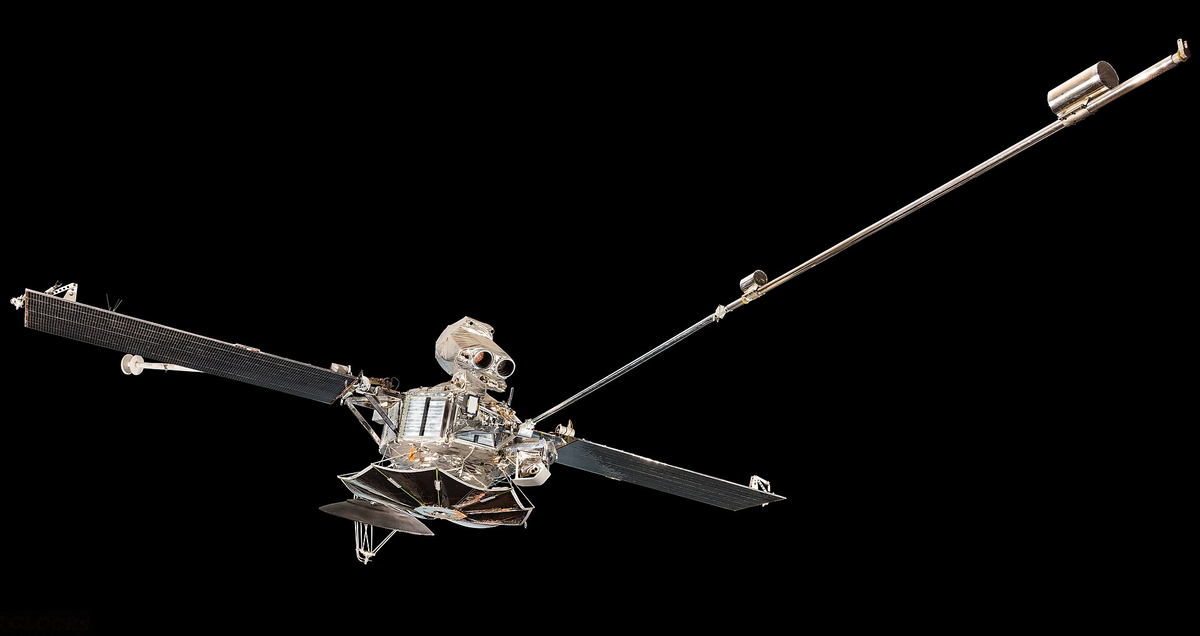
First mission sent to study Mercury
Cape Canaveral, Florida, United States
Space Exploration
Planetary Science
NASA Missions
4 min read
Updated By: History Editorial Network (HEN)
Published:
Updated:
On 03/11/1973, NASA launched Mariner 10, the first spacecraft designed to explore the planet Mercury and the first mission to study two planets during a single flight. The launch marked the beginning of a pioneering mission that introduced several new techniques in interplanetary exploration.
Mariner 10 was the first spacecraft to use a gravity-assist maneuver, passing by Venus on 05/02/1974 to alter its trajectory toward Mercury. This approach allowed the spacecraft to conserve fuel while reaching its target, establishing a method that would become standard in future missions. After the Venus flyby, Mariner 10 proceeded toward Mercury, where it conducted its first close encounter on 29/03/1974.
During its mission, Mariner 10 became the first probe to return close-up images and direct scientific data from Mercury. The spacecraft revealed a heavily cratered surface, similar in appearance to the Moon, and identified major geological features such as the Caloris Basin. It also discovered that Mercury has a magnetic field, providing new insights into the planet’s internal structure.
The spacecraft’s trajectory placed it in a solar orbit that allowed repeated encounters with Mercury. It conducted a second flyby on 21/09/1974 and a third on 16/03/1975, becoming the first spacecraft to visit the same planet multiple times. In addition, Mariner 10’s earlier Venus encounter made it the first mission to explore two planets during a single journey.
Mariner 10’s combination of gravity-assist navigation, multi-planet exploration, and repeated flybys established new possibilities for spacecraft mission design and expanded scientific understanding of the inner Solar System.
#mooflife
#MomentOfLife
#Nasa
#Mariner10
#MercuryExploration
#PlanetaryScience
#SpaceMissions
Primary Reference
Mariner 10

Explore the Life Moments of
 AI Twin