Wilson Bohannan Lock Company

American Family-Owned Manufacturer
Related Lives

Cricket World Cup
ICC Men's Cricket World Cup

PepsiCo
Food company

Kentucky Derby
The Run for the Roses

Kentucky Derby
The Run for the Roses

Shell
Oil industry company

Boeing
American multinational corporation

Patek Philippe
Watch and clock manufacturing

1926
On 16 December 1926, The Wilson Bohannan Company was incorporated in Ohio as the business prepared to transfer its manufacturing operations from Brooklyn, New York, to Marion, Ohio. Better Business Bureau corporate data records this date as the company's incorporation date and lists the business as beginning local operations in Marion in 1927. New York corporate records likewise identify 16 December 1926 as the company's Ohio formation date.
The incorporation formed part of a broader transition led by Wilson Bohannan Tway. Our company records place the move from Brooklyn to Marion in 1926, while other historical accounts describe the physical relocation and start of local operations as occurring in 1927. The December incorporation therefore provides a precise legal date within that transition, rather than necessarily the date on which manufacturing physically moved.
View detailsIn 1926, Wilson Bohannan Tway, a grandson of founder Wilson Bohannan, concluded that our aging Brooklyn factory could no longer efficiently support the business. The company began looking for a new manufacturing location, with the search ultimately leading to Marion, Ohio.
Marion offered an existing industrial building that could accommodate our operations and a central location with strong railroad connections—an important consideration for a company whose customers included railroads and industrial businesses across the country. The decision began the transition away from Brooklyn, where Wilson Bohannan had started making locks in 1860, toward the Ohio manufacturing base that would become the company's long-term home. The physical move took place the following year.
View details1922
In 1922, our catalogue documented additional numbered padlocks in the Wilson Bohannan range, including Models 305 and 306. Both were lever-type padlocks, continuing a product family that had developed through earlier catalogues as we produced locks for commercial, railroad and industrial service.
The surviving 1922 documentation helps trace how individual Wilson Bohannan models evolved over time. Specialist research based on company catalogues identifies 1922 as the first documented catalogue appearance of Models 305 and 306. Their addition alongside established designs reflects the continuing refinement and expansion of our lever-lock range more than six decades after the business began.
View details1911
On 1 April 1911, we issued a new illustrated catalogue from our Brooklyn factory, presenting what the company described as its full line of padlocks, latches, store-door locks, combination and key-operated drawer locks, and related hardware. The 157-page catalogue provides a detailed record of the range being manufactured as Wilson Bohannan entered its sixth decade in business.
Railroad products remained a distinct part of the range. The catalogue specifically indexed padlocks for railroad use and highlighted W.B. switch locks, alongside numerous bronze and steel-key padlock configurations. The breadth of the catalogue also shows that production extended well beyond railroad locks to equipment for commercial buildings and other industrial applications.
View details1904
In 1904, Wilson Todd Bohannan, the son of company founder Wilson Bohannan, died at the age of 58. He had been involved in the business from its earliest days, beginning in 1860 when, at 14, he worked alongside his father in the small workshop behind the family's Brooklyn home. After Wilson Bohannan's death in 1896, Wilson Todd remained part of the family enterprise during its transition to a new generation.
Wilson Todd's death brought another change in the family's stewardship of the company. The business continued under members of the Bohannan family, including his son, George W. Bohannan, as it moved further into the 20th century. The surviving company history identifies this period as part of the succession that ultimately maintained family involvement in the business across several generations.
View details1900
In 1900, we published another illustrated catalogue documenting the range of locks produced at our Brooklyn works. The catalogue shows that our product line had broadened considerably by the turn of the century, covering bronze and iron padlocks as well as drawer and cupboard locks, chest locks, night latches and store-door locks. It also included specialised padlocks for railroad service.
The catalogue records the continued development and standardisation of individual models. Locks including Models 301, 310, 311, 451 and 551 are documented as first appearing in the 1900 catalogue, while established railroad products remained part of the range. Around this period, our Brooklyn operation employed nearly 200 people and was shipping an estimated 100,000 padlocks, with railroads among the company's largest customers
View details1896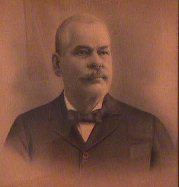
On 22 February 1896, our founder, Wilson Bohannan, died at the age of 68. By then, the small padlock business he had started with his son behind their Brooklyn home in 1860 had developed into an established manufacturing operation. Our company history records that Bohannan's patented padlocks were being distributed worldwide before his death.
Product development remained an important part of Bohannan's work throughout his career. Company historical material states that he ultimately held 20 lock-related patents; an 1880 company catalogue had already credited him with nine distinct patents by that point. After his death, the business and estate passed to his family, beginning the transition to the next generation of family management
View details1894
In July 1894, we published a new catalogue that prominently featured our participation in the previous year’s World’s Columbian Exposition in Chicago. Its opening page presented an illustration of the Wilson Bohannan World’s Fair exhibit accompanied by the statement “Five Medals Awarded,” carrying the recognition from the exposition directly into our commercial literature.
The catalogue also documented the breadth of the business at the time, illustrating bronze and handmade spring padlocks alongside combination and key-operated locks and other locking hardware. Wilson Bohannan’s introduction referred to increased manufacturing facilities at the new Brooklyn factory. By placing the World’s Fair awards at the front of this catalogue, the company used the exposition recognition as a prominent credential when presenting its products to customers beyond its home market.
View details1893
In 1893, we exhibited our locks at the World’s Columbian Exposition in Chicago and received five awards for our products. The recognition came more than three decades after Wilson Bohannan began making padlocks in Brooklyn and at a time when the business had expanded into its Lexington Avenue factory. A contemporary company catalogue published the following year prominently recorded “Five Medals Awarded” alongside its reference to the World’s Fair Columbian exhibit.
The awards provided outside recognition for the locks we were manufacturing and selling to commercial and industrial customers during this period. The 1894 catalogue, issued shortly after the exposition, documented an extensive range that included bronze spring padlocks, combination and key-operated locks, and other locking hardware
View details1890
In 1890, we published a new illustrated catalogue documenting the range of locks being manufactured at our Lexington Avenue works in Brooklyn. The catalogue presented an extensive selection of padlocks and related hardware, with products identified by model numbers, sizes, construction and available options. It provides a contemporary record of how the Wilson Bohannan range had expanded and become increasingly standardised during the company's first three decades.
The catalogue also illustrates the scale of the business following the opening of the Lexington Avenue factory in 1888. Its cover identifies the works at 754–776 Lexington Avenue and depicts the factory complex, while the product pages show locks intended for commercial and industrial applications, including railroad use. As one of the surviving late-19th-century Wilson Bohannan catalogues, it provides an important record of both our manufacturing operations and the products offered to customers at the time.
View details1888
In 1888, our business entered another period of expansion in Brooklyn. Company histories describe the business as being incorporated that year as sales and manufacturing activity grew. We also built a new four-storey factory on Lexington Avenue, providing approximately 10,000 square feet of manufacturing space.
There is, however, a discrepancy in the surviving company record over the incorporation date. Our current historical account gives 1888, while a detailed company history published in the 1922 Wilson Bohannan catalogue states that the business was incorporated in 1901, with stock allotted to Wilson Bohannan's heirs. The 1922 source does independently confirm that the Lexington Avenue factory was erected in 1888. For a historical timeline, it is therefore safest to describe 1888 as a documented expansion and factory-building year while noting that the precise legal incorporation date is uncertain from the available sources.
View details1886
In 1886, our catalogue included the Model 115, a 2½-inch padlock designed for railroad cars and switches. Surviving examples show a bronze body, with versions using bronze or iron shackles, a post key, spring dust guard, and a clevis and chain. Specialist documentation of historic Wilson Bohannan locks identifies 1886 as the model's first catalogue appearance.
Railroads had become an important market for Wilson Bohannan, and the Model 115 developed into one of our better-known railroad locks. Our company history identifies the 115, together with the Model 119, among the most popular WB padlocks supplied to railways and notes that both were manufactured in large quantities. Surviving Model 115 locks bearing railroad markings provide further evidence of the model's use across the industry
View details1885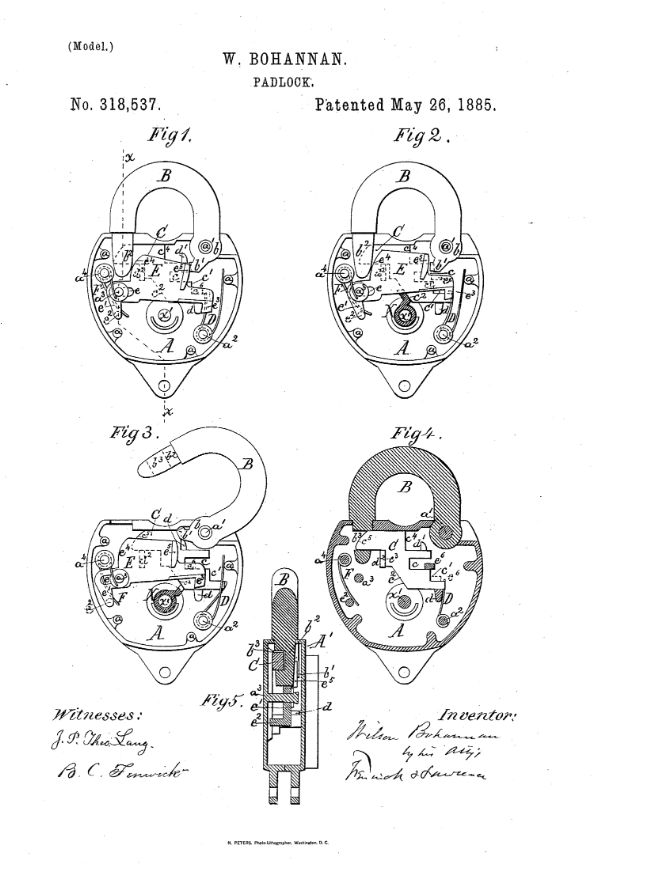
On 26 May 1885, Wilson Bohannan received U.S. Patent No. 318,537 for an improvement in padlocks. The design used a swinging shackle and a spring-operated locking mechanism that allowed the lock to secure itself when the shackle was pressed into the case. A key was therefore needed to unlock the padlock, but not to lock it.
The arrangement was designed to make securing the lock straightforward while retaining a positive mechanical engagement between the shackle and locking components. This type of self-locking operation was well suited to working environments where locks needed to be opened and secured repeatedly, including railroad and other industrial applications served by our commercial padlock range.
View details1884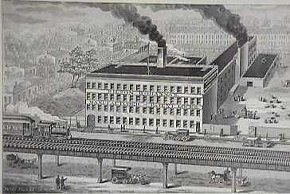
In 1888, we expanded our Brooklyn manufacturing operations with the construction of a new four-storey factory on Lexington Avenue. The original building provided approximately 10,000 square feet of manufacturing space, giving the business additional capacity as demand for Wilson Bohannan locks increased. Our 1922 company history records this as the first unit of what subsequently became a larger group of factory buildings.
Later additions expanded the Lexington Avenue plant and included a substantial brass foundry and specialised machinery for manufacturing lock and bolt mechanisms. A company catalogue from 1890 identifies the factory at 754–776 Lexington Avenue and includes a period illustration of the industrial complex, providing an early visual record of the new manufacturing site
View details1880
In 1880, we issued a new illustrated catalogue documenting the padlocks and related hardware then available from Wilson Bohannan. The surviving catalogue provides a detailed record of a product range built around the patented lock mechanisms developed during the company's first two decades. It includes padlocks in different sizes and configurations for a variety of commercial uses, reflecting the transition from the small workshop established in 1860 to a more established manufacturing business.
The 1880 catalogue is particularly valuable because it preserves contemporary illustrations, specifications and patent references for our products. Alongside the earlier 1869 catalogue and later editions, it shows the continuity and development of the commercial range during the second half of the 19th century, including locks designed for increasingly specialised industrial applications.
View details1878
On 25 June 1878, Wilson Bohannan received U.S. Patent No. 205,171 for an improvement in padlocks. The design incorporated a hinged shackle, tumbler mechanism and key-retaining arrangement, together with versions featuring a movable cover over the keyhole.
The design became part of our commercial product range. Our 1894 catalogue shows several cast-bronze spring padlocks stamped “PATENTED JUNE 25, 1878,” including tumbler locks with plain or spring-operated keyhole covers. Surviving examples also show the patent being used for specialised customers: documented locks made for the Buffalo, Rochester & Pittsburgh railroad and Standard Oil carry the 1878 patent date and are identified with Patent No. 205,171
View details1871
On 28 February 1871, Wilson Bohannan received U.S. Patent No. 112,211 for a “Keyless Lock.” The patent was associated with the American Seal Lock Company and represented a different approach from the key-operated padlocks Bohannan had patented during the previous decade.
The design was intended for applications including mail bags. Rather than being routinely opened with a key, its security depended on a marked locking component that had to be cut to open the lock. Corresponding identification marks on the lock and locking piece provided a means of checking the integrity of the closure. The patent reflects the range of specialised security mechanisms Wilson Bohannan was developing alongside our conventional padlock designs in the early 1870s.
View detailsOn 21 February 1871, Wilson Bohannan received U.S. Patent No. 112,011 for an “Improvement in Seal-Locks.” The design combined a conventional locking mechanism with a seal positioned over the keyhole. Access to the key required the seal to be broken, providing visible evidence that the lock had been opened or tampered with.
The patent described a hinged cap covering the keyhole and an arrangement for securing a seal beneath it. This approach added a means of detecting unauthorised access rather than relying solely on the lock to prevent entry. It was another example of the specialised lock mechanisms we were developing during our first decade in business.
View details1870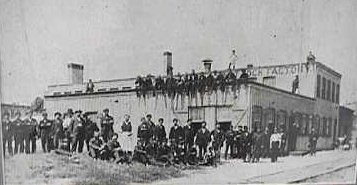
In 1870, we moved from the small workshop behind the Bohannan family home into larger premises at the corner of Broadway and Kossuth Place in Brooklyn, New York. A company history published in our 1922 catalogue records that growth had made the move necessary and that lockmaking could now be carried out on a larger scale.
The new plant initially used foot-powered lathes, stamping machines and drilling equipment. Steam power was not installed at the time of the 1870 move: the 1922 company account states that it was introduced three years later, around 1873, to provide both power for machinery and heat for the building. Later descriptions of the Broadway and Kossuth facility show that it developed into a more extensive manufacturing operation with a brass foundry, machine shop, polishing and finishing rooms, and packing and shipping facilities.
View details1869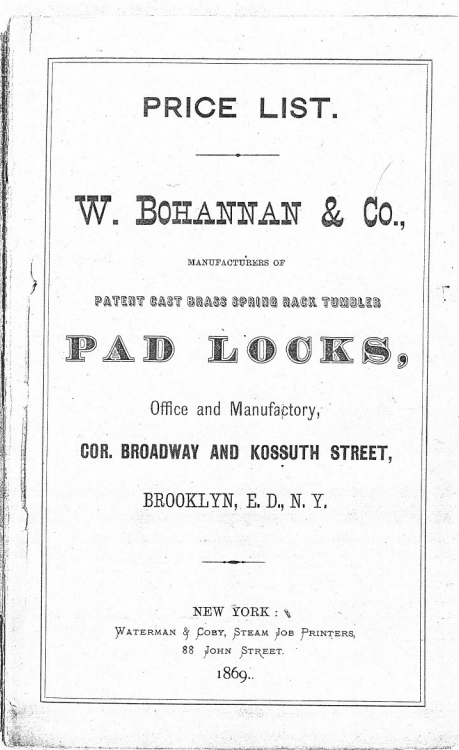
In 1869, we issued an early product catalogue under the name W. Bohannan & Co. Surviving records of the catalogue document an established range of padlocks in different sizes and configurations, including brass locks based on Wilson Bohannan’s earlier patented designs. Individual models identified as appearing in the 1869 catalogue ranged from smaller general-purpose locks to heavier versions intended for uses such as railroad cars and switches.
The catalogue is an important surviving record of the business less than a decade after Wilson Bohannan began making locks in Brooklyn. It also records the trading name W. Bohannan & Co. and references the patents obtained during the 1860s, providing a useful picture of how those early designs had developed into a commercial product range.
View details1866
In 1866, Wilson Bohannan continued developing new lock mechanisms, receiving U.S. Patents Nos. 55,047 and 55,048. Both were issued on 29 May 1866 and described improvements intended to refine the construction and operation of locks. Patent No. 55,047, issued to Bohannan alone, covered a self-locking bolt and hooked keeper arrangement.
Patent No. 55,048 was developed jointly by Wilson Bohannan and Frank G. Johnson of Brooklyn. It covered a more elaborate design incorporating grooved tumblers and springs within a movable case, together with mechanisms governing the hasp and its release. The two patents, following Bohannan's earlier patents of 1860 and 1865, document the continued product development taking place during the company's first years.
View details1865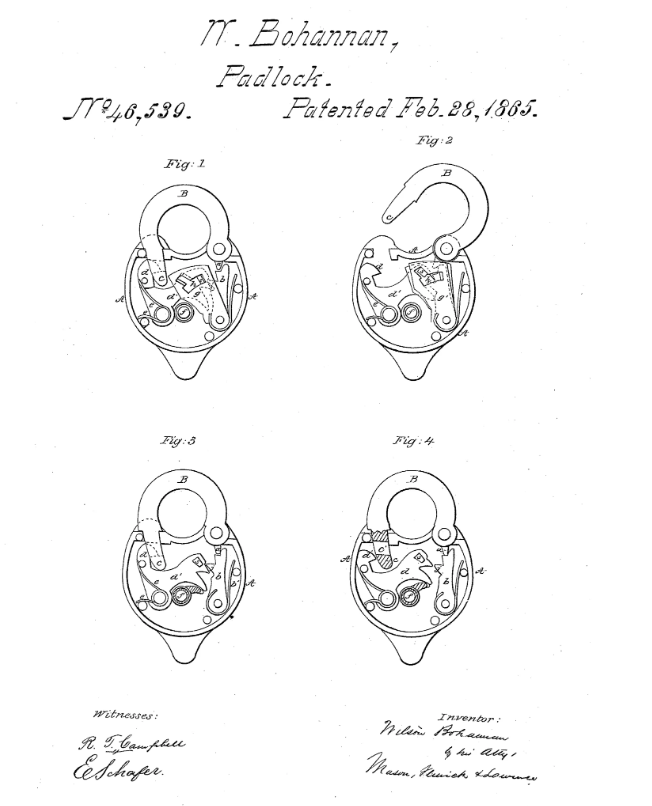
On 28 February 1865, Wilson Bohannan received U.S. Patent No. 46,539 for an “Improvement in Padlocks.” Filed on 29 November 1864, the patent described a self-locking mechanism in which the shackle itself helped operate a spring-pawl and catch as it was closed. The arrangement allowed the shackle to be secured with relatively little effort, while slotted tumblers controlled its release when the key was used.
This was one of the early patents behind our developing range of commercial padlocks. Surviving Wilson Bohannan locks are known with the 28 February 1865 patent date stamped on them, providing physical evidence that the patented design was put into manufacture. Our 1880 catalogue also listed the February 1865 patent among the patents associated with the locks we were producing at the time.
View details1860
In 1860, Wilson Bohannan and his 14-year-old son, Wilson Todd Bohannan, set up a small workshop behind the family home in Brooklyn, New York, and began assembling padlocks. Wilson had previously worked for other manufacturers, including in lockmaking, before establishing the workshop as his own enterprise.
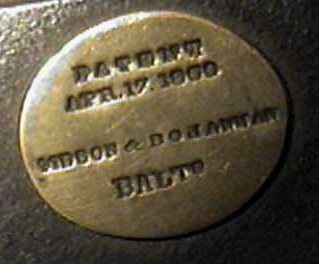
We trace the founding of Wilson Bohannan Lock Company to this modest operation. A company catalogue published in 1922 described the workshop as being at the rear of the Bohannan home and identified Wilson Todd Bohannan as his father's 14-year-old assistant. Our company history continues to use 1860 as its founding year, alongside Wilson Bohannan's first padlock patent, granted on 17 April of that year.
View detailsOn 17 April 1860, Wilson Bohannan received his first U.S. patent for a padlock, Patent No. 27,883. Contemporary patent references record the inventor's first name as “Wilsin,” while the company and later records identify him as Wilson Bohannan. Surviving examples of locks based on the patent were stamped with the 17 April 1860 patent date.
That same year, Wilson and his 14-year-old son, Wilson Todd Bohannan, set up a small workshop behind the family home in Brooklyn, New York, where they began assembling padlocks. We trace the beginning of our business to this workshop and the granting of Wilson's first patent in 1860
View details