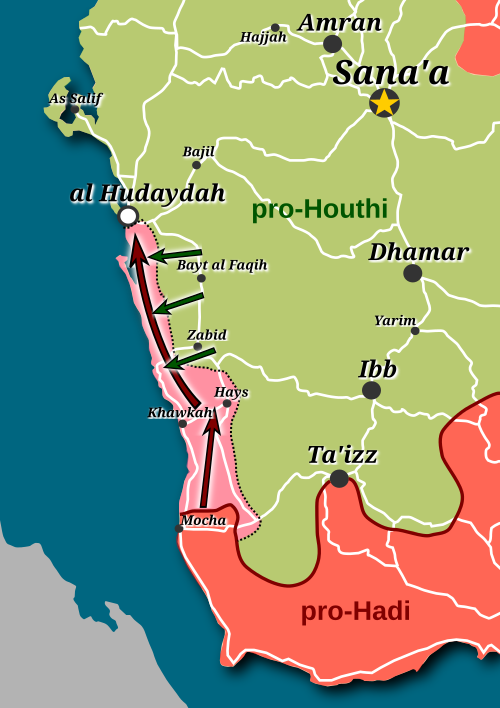
Hadi Government begins Al Hudaydah offensive
Al Hudaydah Governorate, Yemen
Military Operations
Political Events
Middle Eastern History
7 min read
Updated By: History Editorial Network (HEN)
Published:
Updated:
On 06/12/2017 and 07/12/2017, forces aligned with Yemen’s internationally recognized government launched a major offensive in Al Hudaydah Governorate against Houthi fighters, shortly after the death of former President Ali Abdullah Saleh. The operation marked a turning point in the conflict’s shifting alliances, as many fighters and commanders previously loyal to Saleh began aligning themselves with anti Houthi forces backed by the Saudi led coalition.
Ali Abdullah Saleh, who ruled Yemen for more than three decades before stepping down in 2012, had entered into an alliance with the Houthis after the outbreak of the civil war despite years of earlier conflict between the two sides. In late November and early December 2017, tensions between Saleh’s General People’s Congress faction and Houthi forces escalated into armed clashes in the capital Sanaa. On 04/12/2017, Saleh was killed while attempting to flee the city after publicly calling for dialogue with the Saudi led coalition and signaling a break from the Houthis.
Following Saleh’s death, anti Houthi Yemeni forces moved to capitalize on the resulting instability. Government aligned troops, supported by coalition airstrikes and armored reinforcements, advanced in parts of Al Hudaydah Governorate along Yemen’s western coastline. The operation focused on areas south of the strategic port city of Al Hudaydah, where coalition backed fighters sought to pressure Houthi supply routes and expand territorial control along the Red Sea coast.
The offensive involved several Yemeni military formations and local fighters who had either defected from Saleh aligned networks or coordinated with coalition supported units already operating in western Yemen. Coalition aircraft reportedly conducted numerous airstrikes targeting Houthi positions, military vehicles, and defensive installations during the opening phase of the campaign. Ground fighting intensified in districts linking Taiz Governorate to the coastal front, with both sides reporting casualties and territorial gains.
Al Hudaydah Governorate carried major strategic importance because the port of Al Hudaydah handled the majority of Yemen’s commercial imports and humanitarian supplies. Control over western coastal territory became increasingly important for both the Houthis and coalition backed forces as the conflict evolved. The December 2017 offensive also set the stage for later large scale military operations along the Red Sea coast, including the 2018 campaign aimed directly at Al Hudaydah city and its port facilities.
International organizations continued to warn that expanding combat operations near key supply corridors could worsen Yemen’s humanitarian emergency. By late 2017, millions of Yemenis were already facing food insecurity, disease outbreaks, and limited access to fuel and medical supplies due to years of war and blockades affecting infrastructure and trade routes.
Why This Moment Matters
The December 2017 offensive reflected how rapidly alliances in Yemen’s civil war could change after Saleh’s death altered the balance between former partners and rivals. The shift of many Saleh loyalists toward the anti Houthi coalition reshaped military dynamics along Yemen’s western coast and contributed to later operations targeting Al Hudaydah and surrounding areas.
#mooflife
#MomentOfLife
#Yemen
#AlHudaydah
#HadiGovernment
#SaudiIntervention
#HumanitarianCrisis
Primary Reference
Al Hudaydah offensive

Explore the Life Moments of
 AI Twin