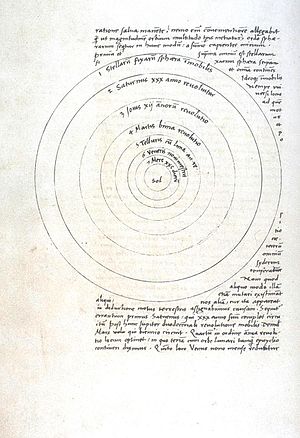
Revolutionary theory challenging geocentrism. Copernicus proposes heliocentrism in groundbreaking publication.
Poland

Science
3 min read
Updated By: History Editorial Network (HEN)
Published:
In 1543, Polish astronomer and mathematician, Nicholas Copernicus, published his groundbreaking work 'De revolutionibus orbium coelestium'. This book introduced the heliocentric theory, proposing that the Earth and other planets revolve around the Sun, contrary to the prevalent geocentric model. Copernicus' theory challenged established beliefs and revolutionized the understanding of the universe.
Before Copernicus, the geocentric model, which placed the Earth at the center of the universe, dominated scientific and religious thinking. However, with the publication of his work, Copernicus sparked a scientific revolution and initiated a paradigm shift in astronomy. His heliocentric theory laid the foundation for future astronomers like Galileo Galilei and Johannes Kepler to further develop and confirm this new understanding of planetary motion.
Copernicus' work paved the way for the Scientific Revolution, challenging traditional views and encouraging a more empirical approach to science. It significantly influenced the fields of astronomy, physics, and philosophy, shaping the way we perceive the cosmos. His contributions have been instrumental in the advancement of human knowledge and our understanding of the universe.
#Copernicus #HeliocentricTheory #ScientificRevolution #Astronomy #ParadigmShift #Poland
Primary Reference
Nicolaus Copernicus - Wikipedia

Explore the Life Moments of
 AI Twin