

About
#TheNewYorkTimes
#NYTimesHistory
#JournalismHistory
#MediaLegacy
Life Classification
News Paper
Life ID
OL7150111524704
Verified Name
new-york-times
Life Type
Organization Life
Founder(s)
Henry Jarvis ,Raymond George, Jones Edward B. Wesley
Date of Founding
1851-Sep-18
Founded In :
New York City, US
Operating Status :
Operating
Life Editor(s)
History Editorial Network (HEN)
Life Privacy
Public
Subscription
Elite
Created On
2026-11-03
Updated On
2026-11-06
Profile Image
By Unknown author - Transferred from the English Wikipedia. http://en.wikipedia.org/wiki/File:NewYorkTimes.svg, Public D
Cover Image
By Ajay Suresh from New York, NY, USA - New York Times Building - Bottom Portion, CC BY 2.0, https://commons.wikimedia.o
Connect
Related Lives


Esterbrook
American writing-instrument manufacturer

Blackberry
Canadian cybersecurity and software comp

InterContinental Hotels & Resorts
Global Luxury Hospitality Brand

Cricket World Cup
ICC Men's Cricket World Cup

Little's Chauffeur Drive
Chauffeur service in Glasgow, Scotland

Arden Dies
Manufacturer of Die Cutting

2026
On 18/09/2026, The New York Times marked the 175th anniversary of its first edition, published on 18/09/1851 as The New-York Daily Times. Founded in New York City by Henry Jarvis Raymond, George Jones, and Edward B. Wesley, the newspaper began as a four-page publication priced at one cent. Its original mission emphasized factual reporting and public affairs. Over the following 175 years, the newspaper developed from a local daily into an international news organization, expanding its coverage across politics, business, science, culture, and investigative journalism.
The anniversary was commemorated with an opening-bell ceremony at the New York Stock Exchange on 17/09/2026, one day before the founding anniversary. The ceremony recognized the newspaper's history under the Ochs-Sulzberger family's leadership and its development across print and digital publishing. By 2026, The New York Times Company operated a portfolio of subscription products including news, Games, Cooking, Wirecutter, and The Athletic, reflecting the expansion of its publishing activities beyond the original printed newspaper.
Historical Significance
The anniversary connected the newspaper's original print publication with its modern international news and digital subscription operations. The New York Stock Exchange ceremony was led by Meredith Kopit Levien, the company's president and chief executive officer.
View details
On 06/05/2026, The New York Times Company reported that its total subscriber base had exceeded 13 million, reflecting continued growth in its subscription-led publishing business. The company's offerings included digital news access and specialized services such as NYT Cooking, Games, Wirecutter, and The Athletic. These products formed part of a strategy to attract and retain paying customers through a combination of journalism, sports coverage, recipes, puzzles, and consumer recommendations.
The subscriber milestone followed years of investment in digital publishing, including the introduction of metered digital subscriptions in 2011 and the expansion of bundled subscription packages. Subscriber growth provided the company with recurring revenue alongside advertising and other commercial activities. The reported total also reflected the company's evolution from a primarily print-focused newspaper publisher into a business serving customers through multiple digital products.
Historical Significance
The milestone demonstrated the growing contribution of digital subscriptions to the company's business. Of its 13.08 million subscribers at the end of the first quarter, approximately 12.52 million were digital-only subscribers.
View details2023
By the end of 2023, The New York Times had expanded its newsroom to more than 2,000 journalists, reflecting sustained investment in reporting across print, digital, audio, video, and visual journalism. The editorial workforce included reporters, editors, photographers, producers, and other journalists covering national politics, international affairs, business, science, culture, and investigative news. The scale of the newsroom supported reporting from New York City, Washington, D.C., and international locations, alongside the newspaper's growing digital news operations.
The expansion took place as The New York Times Company developed a subscription-focused business encompassing news and specialized digital products. During 2023, the company continued investing in journalism while integrating The Athletic, the sports publication acquired in 2022, into its broader reporting operations. The newsroom's size reflected the resources devoted to producing original journalism for readers across multiple platforms, including the website, mobile applications, newsletters, podcasts, and the printed newspaper.
View details2022
On 06/01/2022, The New York Times Company announced an agreement to acquire The Athletic, a subscription-based digital sports journalism platform, for approximately $550 million in cash. Founded in 2016 by Alex Mather and Adam Hansmann, The Athletic had developed a network of sports journalists covering professional and college teams across the United States and internationally. At the time of the announcement, the platform had approximately 1.2 million subscribers. The acquisition was intended to expand The New York Times Company's sports coverage and strengthen its portfolio of digital subscription products.
The transaction was completed on 01/02/2022, bringing The Athletic under The New York Times Company's ownership. The sports publication continued operating as a distinct brand, providing reporting, analysis, interviews, and coverage of major sporting competitions. The acquisition complemented the company's existing digital offerings, including NYT Cooking, Games, and Wirecutter. It also supported the company's strategy of attracting subscribers through a broader range of journalism and specialized services beyond general news.
Historical Significance
The acquisition expanded The New York Times Company's presence in subscription-based sports journalism. It also provided the foundation for a later restructuring of the newspaper's sports coverage around The Athletic.
View details2020
On 02/03/2020, The New York Times was expanding its continuously updated reporting on the emerging coronavirus outbreak, providing readers with information about infections, public health measures, and government responses. The disease, later designated COVID-19, had first been identified in Wuhan, China, in December 2019 and was spreading internationally. By early March 2020, the newspaper was publishing frequent updates on confirmed cases, travel restrictions, medical research, and preparations by health authorities. Its coverage drew on reporting from correspondents in the United States and abroad, alongside information from public health agencies.
As the outbreak developed into a global pandemic, declared by the World Health Organization on 11/03/2020, The New York Times expanded its live updates, explanatory articles, data visualizations, and tracking of infections and deaths. The newspaper's coronavirus coverage included reporting on hospital capacity, testing, vaccination development, economic disruption, and public health policies. Its publicly accessible COVID-19 tracking database later became a widely used source of county-level pandemic data in the United States, supporting research and public understanding of the outbreak.
View details2019
On 14/08/2019, The New York Times Magazine began publishing The 1619 Project, an initiative developed by journalist Nikole Hannah-Jones to examine the history of slavery in the United States and its continuing consequences. The project marked 400 years since the arrival of captive Africans in the English colony of Virginia in August 1619. Its first major magazine issue, dated 18/08/2019, featured essays, photography, poetry, and historical analysis addressing slavery's relationship to American politics, economics, culture, healthcare, and social institutions. Contributors included historians, journalists, writers, and artists.
The project attracted national attention and generated debate among historians, educators, political leaders, and readers about its historical interpretations and arguments. Some scholars challenged particular claims, including aspects of its account of slavery's relationship to the American Revolution, while others supported its emphasis on slavery's role in American history. The initiative subsequently expanded into educational materials, podcasts, and books. Nikole Hannah-Jones received the 2020 Pulitzer Prize for Commentary for her introductory essay.
View details2017
On 05/10/2017, The New York Times published an investigation by journalists Jodi Kantor and Megan Twohey detailing decades of sexual harassment allegations against Hollywood film producer Harvey Weinstein. The report drew on interviews with former employees, actresses, and other sources, as well as legal documents and confidential settlement records. It revealed that Weinstein had reached settlements with at least eight women over allegations of harassment and unwanted sexual advances. Actress Ashley Judd was among the women who spoke publicly about their experiences. Weinstein disputed allegations of nonconsensual sexual activity.
The investigation prompted further reporting, including an article by Ronan Farrow in The New Yorker on 10/10/2017, and encouraged additional women to publicly describe experiences of sexual harassment and assault. Weinstein was dismissed from The Weinstein Company on 08/10/2017. The revelations helped accelerate the global #MeToo movement, originally founded by activist Tarana Burke in 2006. Kantor and Twohey shared the 2018 Pulitzer Prize for Public Service with The New Yorker for reporting that exposed sexual misconduct and institutional failures to address it
View detailsOn 30/01/2017, The New York Times launched The Daily, a weekday news podcast hosted by journalist Michael Barbaro. Developed by the newspaper's audio team, the program offered in-depth explanations of current events through interviews, original reporting, and conversations with The New York Times journalists. Episodes generally lasted around 20 minutes, providing listeners with a focused examination of a major news story. The podcast debuted shortly after the inauguration of President Donald Trump, during a period of heightened public interest in American politics and national news.
The Daily quickly attracted a large audience and became one of the newspaper's most widely recognized audio journalism products. Its format combined narrative storytelling with reporting from journalists covering politics, international affairs, business, and social issues. The program expanded its reach through major podcast platforms and later radio distribution. In 2020, The New York Times reported that The Daily reached approximately four million listeners each day, demonstrating the scale of its audio audience.
View details2016
On 24/10/2016, The New York Times Company announced its acquisition of Wirecutter, a consumer product recommendation website founded in 2011 by technology journalist Brian Lam. The transaction, reportedly valued at approximately $30 million, also included Wirecutter's sister website, The Sweethome, which focused on household products. Wirecutter had developed a reputation for detailed product testing, comparative reviews, and purchasing guides covering electronics, appliances, and everyday consumer goods. The acquisition expanded the company's digital publishing activities beyond conventional news reporting into service journalism designed to help readers make purchasing decisions.
Following the acquisition, Wirecutter continued producing independently researched product recommendations under The New York Times Company's ownership. Its business model included affiliate commissions earned when readers purchased products through qualifying retailer links, alongside advertising revenue. The Sweethome's coverage was subsequently incorporated into Wirecutter, consolidating the company's product review operations. In 2021, Wirecutter introduced a paid subscription model, further integrating the service into the company's expanding portfolio of digital subscription products.
View details2014
On 17/09/2014, The New York Times launched NYT Cooking, a dedicated digital platform offering recipes, cooking guidance, and food-related editorial content. Developed as part of the newspaper's expansion into specialized digital services, the platform brought together thousands of recipes from its extensive food journalism archives. Food editor Sam Sifton played a central role in its development, working with a team of editors, designers, and technology specialists. The service allowed users to search recipes by ingredients, dishes, and cooking methods, save favorites, and organize personal recipe collections.
NYT Cooking initially launched as a free service, making recipes and cooking instructions available through a dedicated website and mobile experience. Its content drew on decades of recipes published by The New York Times, including contributions from established food writers and chefs. In 2017, the company introduced a paid subscription model for NYT Cooking, creating a separate digital revenue stream beyond general news subscriptions. The platform subsequently expanded with instructional videos, seasonal collections, and new recipes developed by its culinary editorial team.
View details2011
On 28/03/2011, The New York Times introduced a metered digital subscription system for readers in the United States and internationally, following its initial launch in Canada on 17/03/2011. The system allowed visitors to read up to 20 articles per month on NYTimes.com without paying, after which a subscription was required for continued access. Initial digital subscription plans started at $15 for four weeks, with higher-priced options covering additional devices and platforms. Print subscribers received digital access as part of their existing subscriptions. The model was designed to generate revenue directly from online readership while preserving some free access to the newspaper's journalism.
The paywall marked a change in the newspaper's digital business strategy after years of relying heavily on online advertising. Unlike a complete subscription barrier, the metered approach allowed occasional readers to access articles without payment. The company subsequently adjusted its article limits, pricing, and subscription packages. By the end of 2011, The New York Times had attracted approximately 390,000 paid digital subscribers, providing an early indication that readers were willing to pay for online news.
View details2007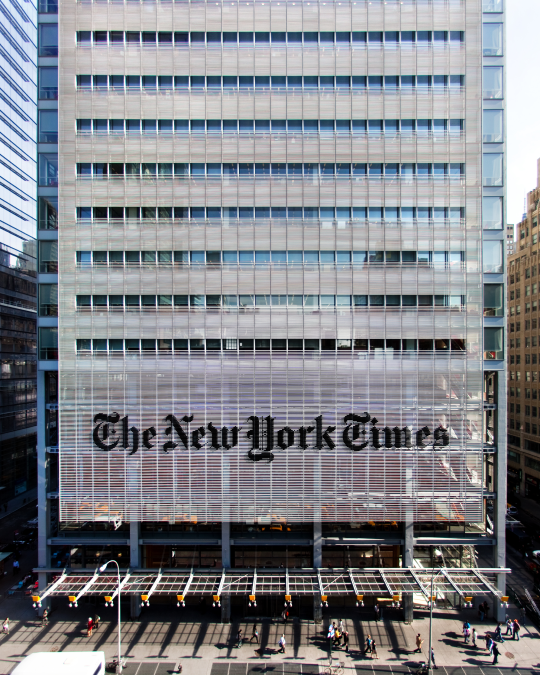
On 11/06/2007, The New York Times began operating from its new headquarters at 620 Eighth Avenue in Midtown Manhattan, New York City. The 52-story skyscraper was designed by Italian architect Renzo Piano in collaboration with the architectural firm FXFOWLE. Located between West 40th and West 41st Streets, the building replaced the newspaper's longtime headquarters at 229 West 43rd Street. Rising approximately 1,046 feet (319 metres), including its architectural mast, the tower incorporated a glass exterior covered with horizontal ceramic rods designed to filter sunlight and reduce solar heat gain.
The building brought together newspaper staff and business operations in a modern workplace designed around natural light, open spaces, and energy efficiency. Its central newsroom supported collaboration across reporting, editing, photography, and digital publishing teams as the company expanded its online journalism. Developed by The New York Times Company and Forest City Ratner Companies, the tower also included
View details2005
On 15/12/2005, The New York Times prepared to publish an investigation revealing that President George W. Bush had authorized the National Security Agency (NSA) to conduct surveillance of certain international communications involving people in the United States without obtaining warrants from the Foreign Intelligence Surveillance Court. The investigation, reported by journalists James Risen and Eric Lichtblau, appeared on 16/12/2005. The surveillance program had been established after the terrorist attacks of 11/09/2001. The newspaper reported that the NSA monitored selected communications involving suspected links to terrorism, raising questions about the program's legality under federal surveillance law.
The revelations prompted congressional scrutiny and public debate over executive authority, national security, and constitutional protections against unreasonable searches. President Bush publicly acknowledged the surveillance program on 17/12/2005, defending it as necessary to prevent terrorist attacks. The reporting earned Risen and Lichtblau the 2006 Pulitzer Prize for National Reporting, recognizing their investigation into secret domestic surveillance activities conducted by the United States government.
View details2003
On 05/06/2003, The New York Times announced the resignations of executive editor Howell Raines and managing editor Gerald M. Boyd following a journalism scandal involving reporter Jayson Blair. An internal investigation found that Blair had fabricated details, plagiarized material, and misrepresented his reporting locations in numerous articles. Blair had resigned on 01/05/2003, and the newspaper published a detailed account of the misconduct on 11/05/2003. The review examined 73 articles written by Blair between October 2002 and April 2003 and identified substantial problems in at least 36 of them.
The scandal exposed weaknesses in editorial supervision, source verification, and communication between newsroom managers. Questions also arose about why earlier warnings concerning Blair's work had not prevented further misconduct. Raines and Boyd stepped down amid criticism of newsroom leadership and management practices. Joseph Lelyveld, a former executive editor, returned temporarily to lead the newsroom until Bill Keller was appointed executive editor in July 2003. The newspaper subsequently reviewed its editorial procedures and introduced additional measures intended to strengthen journalistic standards and accountability.
View details2001
In October 2001, The New York Times launched DealBook, a financial news newsletter developed by journalist Andrew Ross Sorkin. The publication focused on mergers and acquisitions, Wall Street transactions, investment banking, corporate leadership, and developments in financial markets. Introduced during a period of growing demand for timely online business information, DealBook provided readers with updates and analysis of major corporate deals. Sorkin, who had joined The New York Times as a student intern in 1995, developed the newsletter as a specialized source of financial reporting within the newspaper's expanding digital operations.
DealBook subsequently evolved from an email newsletter into a broader business journalism platform featuring articles, interviews, and coverage of financial institutions and corporate decision-making. Its reporting examined major developments including the 2008 global financial crisis, regulatory changes, and prominent corporate transactions. The brand also expanded into live events and executive discussions, including the DealBook Summit. Its development demonstrated how specialized newsletters could support focused reporting and establish recurring relationships with readers interested in particular subjects.
View detailsOn 12/09/2001, The New York Times published extensive reporting on the terrorist attacks carried out against the United States the previous day. On 11/09/2001, al-Qaeda hijackers seized four commercial aircraft, crashing two into the World Trade Center in New York City and one into the Pentagon in Arlington, Virginia. A fourth aircraft crashed near Shanksville, Pennsylvania, after passengers and crew resisted the hijackers. The attacks killed 2,977 victims, excluding the 19 hijackers. The newspaper's coverage documented the destruction of the Twin Towers, emergency rescue operations, eyewitness accounts, and the immediate responses of President George W. Bush and federal authorities.
In the days that followed, The New York Times expanded its reporting on the victims, rescue efforts, national security, and the economic consequences of the attacks. On 15/09/2001, it introduced Portraits of Grief, a series of short personal profiles commemorating people who had died. The newspaper's coverage contributed to its seven Pulitzer Prizes in 2002, including the Public Service award for its reporting on the attacks and their aftermath.
View details1997
On 16/10/1997, The New York Times published its first front page featuring color photography, introducing a new visual approach to a newspaper long associated with black-and-white presentation. The change took place under publisher Arthur Ochs Sulzberger Jr. and executive editor Joseph Lelyveld. The introduction of color required changes to the newspaper's printing operations and production processes, allowing photographs and graphics to appear in color on its most prominent page. The decision reflected developments in newspaper printing technology and the growing use of color photography across American journalism.
The adoption of color marked a shift in the newspaper's visual presentation while retaining its established emphasis on written reporting. Color photographs enabled readers to see additional visual detail in coverage of national events, international affairs, sports, and cultural subjects. The change formed part of a broader modernization of The New York Times during the 1990s, which also included the launch of NYTimes.com in January 1996. Color subsequently became a regular element of the newspaper's print design.
View details1996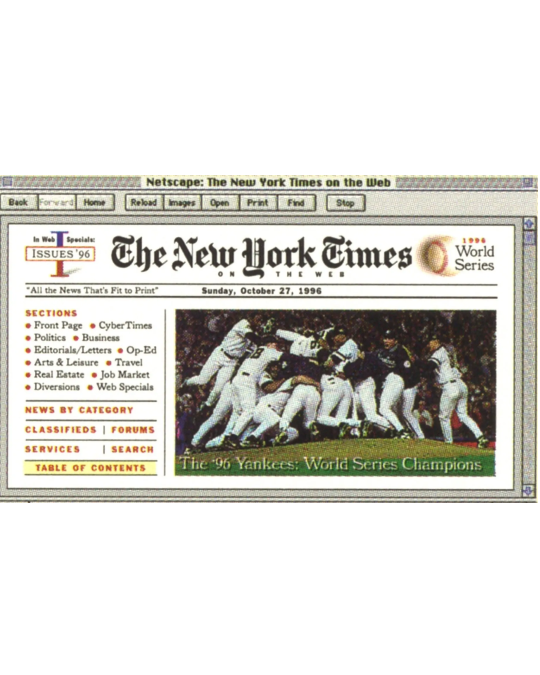
On 22/01/1996, The New York Times launched its website, NYTimes.com, bringing the newspaper's journalism to readers through the World Wide Web. The launch marked the publication's entry into daily online news distribution, allowing readers with internet access to follow reporting beyond the newspaper's traditional print circulation areas. The website initially offered news, features, and selected content from the print edition, extending the newspaper's coverage of politics, business, international affairs, culture, and other subjects to a growing digital audience.
The website's introduction came as American newspapers began developing online editions in response to increasing public use of the internet. Unlike printed newspapers, NYTimes.com could make articles available to readers across different geographic regions without physical distribution. Over subsequent years, The New York Times expanded its digital operations with more frequent news updates, multimedia reporting, searchable archives, and interact
View details1995
On 19/09/1995, The Washington Post published the approximately 35,000-word manifesto Industrial Society and Its Future, written by the unidentified bomber later revealed to be Theodore “Ted” Kaczynski. The publication followed a joint decision by The New York Times and The Washington Post, made after consultations with the FBI and the United States Department of Justice. Kaczynski, known as the Unabomber, had demanded publication of his writings as a condition for ending his bombing campaign. The two newspapers agreed to share the publication costs, with the complete text appearing as a special supplement in The Washington Post.
The manifesto criticized industrial society and technological development. Its publication enabled readers to examine the text, including Kaczynski's brother David, who recognized similarities between the manifesto and his brother's earlier writings. David subsequently contacted authorities through an attorney, providing information that helped investigators identify Kaczynski. FBI agents arrested him on 03/04/1996 at his remote cabin near Lincoln, Montana. Kaczynski's bombing campaign, conducted between 1978 and 1995, killed three people and injured 23 others.
Historical Significance
The publication raised questions about how news organizations should respond to demands from violent offenders. In this case, making the manifesto publicly available contributed directly to identifying a suspect and ending a lengthy federal investigation.
View details1976
In 1976, The New York Times began a broader expansion of its specialized newspaper sections under publisher Arthur Ochs Sulzberger and executive editor A. M. Rosenthal. The initiative aimed to broaden the newspaper's appeal beyond traditional national, international, and business reporting by providing more dedicated coverage of readers' interests. The expansion included Weekend, introduced in 1976, followed by sections covering home-related subjects, sports, science, and lifestyle. These additions gave readers more clearly organized reporting on recreation, entertainment, consumer interests, and developments outside daily political news.
The strategy continued over several years rather than through a single launch. The newspaper introduced Home in 1977, SportsMonday in 1978, and Science Times in 1978, establishing recurring destinations for specialized journalism. These sections created additional opportunities for advertising tied to particular subjects and audiences. The expansion became part of the newspaper's efforts to strengthen readership and commercial performance while maintaining its established general-news coverage.
View details1971
On 13/06/1971, The New York Times began publishing excerpts from the Pentagon Papers, a classified United States Department of Defense study examining American political and military involvement in Vietnam from 1945 to 1967. The 47-volume study, commissioned in 1967 by Defense Secretary Robert McNamara, contained approximately 7,000 pages of documents and analysis. Former military analyst Daniel Ellsberg provided the material to the newspaper, where a reporting team led by Neil Sheehan examined its contents. The first installment revealed discrepancies between public government statements and internal assessments of United States involvement in Vietnam.
The Nixon administration sought to prevent further publication, obtaining a temporary court order against The New York Times on 15/06/1971. The dispute reached the United States Supreme Court, which ruled 6–3 on 30/06/1971 in New York Times Co. v. United States. The Court rejected the government's attempt to impose prior restraint, allowing publication to continue. The Pentagon Papers reporting subsequently earned The New York Times the 1972 Pulitzer Prize for Public Service.
View details1970
On 21/09/1970, The New York Times launched its Op-Ed page, creating a dedicated space for opinion articles by writers outside the newspaper's editorial board. The page appeared opposite the newspaper's editorial page, giving rise to the name “Op-Ed.” Introduced under publisher Arthur Ochs Sulzberger, the section featured contributions from journalists, academics, political figures, and other specialists. Its purpose was to present a range of perspectives on public affairs, politics, culture, and international issues while distinguishing individual commentary from the newspaper's institutional editorial positions.
The new page combined essays with illustrations and commentary, offering readers perspectives beyond those expressed in the newspaper's editorials. Its early development was associated with editorial page editor John B. Oakes, who had advocated expanding the range of voices published in the opinion section. The format attracted contributors from different professional and political backgrounds and became a recognizable feature of the newspaper. Other American newspapers subsequently adopted similar opinion-page arrangements.
View details1964
On 09/03/1964, the United States Supreme Court issued a unanimous 9–0 ruling in New York Times Co. v. Sullivan, establishing constitutional protections for criticism of public officials under the First and Fourteenth Amendments. The case originated from a full-page advertisement titled “Heed Their Rising Voices,” published in The New York Times on 29/03/1960 in support of the civil rights movement. L. B. Sullivan, a Montgomery, Alabama, city commissioner, filed a libel lawsuit over factual inaccuracies in the advertisement, although he was not named in it. An Alabama jury awarded him $500,000 in damages.
Writing for the Court, Justice William J. Brennan Jr. overturned the judgment and established the “actual malice” standard. Under this rule, public officials suing for defamation over statements concerning their official conduct must prove that a false statement was published with knowledge of its falsity or with reckless disregard for whether it was true. The decision strengthened constitutional safeguards for reporting and public debate about government officials, particularly in cases involving criticism of official conduct during the civil rights movement.
View details1945
On 16/07/1945, The New York Times science reporter William L. Laurence witnessed the Trinity test, the first detonation of a nuclear weapon, at the Alamogordo Bombing Range in New Mexico. The explosion occurred at approximately 5:29 a.m. local time as part of the Manhattan Project, the secret American-led program to develop atomic weapons during World War II. Laurence had been granted unusual access to the project by the United States military and was the only newspaper journalist present to observe the test. His account described the explosion's intense light, rising cloud, and effects on the surrounding desert.
Laurence had joined the Manhattan Project's information activities in 1945 while retaining his association with The New York Times. Because the program remained classified, his reporting could not be published immediately. After the United States dropped atomic bombs on Hiroshima on 06/08/1945 and Nagasaki on 09/08/1945, his articles helped explain the development and destructive power of the new weapons. His reporting earned the 1946 Pulitzer Prize for Reporting, although his simultaneous work for the military later raised questions about journalistic independence.
Historical Significance
Laurence's access produced rare eyewitness reporting on the development and use of atomic weapons. His simultaneous work preparing official government communications also remains an example of the ethical questions raised when journalists work directly for institutions they cover.
View details1942
On 15/02/1942, The New York Times published its first crossword puzzle in the Sunday edition, introducing a feature that became a regular part of the newspaper's cultural coverage. The puzzle appeared during World War II, when crosswords were already popular among American newspaper readers. Margaret Petherbridge Farrar, an experienced crossword editor who had previously worked with The New York World, became the newspaper's first crossword editor. The introduction marked a change in the publication's earlier reluctance to include crossword puzzles, which had been viewed as unsuitable for its editorial approach.
The newspaper also expanded its literary coverage through book reviews and best-seller rankings, although its best-seller lists predated the crossword's 1942 debut. Under Farrar's direction, the Sunday crossword developed standards for clue construction, vocabulary, and puzzle design. The feature later expanded into daily puzzles, introduced in 1950, and became a longstanding component of The New Yor
View details1935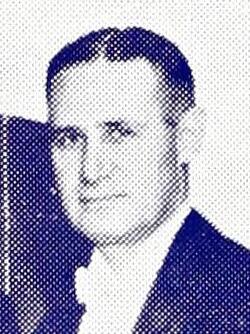
In 1935, Arthur Hays Sulzberger became publisher of The New York Times, succeeding his father-in-law, Adolph S. Ochs, who died on 08/04/1935. Ochs had controlled the newspaper since 1896 and established its emphasis on comprehensive reporting and editorial independence. Sulzberger, born on 12/09/1891 in New York City, had joined the newspaper's business operations in 1918 and gained experience in its administration before assuming leadership. His appointment continued the Ochs family's involvement in the newspaper through the Sulzberger family.
During Sulzberger's tenure, The New York Times reported extensively on the Great Depression, World War II, and the early Cold War. He oversaw the newspaper's business operations and expansion while maintaining its established approach to national and international news coverage. Sulzberger served as publisher until 1961, when his son-in-law, Orvil E. Dryfoos, succeeded him. His 26-year tenure provided continuity in the newspaper's ownership and management through periods of economic, political, and technological change.
View details1930
On 06/09/1930, Argentina experienced a military coup that removed President Hipólito Yrigoyen from power. The uprising was led by General José Félix Uriburu, whose forces took control of Buenos Aires and established a military government. The New York Times reported on the political upheaval using international wireless telephone communications, which enabled information to reach its newsroom in New York despite restrictions on conventional communication channels. The technology provided an alternative means of obtaining news from Argentina during a period of political instability and government control over information.
Wireless telephone services transmitted spoken reports over long distances using radio signals, reducing dependence on written cables and traditional telegraph connections. Their use in covering the Argentine coup illustrated how emerging communication technologies could support international journalism when access to information was disrupted. Uriburu assumed the presidency following the overthrow of Yrigoyen, beginning a period of military intervention and electoral manipulation in Argentine politics commonly associated with the country's Infamous Decade.
View details1928
On 06/11/1928, The New York Times introduced an illuminated electronic news ticker on its former headquarters at One Times Square in Manhattan, New York City. Known as the “Motograph” and later popularly called the “Zipper,” the display used thousands of electric light bulbs to present moving headlines around the building's exterior. Its debut coincided with the United States presidential election between Republican Herbert Hoover and Democrat Al Smith. The first message announced Hoover's electoral victory, allowing crowds gathered in Times Square to follow election results through a continuously moving illuminated display.
The ticker was installed near the fourth-floor level of One Times Square and became a recognizable feature of the district's streetscape. It provided pedestrians with news updates without requiring them to purchase a newspaper or listen to a radio broadcast. Over subsequent decades, the display carried election results, international developments, sports outcomes, and other breaking news. Its introduction extended The New York Times' reporting beyond printed pages into a public electronic format visible to large audiences.
View details1926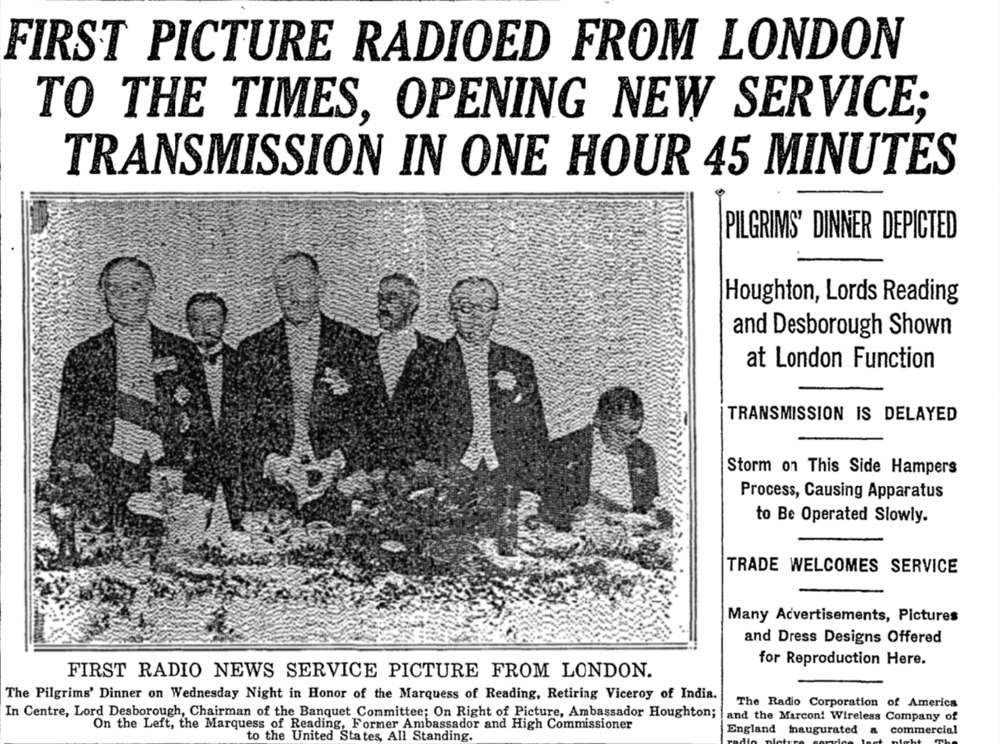
On 06/11/1926, The New York Times received a photograph transmitted through a commercial radio communication system, marking an early development in the newspaper's use of electronic image transmission. Radio-based photographic technology converted an image into electrical signals that could be transmitted over long distances and reconstructed at a receiving station. Unlike conventional photographic delivery, which depended on physically transporting negatives or prints, this method offered the possibility of sending news images between distant locations without waiting for mail, trains, or other transportation.
The experiment occurred during a period of rapid development in wireless communication and newspaper photography. Radio transmission offered news organizations a way to receive visual material from remote locations more quickly, although early systems required specialized equipment and produced images with technical limitations. As image transmission technology improved, newspapers increasingly adopt
View details1918
23/06/1918: The New York Times Receives Its First Pulitzer Prize for World War I Reporting
In 1918, The New York Times received its first Pulitzer Prize, winning the award for Public Service for its coverage of World War I. The newspaper was recognized for publishing official documents, speeches, and reports concerning the war, making important source material available to American readers. The coverage included information about the governments, military decisions, and diplomatic developments involved in the conflict. Rather than recognizing a single correspondent or article, the award acknowledged the newspaper's broader effort to provide documentary coverage of the war.
The prize came during the early years of the Pulitzer journalism awards, which were first presented in 1917 following the establishment of the program through Joseph Pulitzer's bequest to Columbia University. Under publisher Adolph S. Ochs, The New York Times had developed extensive international reporting and devoted substantial space to wartime news. Its 1918 Public Service award began the newspaper's history of Pulitzer recognition.
View details