
Philips

Multinational Health Technology Company
Related Lives

Mercedes-Benz
More Than a Drive

NATO
North Atlantic Treaty Organization

Ford Motor Company
Car manifacture

G7
Group of Seven

Procter & Gamble
Global Leader in Consumer Goods

Nokia
Telecommunications company

Microsoft
Technology company

Boeing
American multinational corporation

1945
Following the end of World War II in 1945, Philips began rebuilding and expanding its industrial operations in Eindhoven, Netherlands, restoring manufacturing facilities and strengthening its international business activities. Under the leadership of Frits Philips and other senior executives, the company focused on technological innovation and the growing demand for electrical and consumer products during Europe's postwar recovery. Philips Research developed new tubular fluorescent lighting, advanced magnetic materials and ceramics, improved hearing aids, modern gramophones, and more compact radio systems. The company also expanded its research into ultraviolet light for medical and hygienic applications while continuing to improve its popular Philishave electric shavers. These developments helped Philips strengthen its manufacturing capabilities and establish new opportunities in electronics, healthcare, and household technology.
Philips' postwar reconstruction became a defining period in its transformation into one of Europe's leading electronics manufacturers. Television emerged as one of the company's most important growth areas, building on experimental research conducted before the war. In 1946, Philips began preparing experimental television broadcasts in Eindhoven, followed by its first postwar experimental broadcasts in March 1948. By 1950, the company introduced the TX400U television receiver, featuring a 625-line picture and FM sound, demonstrating its advanced expertise in broadcasting and electronic engineering. Philips also made important progress in magnetic materials, including Ferroxcube and Ferroxdure, which supported future developments in electronic components and recording technologies. These achievements strengthened the company's reputation for scientific innovation and helped establish its leadership in television, audio equipment, medical technology, and consumer electronics throughout the following decades.
View details1940
On May 10, 1940, Germany invaded the Netherlands, marking the beginning of a challenging period for Philips during World War II. The German occupation significantly disrupted the company's industrial operations, manufacturing activities, and international business networks. Anticipating the invasion, senior executives, including Anton Philips and Frans Otten, relocated abroad, eventually establishing operations in the United States to safeguard the company's international interests. Meanwhile, Frits Philips, the son of Anton Philips, remained in Eindhoven to oversee Dutch operations and support the company's employees. Under German supervision, Philips factories continued certain manufacturing activities while facing wartime restrictions, material shortages, and increasing pressure from the occupying authorities. These circumstances required substantial organizational adjustments to maintain essential operations and protect the company's long-term future.
The wartime period became a defining chapter in Philips' history, demonstrating the company's resilience and ability to adapt under extraordinary circumstances. Frits Philips played an important role in supporting employees and worked to protect Jewish workers from deportation, efforts for which he was later recognized by Yad Vashem as one of the Righteous Among the Nations in 1995. Despite extensive disruption, Philips maintained parts of its production and preserved important technological expertise. Its industrial facilities in Eindhoven suffered significant damage during Allied bombing raids in December 1942 and March 1943, creating major reconstruction challenges. Following the liberation of the Netherlands in 1944–1945, the company began rebuilding its factories, restoring production, and reconnecting its international operations. By the end of 1946, much of its industrial infrastructure had been restored, allowing Philips to resume technological expansion in electronics, lighting, and healthcare equipment. The experience helped shape the company's postwar development into a major global technology enterprise.
View details1939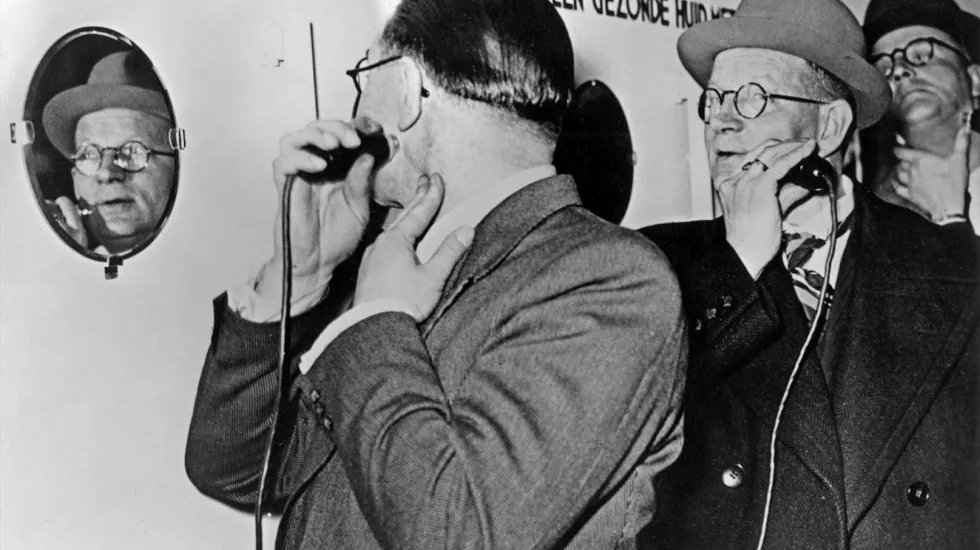
In 1939, Philips introduced the Philishave electric shaver, an important consumer product innovation that expanded the company’s presence in household and personal care technology. Developed around the rotary shaving system created by engineer Alexandre Horowitz, the Philishave used rotating cutting heads beneath a thin metal guard to provide a safer and more convenient shaving experience than many earlier electric razors. Its launch marked a significant step for Philips as it moved beyond lighting, radio, and electronic components into everyday consumer products designed for personal use.
The Philishave soon became one of Philips’ most recognizable inventions and helped establish the company as a leading manufacturer of personal grooming technology. Its rotary design distinguished it from competing shavers and became the foundation for a long-running product line sold internationally. Over the following decades, Philips continued refining the design with improved motors, more efficient shaving heads, and mo
View details1927
In 1927, Philips acquired the German vacuum tube manufacturer Valvo, based in Hamburg, Germany, marking an important step in its international expansion. The acquisition took place through Philips' purchase of C. H. F. Müller and its subsidiary, Radio-Röhrenfabrik GmbH, which manufactured electronic valves under the Valvo brand. Originally established in 1924, the German company specialized in vacuum tubes used in radio receivers and other electronic equipment. The acquisition strengthened Philips' presence in the German electronics market and expanded its manufacturing capabilities at a time when radio broadcasting and consumer electronics were experiencing rapid growth. By combining Valvo's production expertise with Philips' advanced research facilities in Eindhoven, the company strengthened its position as a leading European manufacturer of electronic components.
The acquisition of Valvo became a significant milestone in Philips' development as a diversified international electronics enterprise. Under Philips' ownership, Valvo expanded its manufacturing operations, producing radio valves, specialized electronic tubes, and eventually a broad range of electronic components used in radio, television, telecommunications, and industrial equipment. During the late 1920s, the company established expanded manufacturing facilities in Hamburg-Lokstedt, strengthening its position in Germany's growing electronics industry. In subsequent decades, Valvo became an important supplier of electronic components, including picture tubes, capacitors, resistors, and semiconductor devices. By 1974, its German operations employed approximately 8,000 people and offered thousands of component types. The 1927 acquisition helped establish Philips as a major force in European electronics manufacturing and demonstrated the company's strategy of combining scientific innovation, industrial expansion, and international partnerships to support long-term technological growth
View detailsIn 1927, Philips expanded into consumer electronics by introducing its first complete radio receiver, the Philips Type 2501, in Eindhoven, Netherlands. This development marked an important milestone in the company's transformation from a leading manufacturer of incandescent light bulbs into a diversified electronics enterprise. Philips had already gained valuable experience in radio technology through the production of vacuum tubes beginning in 1918 and the introduction of its innovative Miniwatt radio valve in 1923. The company's first radio receiver combined a separate tuning unit, amplifier, and distinctive horn-shaped loudspeaker, allowing households to receive radio broadcasts and enjoy news, music, and entertainment. Supported by research conducted at the Philips NatLab laboratory, the expansion demonstrated the company's growing expertise in electronic components, sound reproduction, and communication technology.
Philips' entry into radio manufacturing became one of the most significant developments in its early history, establishing the company as a major international producer of household electronic equipment. In 1927, Philips also introduced advanced radio technology, including the pentode vacuum tube, which improved signal amplification and sound quality. That same year, the company demonstrated international shortwave communication when Queen Wilhelmina and Princess Juliana addressed listeners in the Dutch overseas territories through a Philips transmitter. As radio broadcasting became increasingly popular, Philips expanded its production facilities and international distribution networks. By 1932, the company had produced its one-millionth radio receiver, establishing itself among the world's leading radio manufacturers. This success helped transform Philips into a global electronics company and laid the foundation for its later innovations in television, audio equipment, telecommunications, and other consumer technologies.
View details
1924
In 1924, Philips introduced its groundbreaking Metalix X-ray tube in London, marking a major advancement in medical imaging technology. Developed at the Philips Research Laboratory (NatLab) in Eindhoven, Netherlands, by physicist Albert Bouwers using earlier research by Gilles Holst, the Metalix was designed to improve the safety and performance of medical X-ray equipment. Unlike conventional X-ray tubes, which allowed radiation to scatter in multiple directions, the Metalix featured a specially designed metal casing that shielded unwanted radiation while allowing X-rays to pass through a controlled opening. This innovation significantly reduced unnecessary radiation exposure for patients and healthcare professionals. Its compact construction and improved electrical insulation also made X-ray equipment safer and more practical for medical use.
The introduction of the Metalix X-ray tube became one of the most important milestones in Philips' transformation from an electric lighting manufacturer into a leading medical technology company. The innovation built upon the company's earlier experience in glass manufacturing, vacuum technology, and scientific research, demonstrating the practical value of its NatLab laboratory. The Metalix received international recognition for its improved radiation protection and technical design, helping Philips strengthen its position in the growing medical equipment industry. In 1928, Albert Bouwers received the prestigious Gold Compton Medal from the Radiological Society of North America in recognition of his contributions to X-ray technology. The Metalix also provided the foundation for later developments, including portable X-ray equipment, dental imaging systems, and the Rotalix rotating-anode X-ray tube introduced in 1929. Its development remains a defining achievement in Philips' history and an important contribution to the advancement of modern diagnostic imaging and patient safety.
View details1914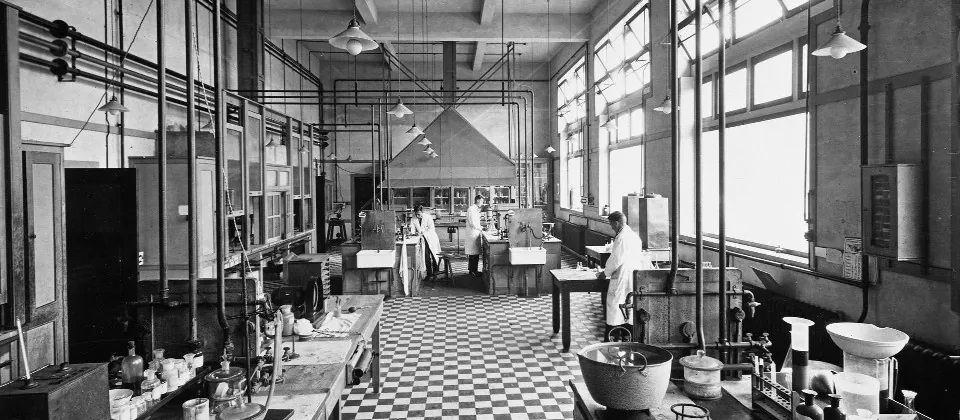
On January 2, 1914, Philips established its renowned research laboratory, known as the Philips Natuurkundig Laboratorium (NatLab), in Eindhoven, Netherlands. The laboratory began its operations under the leadership of Dutch physicist Gilles Holst, who was appointed to direct the company's scientific research activities. Founded through the vision of brothers Gerard and Anton Philips, NatLab was created to strengthen technological innovation, improve electric lighting products, and support the company's expanding industrial operations. Initially, research focused on improving incandescent light bulbs, understanding materials, and developing more efficient lighting technologies. The establishment of this dedicated scientific facility marked a major transformation in Philips' development, moving the company beyond traditional manufacturing toward systematic research and technological discovery.
The establishment of NatLab became one of the most significant milestones in Philips' history, laying the foundation
View details1912
On September 11, 1912, Philips & Co. officially reorganized as N.V. Philips' Gloeilampenfabrieken, a public limited company based in Eindhoven, Netherlands. The transformation marked a major milestone in the company's development from a family-owned electric light bulb manufacturer into a growing industrial enterprise. Under the leadership of brothers Gerard and Anton Philips, the company established a stronger corporate structure to support expanding manufacturing operations, increasing financial requirements, and international business activities. The reorganization also enabled Philips to offer shares on the Amsterdam Stock Exchange, providing access to capital for future investments. By this time, Philips had established itself as a leading European producer of incandescent lamps, benefiting from technological improvements and growing global demand for electric lighting.
The establishment of N.V. Philips' Gloeilampenfabrieken laid the foundation for the company's continued industrial expansion and international growth throughout the twentieth century. The new corporate structure strengthened its ability to finance advanced manufacturing facilities, invest in scientific research, and expand its presence in overseas markets. In 1914, Philips established its renowned Physics Laboratory, known as NatLab, under physicist Gilles Holst, marking an important step toward research-driven technological innovation. During the following decades, the company expanded beyond electric lighting into radio equipment, electronic components, household appliances, and medical technology. The 1912 reorganization remains a defining milestone in the history of Royal Philips, demonstrating how strategic corporate development and technological innovation helped transform a successful Dutch manufacturer into an internationally recognized technology enterprise.
View details1900
During the early twentieth century, Philips & Co. experienced remarkable industrial growth, becoming the largest private employer in the Netherlands with more than 2,000 employees by approximately 1910. Founded in 1891 by Frederik and Gerard Philips, the company expanded rapidly as demand for electric lighting increased across Europe and international markets. Under the technical leadership of Gerard Philips and the commercial expertise of his brother Anton Philips, the business developed into a major manufacturer of incandescent light bulbs. Its expanding factories attracted workers from throughout the Netherlands and neighboring countries, transforming Eindhoven from a relatively small industrial town into a growing manufacturing center. The company's increasing workforce and production capacity reflected its emergence as one of the Netherlands' most important industrial enterprises.
Philips' rapid expansion also encouraged significant developments in employee welfare, housing, and community services. In 1910, the company began developing Philipsdorp, a residential neighborhood designed to provide comfortable and affordable housing for factory workers and their families. The neighborhood eventually included more than 800 homes, green spaces, shops, and recreational facilities. Philips also introduced pioneering social initiatives, including financial support during illness beginning in 1900, a medical service in 1909, and an employee pension fund in 1913. The company additionally supported sports, education, and professional training, contributing to the development of a strong industrial community. These initiatives helped establish Philips as an influential employer known for combining technological innovation with social responsibility. Its early growth played a major role in Eindhoven's transformation into one of Europe's important centers of industry, engineering, and technology.
View details1895
In January 1895, Anton Philips joined the family business, Philips & Co., in Eindhoven, Netherlands, marking an important turning point in the company's early development. At just 20 years old, Anton was invited by his father, Frederik Philips, to assist his older brother Gerard Philips, who had established the electric light bulb manufacturing company in 1891. Having studied commerce in Amsterdam and gained business experience in London, Anton brought valuable commercial knowledge and entrepreneurial skills to the growing enterprise. Initially joining for a temporary six-month period, he quickly demonstrated exceptional sales abilities and began strengthening customer relationships, expanding distribution networks, and identifying new markets for Philips incandescent light bulbs. His arrival created a successful partnership in which Gerard concentrated on engineering and manufacturing while Anton managed sales and commercial expansion.
Anton's involvement became a major factor in transforming Philips from a small Dutch light bulb manufacturer into a successful international industrial enterprise. Through extensive business travel, strategic customer relationships, and effective marketing, he helped establish markets throughout the Netherlands and neighboring European countries. By 1900, Philips had become one of Europe's important incandescent lamp manufacturers, and its continued expansion helped position it among the Netherlands' leading industrial companies. Anton eventually became co-director alongside Gerard in 1912 and assumed greater leadership responsibilities following Gerard's retirement in 1922. His commercial vision, entrepreneurial determination, and commitment to international growth helped establish the foundations of Philips' long-term success. His contributions remain an important part of the company's history, demonstrating how the combination of technological innovation and effective business leadership can build a globally influential enterprise.
View details1891
On May 15, 1891, Frederik Philips and his son Gerard Philips established Philips & Co. in Eindhoven, Netherlands, laying the foundation for one of Europe's most influential technology companies. The business began as a small manufacturing operation dedicated to producing incandescent electric light bulbs, a rapidly developing technology that was transforming homes, businesses, and cities during the late nineteenth century. Frederik Philips provided financial support, while Gerard, a trained engineer, oversaw the company's technical development and production processes. Operating from a modest factory in Eindhoven, the company initially faced manufacturing and commercial challenges but gradually established itself as a producer of electric lighting equipment. This pioneering venture marked the beginning of the Philips industrial enterprise.
The founding of Philips & Co. marked the beginning of a remarkable journey from a small light bulb factory to a globally recognized technology enterprise. In 1895, Gerard's younger brother Anton Philips joined the business, helping expand sales and establish international markets. Through continuous innovation and industrial development, Philips became one of the Netherlands' largest employers and a leading European electronics manufacturer. The company later expanded into radio technology, electric appliances, medical equipment, and advanced healthcare systems. The establishment of Philips Research Laboratories in 1914 further strengthened its commitment to scientific discovery and technological progress. Today, Royal Philips is internationally recognized for its contributions to healthcare technology, medical imaging, and patient monitoring. Its founding in 1891 remains a significant milestone in European industrial history, demonstrating how innovation and entrepreneurship can transform a small manufacturing business into an influential global company.
View details