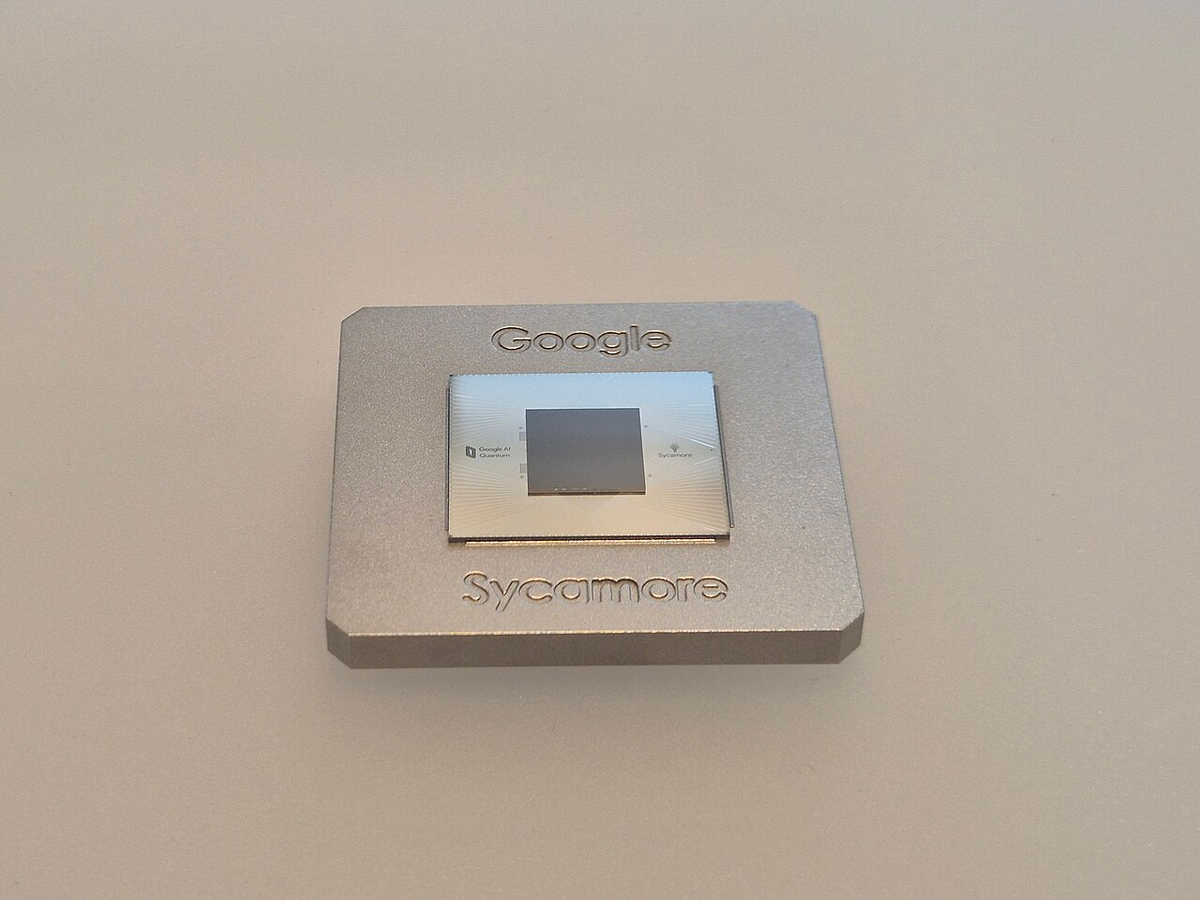
Google publishes its quantum supremacy experiment results using the Sycamore processor in Nature.
United States
Technology
Science
5 min read
Updated By: History Editorial Network (HEN)
Published:
Google published in Nature the results of its quantum computing experiment using the Sycamore processor, reporting that it had performed a specific computational task beyond the practical capabilities of classical supercomputers. The paper, titled “Quantum supremacy using a programmable superconducting processor,” described experiments conducted by the Google AI Quantum team on a 53-qubit superconducting quantum processor named Sycamore.
The Sycamore processor was designed with 54 qubits arranged in a two-dimensional grid, though one qubit was inoperable, leaving 53 functional qubits for the reported experiment. The team implemented a random circuit sampling task, in which the quantum processor generated outputs from a complex probability distribution defined by a sequence of quantum gates. According to the paper, Sycamore completed the sampling task in approximately 200 seconds. Google estimated that the same task would require about 10,000 years on Summit, a leading classical supercomputer at the time located at Oak Ridge National Laboratory.
The experiment relied on superconducting transmon qubits operating at millikelvin temperatures within a dilution refrigerator. The team reported a two-qubit gate fidelity of approximately 99.4% and single-qubit gate fidelities above 99.8%, contributing to the overall system performance necessary for the demonstration. Verification of the results was performed using classical simulation methods on smaller circuit instances to confirm statistical consistency.
The publication prompted responses from other researchers, including work from IBM, which argued that improved classical simulation methods could reduce the estimated classical computation time significantly. The discussion centered on definitions and benchmarks for “quantum supremacy,” a term introduced earlier by John Preskill to describe the point at which a quantum device can perform a task infeasible for classical computers.
The 23/10/2019 publication documented one of the first large-scale experimental claims that a programmable quantum processor had executed a computation beyond straightforward classical reach, contributing to ongoing research into scalable quantum computing systems.
#Google #QuantumSupremacy #Sycamore #NatureJournal #QuantumComputing
#Google
#QuantumSupremacy
#Sycamore
#NatureJournal
#QuantumComputing
Primary Reference
Quantum computing

Explore the Life Moments of
 AI Twin