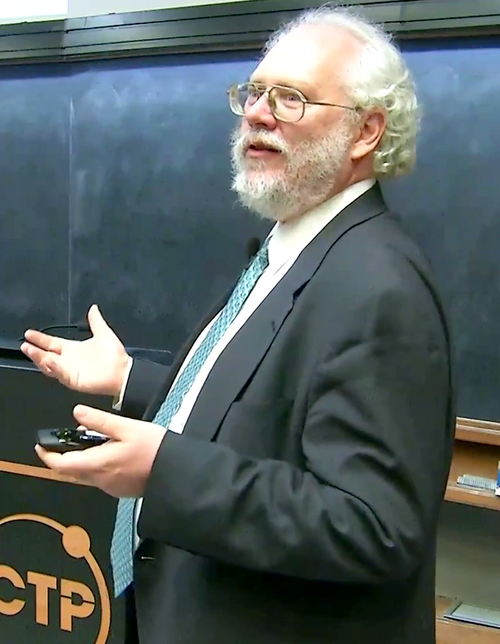
Peter Shor develops Shor’s algorithm
United States
Technology
Science
7 min read
Updated By: History Editorial Network (HEN)
Published:
In 1994, mathematician Peter Shor introduced Shor’s algorithm, a quantum computing method that demonstrated how a sufficiently powerful quantum computer could factor large integers exponentially faster than the best-known classical algorithms. The result, presented at the IEEE Symposium on Foundations of Computer Science in 1994, provided the first clear evidence that quantum computers could solve certain mathematically hard problems far more efficiently than classical machines.
Shor’s algorithm specifically addressed the problem of integer factorization—breaking down a large composite number into its prime components. Classical computers rely on algorithms whose running time grows superpolynomially with input size when factoring large numbers. By contrast, Shor showed that a quantum computer could factor an integer N in polynomial time, using quantum parallelism and the quantum Fourier transform to find the period of a function related to modular exponentiation. The core speedup comes from efficiently solving the order-finding problem, which underpins integer factorization.
The implications were immediate for public-key cryptography. The widely used RSA cryptosystem, named after its inventors Ron Rivest, Adi Shamir, and Leonard Adleman, depends on the practical difficulty of factoring large semiprime numbers. At the time of Shor’s discovery, factoring numbers hundreds of digits long was computationally infeasible for classical machines. Shor’s result showed that if scalable quantum hardware were built, RSA encryption could be broken in polynomial time. This finding reshaped research priorities in both quantum computing and cryptography.
In 1994, large-scale quantum computers capable of running Shor’s algorithm did not yet exist. The first experimental demonstrations came later: in 2001, a team at IBM and Stanford used a 7-qubit nuclear magnetic resonance quantum computer to factor the number 15 into 3 and 5 using a compiled version of Shor’s algorithm. Although limited in scale, the experiment provided proof-of-principle validation of the theoretical work.
Following Shor’s publication, quantum computing research accelerated worldwide. Governments and research institutions began investing in quantum hardware development and quantum-resistant cryptography. Work on post-quantum cryptography—encryption schemes designed to resist attacks from quantum computers—expanded significantly in the decades that followed. In 2016, the U.S. National Institute of Standards and Technology (NIST) launched a process to standardize post-quantum cryptographic algorithms, reflecting the long-term security implications raised by Shor’s 1994 result.
Shor’s algorithm remains a foundational result in quantum information science, demonstrating that quantum computers are not merely faster versions of classical machines but can exploit fundamentally different computational principles. The 1994 breakthrough established integer factorization as a central benchmark problem in quantum computing research and continues to influence both theoretical studies and hardware development.
#ShorsAlgorithm #QuantumComputing #Cryptography #RSA #ComputerScience
Primary Reference
Quantum computing

Explore the Life Moments of
 AI Twin