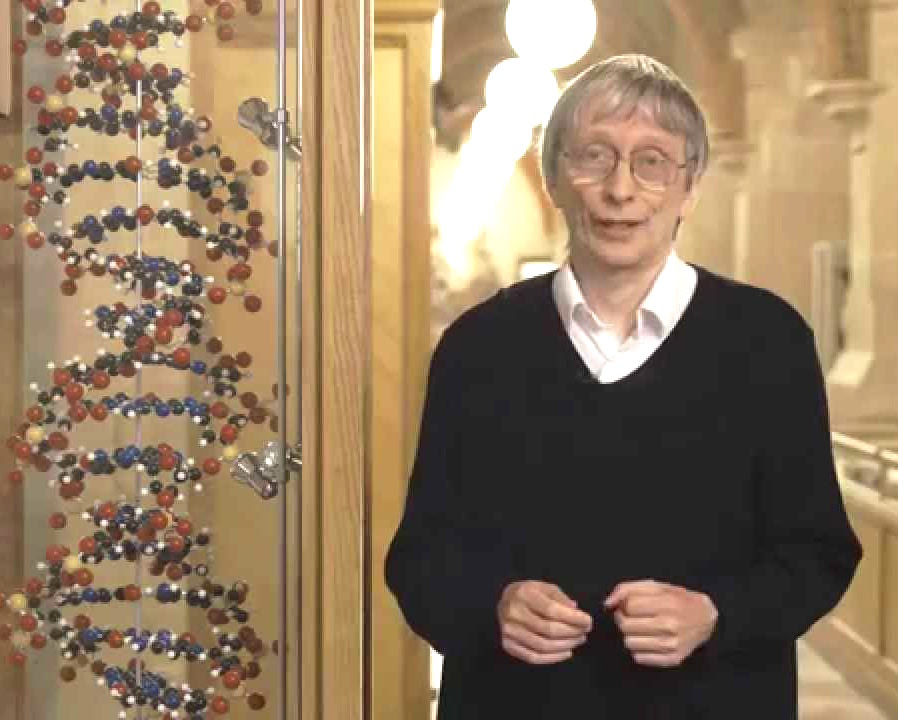
David Deutsch publishes the paper describing a universal quantum computer (Proceedings of the Royal Society A)
United States
Technology
Science
4 min read
Updated By: History Editorial Network (HEN)
Published:
David Deutsch published his paper “Quantum theory, the Church–Turing principle and the universal quantum computer” in Proceedings of the Royal Society A, formally describing the concept of a universal quantum computer. The paper appeared in Volume 400, Issue 1818 of the journal of the Royal Society.
In this work, Deutsch extended earlier ideas about quantum computation, including those discussed by Richard Feynman in 1981, and proposed a general theoretical model for a computing machine that operates according to the laws of quantum mechanics. Deutsch introduced a quantum analogue of the universal Turing machine, demonstrating that a finite set of quantum gates could simulate any physical process, provided the process itself obeys quantum mechanics. His formulation connected quantum theory with the Church–Turing principle, which concerns the limits of what can be computed.
Deutsch’s model relied on quantum bits (qubits), which, unlike classical bits, can exist in superpositions of states. He also described quantum logic gates capable of operating on superposed states and entangled systems. The paper provided a mathematical framework for quantum computation, establishing that quantum computers could, in principle, perform computations beyond the efficient reach of classical machines for certain problems.
The 1985 publication is widely cited as the first formal description of a universal quantum computer. It laid the theoretical groundwork for later developments in quantum algorithms, including work in the 1990s on factoring and search algorithms, and helped define quantum information science as a distinct research field.
#DavidDeutsch #QuantumComputing #RoyalSociety #QuantumInformation #HistoryOfScience
Primary Reference
Quantum computing

Explore the Life Moments of
 AI Twin