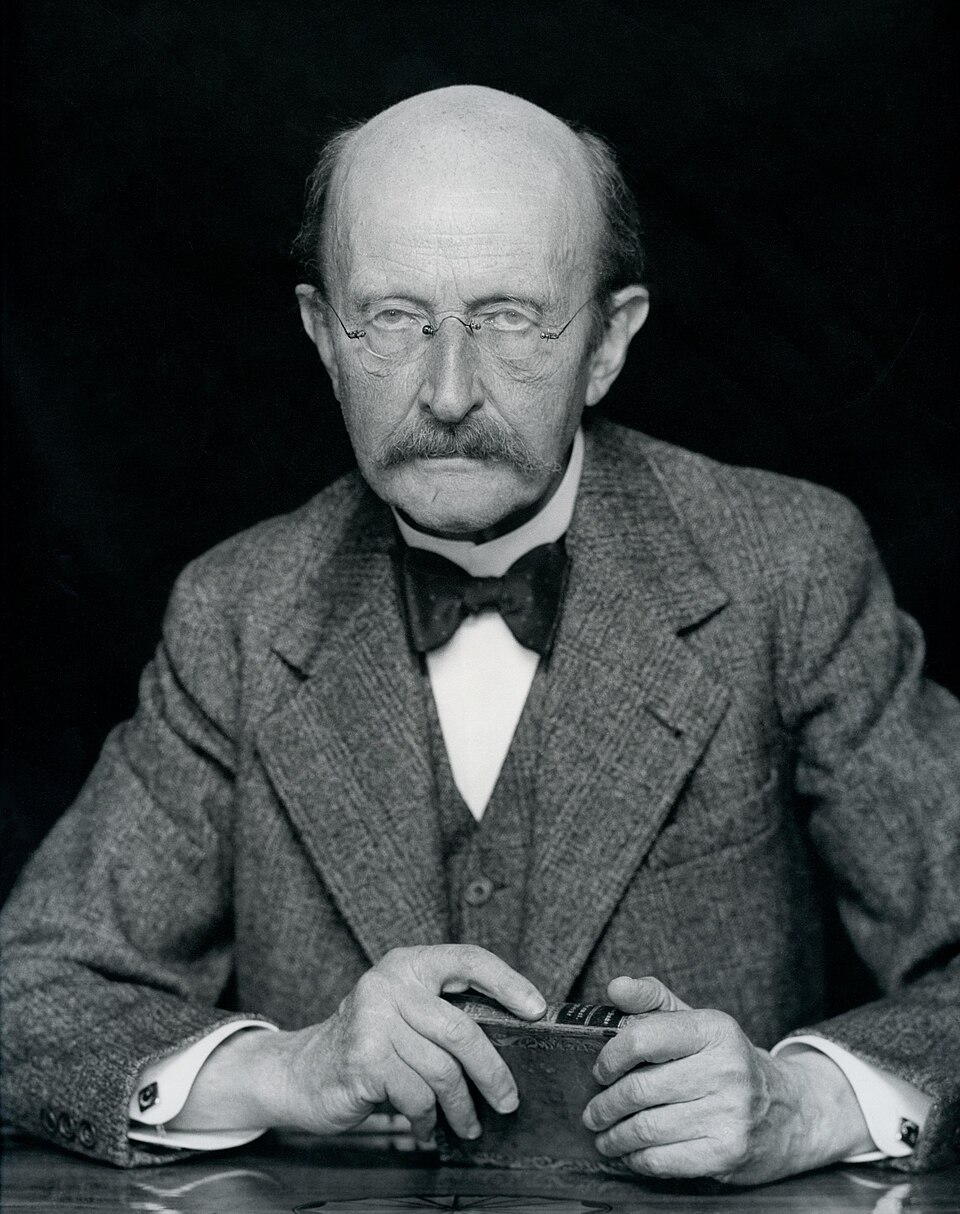
Max Planck presents quantum theory to the German Physical Society in Berlin.
United States
Technology
Science
5 min read
Updated By: History Editorial Network (HEN)
Published:
Updated:
Max Planck presented his derivation of the blackbody radiation law to the German Physical Society in Berlin, introducing the concept that energy is emitted and absorbed in discrete units—later called “quanta.” The presentation took place during a meeting of the society, where Planck outlined a formula that accurately described the spectrum of radiation emitted by a blackbody across all wavelengths, resolving a problem that had challenged physicists in the late 19th century.
At the time, experimental measurements—most notably those by Heinrich Rubens and Ferdinand Kurlbaum—had revealed discrepancies between observed radiation curves and predictions based on classical physics. Existing models, including Wien’s law and the Rayleigh-Jeans law, failed to match empirical data across the full spectrum. Planck’s solution involved assuming that electromagnetic energy could be emitted only in discrete amounts proportional to frequency, expressed mathematically as E = hν, where h is now known as Planck’s constant. He introduced the constant h with a value that closely matches the modern accepted value of approximately 6.626 × 10⁻³⁴ joule-seconds.
Planck initially regarded the quantization of energy as a mathematical assumption to derive the correct formula rather than as a fundamental statement about nature. Nevertheless, the formula he presented—now known as Planck’s law—fit the experimental data with high precision. The announcement on 14/12/1900 is widely recognized as the birth of quantum theory because it marked the first time energy quantization was formally introduced into physics.
In subsequent years, Planck’s work influenced further developments by physicists such as Albert Einstein, who in 1905 applied the quantum concept to explain the photoelectric effect, and Niels Bohr, who incorporated quantization into his 1913 model of the atom. Planck was awarded the Nobel Prize in Physics in 1918 for his discovery of energy quanta, formally recognizing the importance of his 1900 presentation.
The meeting in Berlin on 14/12/1900 thus marked the formal introduction of quantum theory to the scientific community, establishing a framework that would underpin 20th-century physics.
#QuantumTheory #MaxPlanck #HistoryOfScience #Physics #Berlin
Primary Reference
Quantum computing

Explore the Life Moments of
 AI Twin