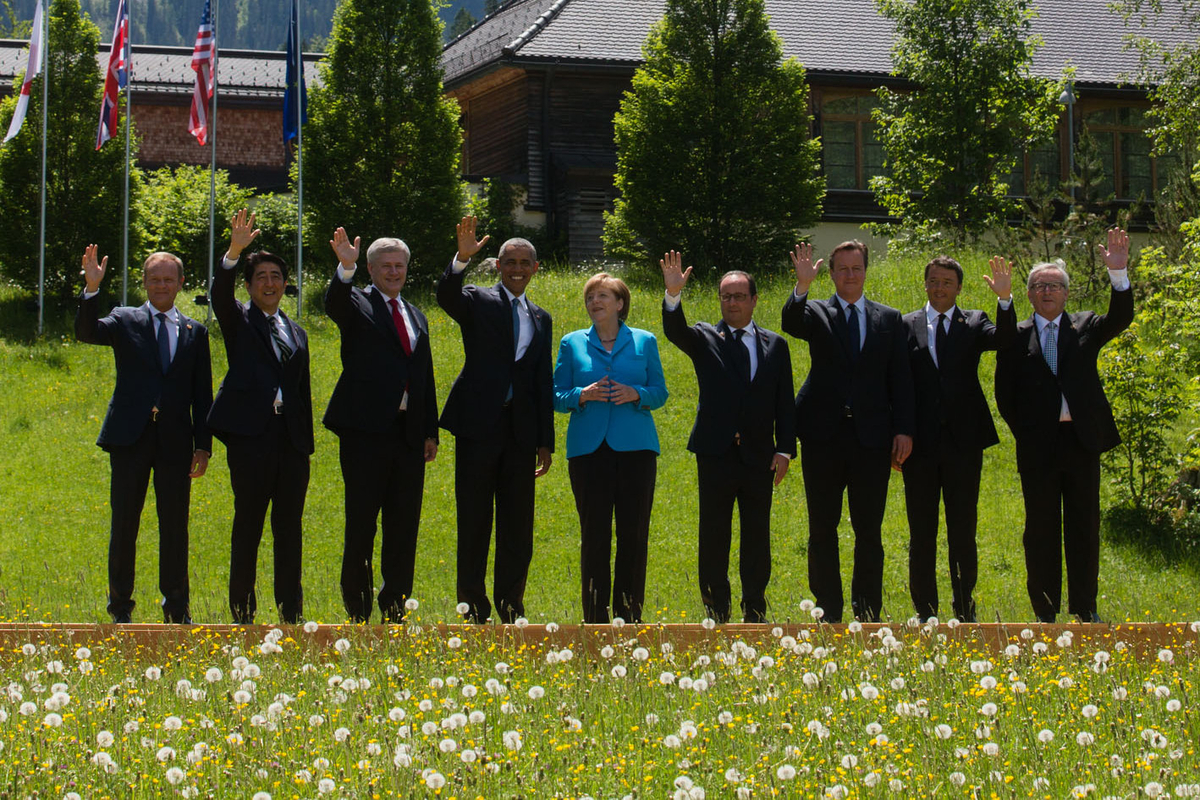
2015 G7 summit Krün, Bavaria
Schloss Elmau, 2, In Elmau, Elmau, Krün, Landkreis Garmisch-Partenkirchen, Bayern, 82493, Deutschland, Germany

Global Economy
Foreign Policy
Climate and Energy Issues
10 min read
Updated By: History Editorial Network (HEN)
Published:
Updated:
The 41st G7 summit was held on 7 and 8 June 2015 at Schloss Elmau, near Krün in the Bavarian Alps of Germany. Hosted by German Chancellor Angela Merkel, it was the first full G7 summit after Russia’s suspension from the former G8 over the annexation of Crimea and the conflict in Ukraine. The calm mountain setting contrasted with a tense agenda that included Ukraine, terrorism, weak recovery, climate change, Ebola, migration and the coming Sustainable Development Goals.
The leaders present were Angela Merkel of Germany, Barack Obama of the United States, David Cameron of the United Kingdom, François Hollande of France, Matteo Renzi of Italy, Stephen Harper of Canada and Shinzo Abe of Japan. The European Union was represented by Donald Tusk and Jean-Claude Juncker. Germany also invited guest leaders and organisations, including representatives from Africa and Iraq, showing that the meeting looked beyond the advanced economies to development, health, conflict and stability.
A central political message concerned Russia and Ukraine. The G7 reaffirmed support for Ukraine’s sovereignty and territorial integrity and stated that sanctions on Russia were linked to full implementation of the Minsk agreements. They rejected the use of force to change borders and stressed that the crisis had to be resolved through international law. This helped define the G7’s post-G8 role as a forum of democratic economies defending a rules-based international order.
Security and foreign policy were major issues. The leaders discussed the so-called Islamic State in Iraq and Syria, foreign terrorist fighters, violent extremism, instability in Libya, the Syrian civil war and pressures across the Middle East and North Africa. Iraqi Prime Minister Haider al-Abadi attended as a guest, underlining support for Iraq in the fight against ISIS. The leaders also backed diplomacy on Iran’s nuclear programme, which soon led to the July 2015 nuclear agreement.
Climate change became the defining policy theme of the summit. The leaders strongly supported an ambitious global climate agreement at the Paris climate conference later in 2015. They endorsed the long-term goal of decarbonising the global economy over the course of the century and supported deep reductions in greenhouse gas emissions. They also reaffirmed climate finance, including the goal of mobilising 100 billion US dollars per year by 2020 to help developing countries. This gave momentum to the Paris Agreement process.
The economic discussions focused on recovery after the global financial crisis. Growth was improving but remained uneven, with concerns about unemployment, weak investment and financial vulnerability. The leaders discussed structural reforms, innovation, infrastructure, fiscal responsibility and open markets. They reaffirmed the value of a rules-based trading system and called for progress in the World Trade Organization. Trade talks such as TTIP and EU-Japan talks were viewed as ways to support growth and standards while resisting protectionism.
Development was another major area because 2015 was the year the Sustainable Development Goals were to be adopted. The G7 supported an ambitious post-2015 development agenda covering poverty reduction, food security, education, health, gender equality and sustainable opportunity. Africa received special attention through discussions with invited African leaders. The summit also addressed hunger and nutrition, supporting efforts to help millions of people escape hunger and malnutrition by 2030 through rural development and resilience to climate shocks.
Global health was shaped by the recent Ebola outbreak in West Africa. The leaders recognised that Ebola had exposed weaknesses in health systems, early warning arrangements and emergency response. They supported strengthening the World Health Organization, improving rapid response capacity and helping developing countries build stronger health systems. They also discussed antimicrobial resistance, neglected tropical diseases and research into medicines and vaccines where commercial incentives were limited.
The summit highlighted women’s economic empowerment and responsible global supply chains. The leaders supported vocational training and economic opportunities for women and committed to reducing the gender gap in labour force participation. They also emphasised stronger labour, social and environmental standards in international supply chains, especially after the Rana Plaza factory collapse had drawn attention to unsafe working conditions.
The 41st G7 summit is remembered for climate action, health security and the defence of international rules. It did not produce a treaty, but it aligned the leading advanced economies before the Paris climate conference and the adoption of the Sustainable Development Goals. It also confirmed the G7’s post-G8 identity: smaller than the G20, but more politically cohesive on democracy, sanctions, security, development and global governance.
#G7Summit
#ClimatePolicy
#GlobalEconomy
#AngelaMerkel
#SchlossElmau
Primary Reference
Meeting of the heads of state and government - G7 Summit programme

Explore the Life Moments of
 AI Twin