Completion of the Florentine Codex
Tlatelolco, New Spain (present-day Mexico City, Mexico), Mexico
Ethnography
Aztec Civilization
Historical Documentation
9 min read
Updated By: History Editorial Network (HEN)
Published:
Updated:
In 1576, the Florentine Codex entered its final stages of compilation during one of the deadliest periods in post-conquest Mexican history. The massive encyclopedic manuscript, formally titled Historia general de las cosas de Nueva España, was being completed while central Mexico suffered through the catastrophic cocoliztli epidemic of 1576 to 1577, often called the Great Pestilence. The epidemic caused widespread mortality among Indigenous communities, including Nahua populations connected to the intellectual and artistic networks that contributed to the project. Despite these conditions, the manuscript was finalized through the collaboration of Franciscan friar Bernardino de Sahagún and Indigenous Nahua scholars, scribes, and painters associated with the Colegio de Santa Cruz de Tlatelolco.
The Florentine Codex had been decades in development before reaching completion in the mid 1570s. Bernardino de Sahagún, born in Spain around 1499, arrived in New Spain in 1529 and devoted much of his life to documenting Nahua language, religion, customs, social organization, and history. Rather than working alone, Sahagún relied heavily on Indigenous intellectuals educated at the Colegio de Santa Cruz de Tlatelolco, an institution founded in 1536 to educate elite Nahua youth in Latin, Spanish, rhetoric, theology, and European scholarly methods. These collaborators gathered oral histories, translated testimonies, created illustrations, and preserved cultural knowledge that survived the Spanish conquest.
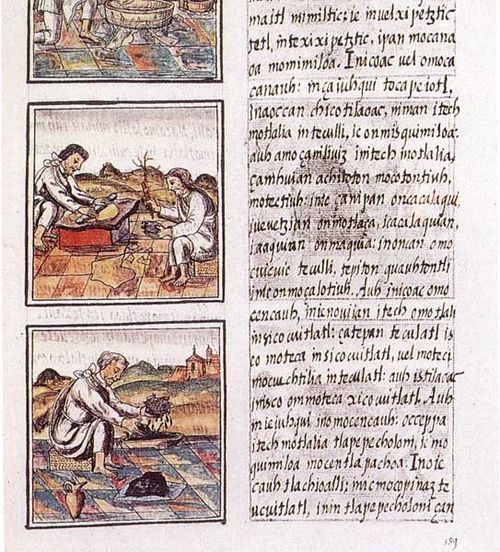
The final version of the Florentine Codex was compiled between approximately 1575 and 1577. The completed manuscript consisted of 12 books containing thousands of lines of Nahuatl and Spanish text alongside nearly 2,500 illustrations created by Indigenous artists known as tlacuilos. The work documented a vast range of subjects including Aztec religion, ceremonies, medicine, botany, astronomy, governance, social customs, trade, warfare, and natural history. Its final book provided one of the most important Indigenous-informed accounts of the Spanish conquest of Tenochtitlan.
One of the manuscript’s most distinctive features was its bilingual format. Each page was generally divided into two columns, with the original Nahuatl text appearing on the right side and a Spanish translation or adaptation by Sahagún on the left. This structure preserved important linguistic and cultural information while also making the material accessible to Spanish readers. Historians today regard the Nahuatl passages as especially valuable because they preserve Indigenous perspectives recorded within decades of the conquest.
The completion of the codex coincided with the severe cocoliztli epidemic that devastated central Mexico beginning in 1576. Modern estimates suggest that millions of Indigenous people may have died during successive epidemic outbreaks in the 16th century, dramatically reshaping the demographic and social structure of New Spain. The epidemic formed the grim historical backdrop against which Nahua scholars and artists completed one of the most detailed surviving records of pre-Hispanic Mesoamerican civilization.
Shortly after its completion, the manuscript was sent to Europe. It eventually entered the collection of the Medici family in Florence, Italy, which later gave rise to its modern name, the Florentine Codex. Today, the manuscript is preserved in the Biblioteca Medicea Laurenziana in Florence and remains one of the most important primary sources for the study of Aztec society, language, religion, and colonial-era Indigenous history.
Historical Significance
The Florentine Codex preserved extensive Nahua knowledge at a time when disease, colonization, and religious suppression were rapidly transforming Indigenous society in central Mexico. Its collaborative creation between European clergy and Indigenous scholars produced one of the most detailed records of pre-Columbian civilization anywhere in the Americas and remains foundational to modern understanding of Aztec history and culture.
#mooflife
#MomentOfLife
#FlorentineCodex
#AztecCivilization
#BernardinoDeSahagún
#EthnographicEncyclopedia
#MexicaHistory
Primary Reference
Introducing the Florentine Codex

Explore the Life Moments of
 AI Twin