Apple Introduces On-Device Artificial Intelligence
United States
Technology
Artificial Intelligence
Apple
6 min read
Updated By: History Editorial Network (HEN)
Published:
Updated:
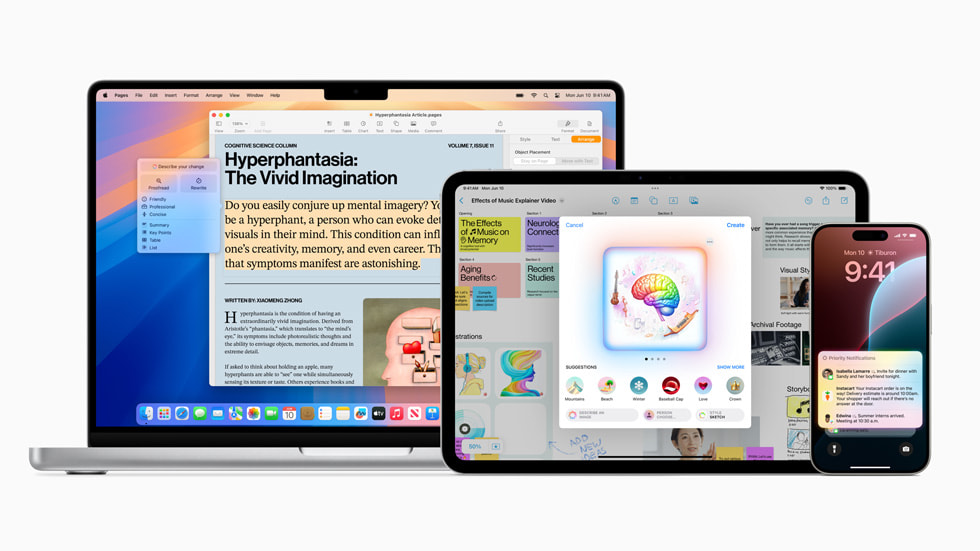
On 10/06/2024, Apple Inc. introduced Apple Intelligence during its Worldwide Developers Conference keynote, presenting a personal intelligence system designed for iPhone, iPad, and Mac. The announcement outlined Apple’s integration of generative models directly into its operating systems, combining on device processing with personal context such as language, photos, and app usage. Apple stated that many requests would run locally on supported devices, while more complex tasks could be handled through Private Cloud Compute, a system designed to extend processing capacity while maintaining user privacy. Apple Intelligence was announced as part of iOS 18, iPadOS 18, and macOS Sequoia.
Apple detailed systemwide Writing Tools that allow users to rewrite, proofread, and summarize text across applications including Mail, Notes, Pages, and supported third party apps. These tools appear as inline controls and offer tone adjustments, concise summaries, and structured formatting. The company also introduced an enhanced Siri experience with more natural language understanding, the ability to maintain context between requests, and awareness of onscreen content. Apple demonstrated Siri performing actions across apps, such as locating files, summarizing emails, and executing multi step commands without requiring repeated prompts.
The announcement also included new image generation features integrated into the operating system. Image Playground enables users to create original images in styles such as Animation, Illustration, and Sketch using text prompts or suggestions based on contacts and photos. Genmoji allows users to generate custom emoji from descriptions and combine attributes such as expressions, accessories, or themes. Apple also introduced the Clean Up tool in the Photos app, which identifies distracting background elements and removes them while preserving the main subject of the image. These tools operate within Messages, Notes, and other apps using shared system level models.
Apple Intelligence also introduced communication and notification improvements. Priority Messages in Mail highlights time sensitive emails at the top of the inbox, while smart notification summaries condense multiple alerts into brief overviews. Apple said these features are designed to reduce interruptions and surface important information. The company confirmed that Apple Intelligence would initially be available in U.S. English, with a phased rollout beginning later in 2024 on supported devices powered by Apple silicon, including iPhone 15 Pro models and Macs and iPads with M series chips.
CUPERTINO, CALIFORNIA - JUNE 10: (L-R) Apple CEO Tim Cook, Apple senior vice president of machine learning and AI strategy John Giannandrea and Apple senior vice president of software engineering Craig Federighi look on during the Apple Worldwide Developers Conference (WWDC) on June 10, 2024 in Cupertino, California. Apple will announce plans to incorporate artificial intelligence (AI) into Apple software and hardware.
#mooflife
#MomentOfLife
#AppleIntelligence
#On-deviceAi
#ArtificialIntelligence
#PrivacyTechnology
#SmartDevices

Explore the Life Moments of
 AI Twin