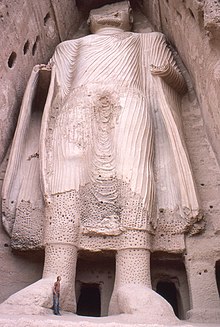
The smaller of the Buddhas of Bamiyan, known as the "Eastern Buddha" built
Afghanistan
8 min read
Updated By: History Editorial Network (HEN)
Published:
In the heart of Afghanistan's central Bamiyan Valley, two colossal statues of Buddha, known as the Buddhas of Bamiyan, were carved into the cliff faces by the ancient Buddhist community that once flourished in the region. The smaller of these statues, referred to as the "Eastern Buddha," was constructed around the year 570 CE.
The Eastern Buddha stood at approximately 38 meters (125 feet) tall and was a magnificent representation of the artistic and cultural zenith achieved by the Gandhara civilization, which spread across modern-day Afghanistan, Pakistan, and northern India. The construction of the Eastern Buddha involved an intricate process of carving directly into the sandstone cliffs, followed by detailed finishing with stucco to enhance the facial features and drapery.
Historical and Cultural Significance
Buddhist Monasticism and the Silk Road
The creation of the Eastern Buddha coincided with a period of intense Buddhist monastic activity in the Bamiyan Valley. The valley was a major hub on the Silk Road, facilitating the exchange of not only goods but also ideas, art, and religion. Monasteries, chapels, and stupas proliferated in the area, contributing to its status as a significant center of Buddhist learning and pilgrimage.
Artistic Achievement
The Eastern Buddha exemplified the synthesis of Greek, Persian, and Indian artistic influences that characterized Gandhara art. This fusion created a unique aesthetic that combined the Hellenistic emphasis on naturalistic form and drapery with traditional Buddhist iconography. The statue’s serene expression, flowing robes, and poised stance were designed to convey the spiritual tranquility and majesty of the Buddha.
Construction Techniques
The artisans employed a combination of rock carving and plaster application to create the Eastern Buddha. After carving the basic shape out of the cliff face, they applied layers of mud and straw mixed with stucco to refine the details. Pigments were then used to paint the statue, though these colors have long since faded.
Historical Context
The construction of the Eastern Buddha took place during the reign of the Hephthalites, also known as the White Huns, who controlled the region in the 5th and 6th centuries. Despite their own cultural and religious practices, the Hephthalites supported the local Buddhist institutions, facilitating a period of relative stability and artistic flourishing.
Legacy and Destruction
The Eastern Buddha, along with its larger counterpart, the Western Buddha, stood as a testament to the rich cultural and religious history of the Bamiyan Valley for over a millennium. However, this legacy was tragically interrupted in March 2001, when the Taliban government ordered the destruction of the Buddhas of Bamiyan, deeming them idolatrous under their interpretation of Islamic law. The statues were destroyed using dynamite, an act that was met with global condemnation and marked a significant loss to world heritage.
Ongoing Efforts
Despite their destruction, the spirit of the Buddhas of Bamiyan endures. There have been ongoing efforts by the international community, including UNESCO, to preserve the site and possibly restore the statues. The niches where the Buddhas once stood remain a poignant reminder of the region's historical and cultural significance.
The smaller "Eastern Buddha" of Bamiyan, built around 570 CE, stands as a symbol of Afghanistan's rich, multicultural heritage and its pivotal role in the spread of Buddhism along the Silk Road. The story of the Eastern Buddha is one of artistic brilliance, spiritual devotion, and the enduring legacy of cultural resilience in the face of destruction.
#MomentsOfLife #MoofLife_Moment #MoofLife #BuddhasOfBamiyan #CulturalHeritage #Buddhism #SilkRoadHistory #GandharaArt #AfghanistanHistory

Explore the Life Moments of
 AI Twin