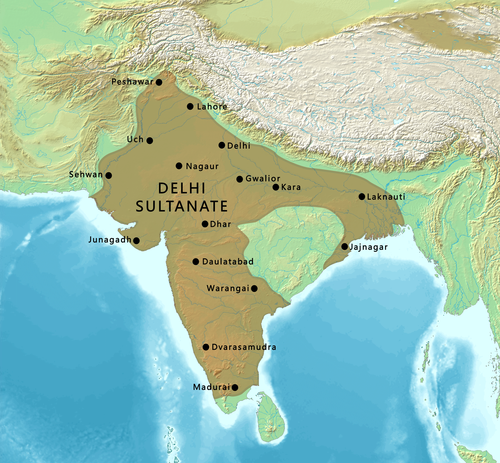
Establishment of Delhi Sultanate in control of some territories beyond its borders.
Afghanistan

Political
Cultural Exchange
3 min read
Updated By: History Editorial Network (HEN)
Published:
After the Ghurid dynasty's conquests in the region, the Delhi Sultanate was formed, extending its rule over parts of Afghanistan. This marked a significant expansion of Islamic power in South Asia. The Sultanate's establishment led to the introduction of Persian culture, language, and Islamic traditions in the region.
The consolidation of the Delhi Sultanate with Afghan territories under its domain brought about a blend of Central Asian, Persian, and Indian influences in governance, art, and architecture. The rule of the Sultanate facilitated trade and cultural exchanges between Afghanistan and the Indian subcontinent. It also paved the way for the spread of Islam in the region, influencing religious practices and societal norms.
The incorporation of Afghan territories into the Delhi Sultanate played a pivotal role in shaping the political landscape of the region, establishing a centralized authority and administrative system. The Sultanate's governance structure and military strategies influenced the political dynamics of Afghanistan, leading to lasting impacts on its societal and cultural development.
#DelhiSultanate #Afghanistan #IslamicExpansion #CulturalExchange #PoliticalImpact
Explore the Life Moments of
 AI Twin