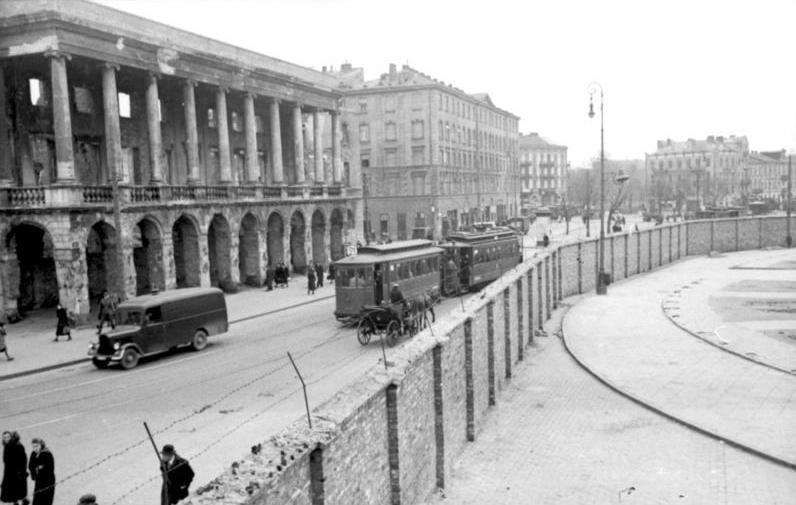
The Forced Relocation of Warsaw’s Jewish Population to the Ghetto
Germany


5 min read
Updated By: History Editorial Network (HEN)
Published:
In the context of Nazi Germany's occupation of Poland during the Second World War, the establishment of the Warsaw Ghetto marked a significant stage in the systematic persecution and segregation of the Jewish population. Following the invasion of Poland in September 1939, the Nazi regime quickly implemented anti-Jewish policies throughout occupied territories. By late 1940, these policies culminated in the forced relocation of Warsaw’s Jewish residents into a segregated urban area, later known as the Warsaw Ghetto.
The decision to isolate Jews in Warsaw was formalized in an order by Hans Frank, the Governor-General of the General Government, which was the Nazi-administered area of occupied Poland. On 12 October 1940, the German authorities announced that all Jews residing in Warsaw—numbering over 350,000—were to be relocated into a specifically demarcated district. This area, enclosed by a 3.5-meter-high wall topped with barbed wire, was officially sealed on 16 November 1940. It encompassed approximately 1.3 square miles, representing only a fraction of the city’s overall space, yet it housed nearly 30% of Warsaw’s total population.
Conditions within the ghetto rapidly deteriorated. The relocation effort was not accompanied by adequate provisions for housing, food, or medical care. Overcrowding, malnutrition, and disease were widespread, with an average of 7.2 persons per room by early 1941. Jewish Council (Judenrat) members, appointed by the Nazis to administer internal affairs under German oversight, were tasked with implementing German orders, including census taking, property confiscation, and later deportations.
The establishment of the Warsaw Ghetto was a precursor to the broader genocidal policies that followed. Between July and September 1942, over 250,000 Jews from the ghetto were deported to the Treblinka extermination camp during the so-called "Grossaktion Warschau." The ghetto’s closure and subsequent liquidation became emblematic of the Holocaust’s systemic nature.
The relocation to the Warsaw Ghetto stands as a critical juncture in the history of the Holocaust, marking the transition from social marginalization and economic exploitation to physical segregation and mass extermination.
#MoofLife #MoofLife_Moment #MomentsOfLife
Primary Reference
Warsaw Ghetto

Explore the Life Moments of
 AI Twin