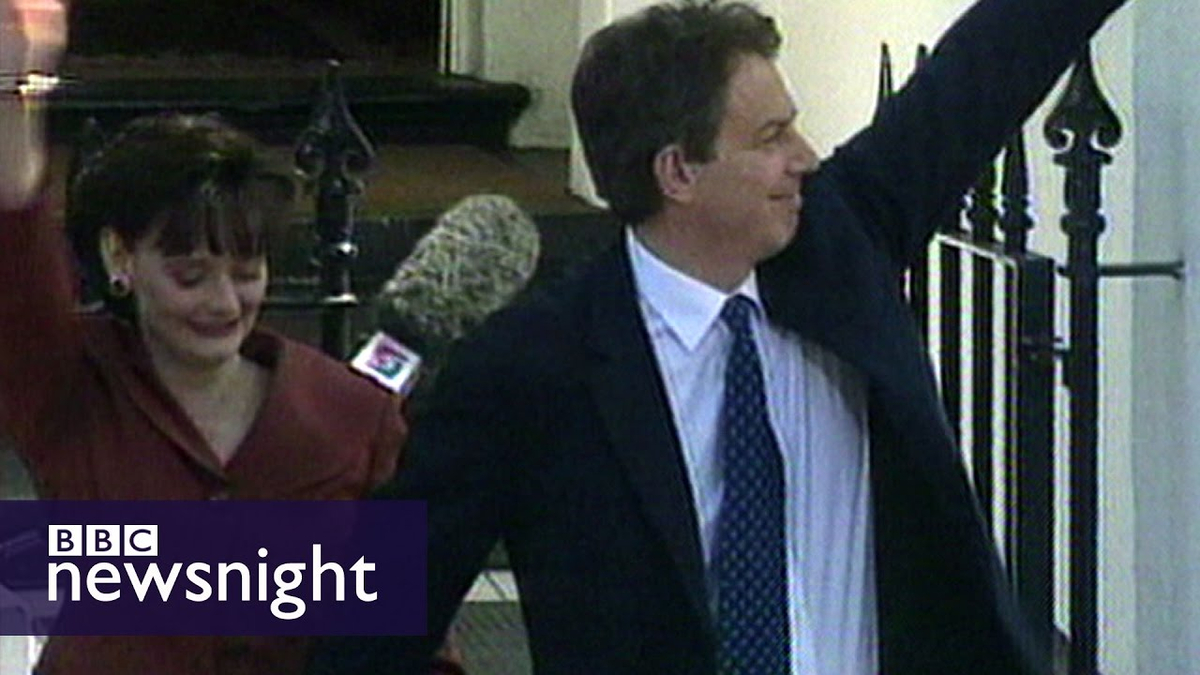
Tony Blair becomes the Prime Minister
Appointment of the Prime Minister
10 min read
Updated By: History Editorial Network (HEN)
Published:
On May 2, 1997, Tony Blair became the Prime Minister of the United Kingdom, leading the Labour Party to a historic landslide victory that ended 18 years of Conservative rule. His premiership marked the beginning of a new era in British politics, characterized by significant domestic reforms and an active role in international affairs.
Tony Blair was born on May 6, 1953, in Edinburgh, Scotland. He studied at St. John's College, Oxford, where he read jurisprudence, and subsequently trained as a lawyer. Blair entered politics as the Member of Parliament (MP) for Sedgefield in 1983. His rapid rise within the Labour Party was driven by his charismatic personality, eloquent communication skills, and a vision to modernize the party.
Blair's ascent to the party leadership came in 1994, following the sudden death of John Smith. As leader, Blair rebranded the Labour Party as "New Labour," distancing it from its traditional socialist image. He embraced a centrist approach, combining free-market policies with a commitment to social justice, encapsulated in the phrase "Third Way." This rebranding was instrumental in broadening the party's appeal to middle-class voters who had previously supported the Conservatives.
The 1997 general election was a watershed moment. Labour's campaign, centered on the themes of "New Labour, New Britain" and a pledge to revitalize public services, resonated with an electorate weary of years of Conservative governance marked by economic turmoil and political scandals. Labour won 418 seats, the largest majority in the party's history, while the Conservatives suffered their worst defeat since 1832.
As Prime Minister, Blair embarked on an ambitious agenda of domestic reform. His government introduced the National Minimum Wage, established the Sure Start program to support early childhood education, and enacted significant constitutional changes, including devolution for Scotland and Wales, and the reform of the House of Lords. Blair's administration also prioritized education and healthcare, increasing funding for schools and the National Health Service (NHS).
One of Blair's most significant achievements was the Good Friday Agreement in 1998, which brought an end to decades of violent conflict in Northern Ireland. The peace process, facilitated by intensive negotiations and the involvement of key political figures from Northern Ireland, the Republic of Ireland, and the United States, resulted in a power-sharing arrangement that significantly reduced sectarian violence and established a framework for political stability in the region.
Blair's foreign policy was characterized by an active and interventionist stance. He forged a close relationship with US President Bill Clinton, and later with President George W. Bush. This "special relationship" was pivotal in shaping Blair's foreign policy decisions, particularly in relation to military interventions. Blair supported NATO's intervention in Kosovo in 1999 and played a key role in the international response to the Sierra Leone Civil War in 2000.
However, Blair's legacy is most controversially defined by his decision to support the US-led invasion of Iraq in 2003. The justification for the invasion was the alleged presence of weapons of mass destruction (WMDs) in Iraq, a claim that was later discredited. The war, which led to the toppling of Saddam Hussein but also resulted in significant loss of life and long-term instability in the region, provoked widespread protests and severely impacted Blair's popularity. The Chilcot Inquiry, published in 2016, criticized the way the decision to go to war was made and the handling of its aftermath.
Despite the controversies surrounding Iraq, Blair won two more general elections in 2001 and 2005, albeit with reduced majorities. His ability to win three consecutive terms was unprecedented for the Labour Party and underscored his electoral appeal.
In 2007, Blair announced his resignation, and Gordon Brown, his long-time Chancellor of the Exchequer, succeeded him as Prime Minister. After leaving office, Blair remained active in public life, focusing on international issues through the Tony Blair Institute for Global Change and his role as a Middle East envoy.
Tony Blair's premiership left a profound impact on the UK. His domestic reforms modernized the Labour Party and addressed key social issues, while his foreign policy decisions, particularly regarding Iraq, continue to spark debate. Blair's legacy is a complex blend of transformative achievements and contentious decisions, reflecting the challenges and responsibilities of leadership in a rapidly changing world.
#MomentsOfLife #MoofLife_Moment #MoofLife #TonyBlair #UKPolitics #NewLabour #GoodFridayAgreement #BritishPrimeMinister #IraqWar #DomesticReforms
Primary Reference
Tony Blair - Wikipedia
Explore the Life Moments of
 AI Twin