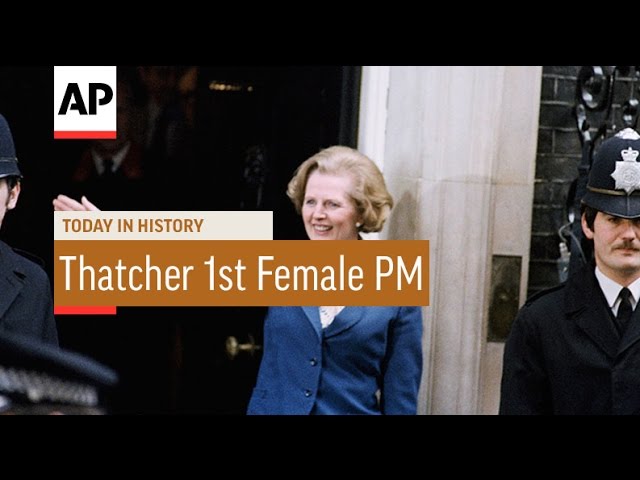
Margaret Thatcher becomes the Prime Minister
Appointment of the Prime Minister
10 min read
Updated By: History Editorial Network (HEN)
Published:
On May 4, 1979, Margaret Thatcher became the first female Prime Minister of the United Kingdom, marking a transformative moment in British political history. Her election ushered in a new era defined by her distinctive brand of conservatism, later known as "Thatcherism," which profoundly reshaped the UK's economic and political landscape.
Margaret Hilda Thatcher, née Roberts, was born on October 13, 1925, in Grantham, Lincolnshire. She studied chemistry at Somerville College, Oxford, and later trained as a barrister. Thatcher entered politics as the Conservative MP for Finchley in 1959, steadily rising through the ranks. Her sharp intellect, strong work ethic, and clear ideological vision quickly distinguished her within the Conservative Party.
Thatcher's path to the premiership began with her appointment as Secretary of State for Education and Science in 1970 under Prime Minister Edward Heath. Her tenure was controversial, particularly for her decision to cut funding for free milk in schools, earning her the moniker "Thatcher, the Milk Snatcher." Despite this, her resolve and clear policy direction garnered respect within her party.
In 1975, after the Conservatives lost the general election and Heath's leadership was questioned, Thatcher challenged him for the party leadership and won, becoming the first woman to lead a major political party in the UK. Her leadership style was assertive and uncompromising, traits that would define her time as Prime Minister.
The 1979 general election was held against a backdrop of economic turmoil and widespread industrial unrest, epitomized by the "Winter of Discontent" in 1978-1979, when a series of strikes paralyzed the country. The Labour government, led by James Callaghan, struggled to manage the crisis, leading to a loss of public confidence. Thatcher's Conservative Party capitalized on this discontent, promising a new direction focused on reducing the power of trade unions, cutting taxes, and curbing inflation.
Thatcher's victory in the 1979 election was decisive, ending 15 years of Labour dominance. Her government immediately set about implementing a series of radical economic reforms aimed at reducing the state's role in the economy and promoting free-market principles. Key policies included privatizing state-owned industries, deregulating the financial sector, and introducing measures to reduce the power and influence of trade unions.
One of the most significant early actions of Thatcher's government was the passage of the Employment Act 1980, which restricted the power of trade unions. This set the stage for her confrontations with the unions, most notably during the miners' strike of 1984-1985. Thatcher's government stood firm against the strike, eventually leading to a significant weakening of the trade union movement in the UK.
Thatcher's economic policies, while controversial, resulted in a period of significant transformation. Her government cut public spending, reduced income tax rates, and encouraged private enterprise. These measures were credited with reducing inflation and stimulating economic growth, but they also led to increased unemployment and social inequality. Thatcher's belief in individual responsibility and entrepreneurialism became central tenets of her political philosophy.
Internationally, Thatcher maintained a strong and assertive foreign policy. She formed a close alliance with US President Ronald Reagan, sharing a commitment to free-market economics and a strong stance against the Soviet Union. Thatcher's leadership during the Falklands War in 1982, when British forces successfully retook the Falkland Islands from Argentine occupation, bolstered her reputation for decisiveness and determination.
Thatcher's approach to Europe was more complex. While she supported the UK's membership in the European Economic Community (EEC), she was skeptical of further political integration. Her famous 1988 Bruges speech articulated her vision of a Europe based on cooperation between sovereign nations rather than a federalist superstate.
Despite facing significant opposition, both from within her party and the public, Thatcher's political acumen and clear ideological vision allowed her to win three consecutive general elections (1979, 1983, and 1987). However, her third term saw increasing dissent over her policies, particularly the introduction of the Community Charge, known as the "poll tax." The unpopularity of this policy, combined with internal party divisions, led to her resignation in November 1990.
Margaret Thatcher's legacy is deeply polarizing. She is hailed by supporters for revitalizing the British economy, curbing the power of the unions, and strengthening the UK's global standing. Critics argue that her policies exacerbated social divisions and led to significant economic hardship for many. Regardless of one's view, Thatcher's impact on the UK was profound and enduring, making her one of the most significant political figures of
Primary Reference
Margaret Thatcher - Wikipedia
Explore the Life Moments of
 AI Twin