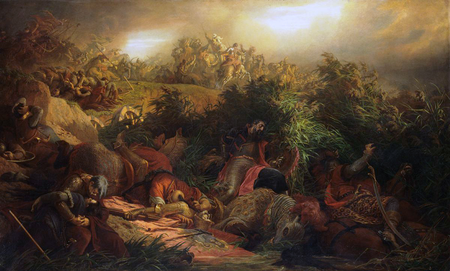
Battle of Mohacs: Ottoman-Hungarian Conflict
Turkey

Political
4 min read
Updated By: History Editorial Network (HEN)
Published:
The Battle of Mohacs marked a significant clash between the Ottoman Empire and the Hungarian Kingdom. The origins of the conflict can be traced back to the Ottoman expansion into southeastern Europe and Hungary's strategic position as a buffer between the Ottomans and the Habsburg Empire.
The Ottomans, led by Sultan Suleiman the Magnificent, sought to assert their dominance over Hungary, while the Hungarian Kingdom, under the rule of King Louis II, aimed to defend its territory and sovereignty. The battle took place near the town of Mohacs, a crucial crossing point on the Danube River.
The outcome of the battle was decisive, with the Ottomans achieving a resounding victory over the Hungarian forces. King Louis II was killed in the battle, and many Hungarian nobles and soldiers were either slain or captured. The defeat at Mohacs had far-reaching consequences for Hungary, as it led to a power vacuum and internal strife within the kingdom.
The Ottomans capitalized on their victory at Mohacs by expanding their territorial control in Hungary and eventually laying siege to the capital, Buda. The Habsburgs, who were rivals of the Ottomans, also sought to capitalize on the chaos in Hungary by making territorial gains.
The Battle of Mohacs was a turning point in the history of Hungary, as it marked the beginning of the Ottoman occupation of the region. The legacy of the battle continues to be felt in modern-day Hungary, as it shaped the country's geopolitical landscape for centuries to come.
#OttomanEmpire #HungarianKingdom #BattleofMohacs #HistoricConflict #SultanSuleiman

Explore the Life Moments of
 AI Twin