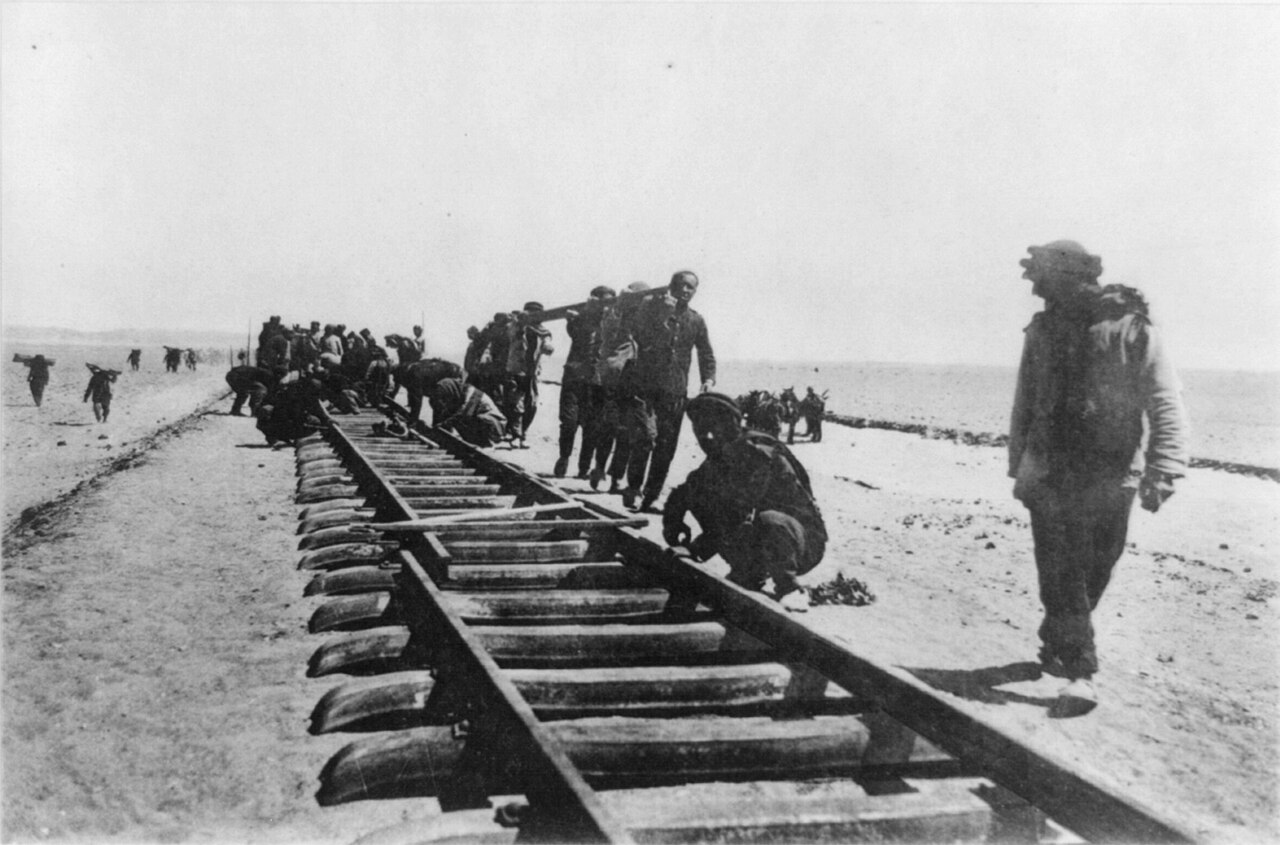
Construction of the Hejaz Railway connecting Damascus to Medina
Syria
Economic Development
Infrastructure
6 min read
Updated By: History Editorial Network (HEN)
Published:
The initiative to construct the Hejaz Railway emerged from the Ottoman Empire's need to improve connectivity within its extensive territories, stretching from Damascus to Medina. The railway aimed to facilitate pilgrimage, bolster administrative control, enhance military logistics, and promote economic integration across the regions it traversed. This project was an ambitious feat given the challenging geography, spanning deserts and mountains.
Funding for this large-scale construction primarily came from contributions by Muslims worldwide, demonstrating a collective investment in the endeavor. The engineering effort drew on expertise from German engineers, who collaborated with local labor, combining Western technological advancements with traditional knowledge.
By the time construction progressed, the railway extended approximately 1,320 kilometers. Practical benefits were immediately evident. Travel time for pilgrims journeying to the holy cities was drastically reduced from weeks to mere days, significantly improving the safety and comfort of their journeys. This efficient connectivity also amplified the Ottoman Empire's administrative capabilities, allowing for quicker troop movements and more effective governance over distant provinces.
Furthermore, the Hejaz Railway played an instrumental role in driving regional economic activity. It enabled the more efficient transport of goods, catalyzing trade within the empire and fostering economic interdependence among the communities along the route. The railway's operational years witnessed a marked increase in economic transactions, elevating the commercial prospects of previously isolated towns and cities.
Despite the benefits, the railway also faced significant challenges. Maintenance and protection of the railway tracks in remote areas proved difficult, particularly during periods of political instability and external threats. The project highlighted the complexities of not only constructing but also sustaining such an infrastructure.
The Hejaz Railway remains a historical artifact symbolizing the intertwined narratives of technological progress, imperial ambition, and the unifying pull of religious and cultural bonds. It stands as a testament to the transformative power of infrastructure in altering the socio-economic and political landscapes of its time.
#HejazRailway #OttomanEmpire #EconomicDevelopment #Pilgrimage #EngineeringFeat #Infrastructure #RegionalConnectivity #MoofLife
Primary Reference
Hejaz railway - Wikipedia

Explore the Life Moments of
 AI Twin