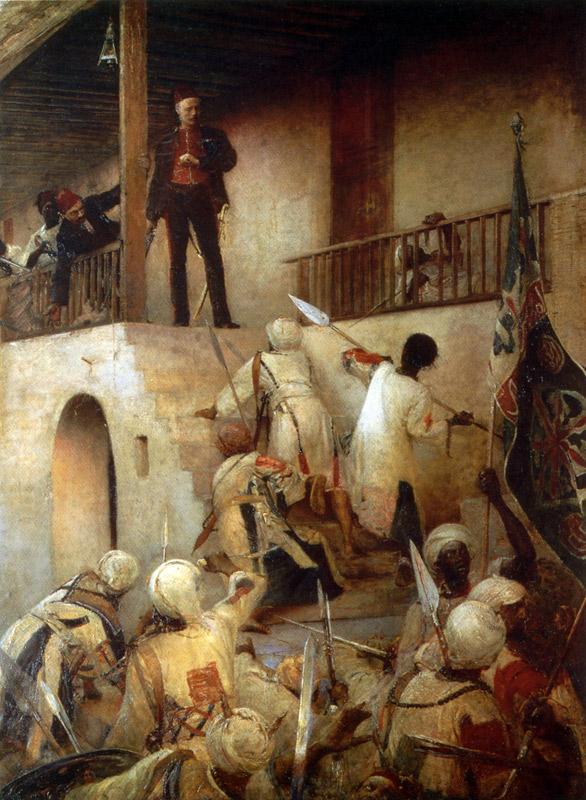
Fall of Khartoum to Mahdist forces: Siege narrative and outcome.
Sudan
Political
Military
4 min read
Updated By: History Editorial Network (HEN)
Published:
The siege and fall of Khartoum was a critical event in the conflict between Mahdist forces and the Khedivate of Egypt, subsequently impacting British colonial interests. Khartoum, the administrative center of the Egyptian Sudan held strategic and symbolic importance. Muhammad Ahmad, self-proclaimed Mahdi, led a religious and military campaign against Sudan's Egyptian rulers, seeking to establish a theocratic state based on Islamic principles.
The conflict escalated when Muhammad Ahmad’s followers, known as the Mahdists, began to capture key towns across Sudan. The Khedive of Egypt's rule was increasingly contested, leading to chaos in the region. British General Charles Gordon was appointed to oversee the defense and evacuation of Khartoum’s inhabitants. However, Gordon opted to fortify the city and make a stand against the advancing Mahdists.
As Mahdist forces laid siege to Khartoum, the city faced severe shortages of food and military supplies. The defenders, comprising Egyptian soldiers and local inhabitants, were vastly outnumbered by the Mahdist army. Despite calls for reinforcements, British military support was delayed, a subject of much controversy back in the United Kingdom. Newspapers and public opinion were fervent about Gordon's heroism, yet questioned the political and military decisions of their leaders.
Providing little relief, the siege continued unabated. After several months of encirclement, the Mahdist forces launched their final assault on Khartoum. They breache

Explore the Life Moments of
 AI Twin