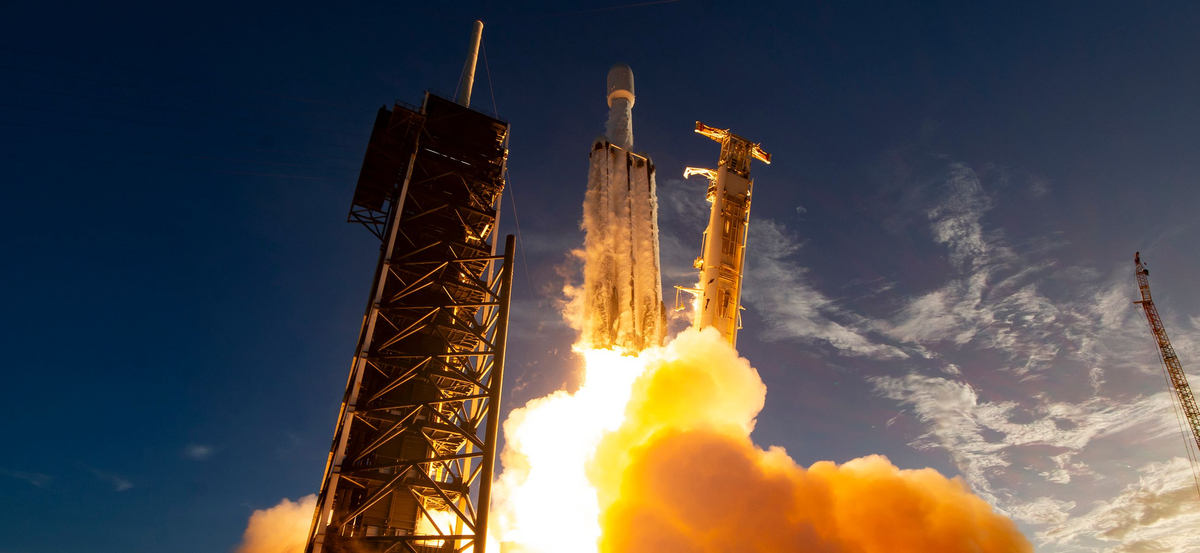
NASA’s Nancy Grace Roman Space Telescope Launches on Falcon Heavy
Launch Complex 39A, Kennedy Space Center, Florida, United States
Space
Science
8 min read
Updated By: History Editorial Network (HEN)
Published:
NASA’s Nancy Grace Roman Space Telescope successfully launched on 30/08/2026, beginning a mission to investigate dark energy, dark matter, exoplanets and the large-scale structure of the universe. The observatory lifted off at 7:26 a.m. EDT aboard a SpaceX Falcon Heavy rocket from Launch Complex 39A at NASA’s Kennedy Space Center in Florida. Ground controllers at NASA’s Goddard Space Flight Center began receiving telemetry seven minutes after launch, and Roman separated from the Falcon Heavy’s upper stage about 31 minutes after liftoff. NASA later confirmed deployment of the observatory’s solar panels and lower instrument sun shade.
Roman is now traveling approximately one million miles toward the second Sun-Earth Lagrange point, L2, with the journey and commissioning period expected to take about three months. From this region of space, the observatory will conduct wide-field infrared surveys designed to examine billions of galaxies, investigate how cosmic structure has evolved and expand the census of planets beyond the Solar System. Its field of view is at least 100 times larger than Hubble’s while providing similarly sharp imagery, allowing Roman to survey large portions of the sky efficiently. NASA describes the telescope as capable of surveying the universe about 1,000 times faster than Hubble.
The observatory’s primary science instrument is the Wide Field Instrument, an approximately 300-megapixel infrared camera containing 18 4K detectors. Roman is expected to transmit around 1.4 terabytes of data to Earth each day, which NASA says is the highest daily data rate yet for one of its astrophysics missions. During the commissioning period, teams will deploy additional hardware and calibrate and test the instruments, with the first public images anticipated in early 2027.
Roman also carries the Coronagraph Instrument, a technology demonstration designed and built by NASA’s Jet Propulsion Laboratory. Unlike the Wide Field Instrument, the coronagraph is intended primarily to demonstrate technologies for directly observing exoplanets by suppressing the overwhelming glare of their host stars. Its system combines masks, filters, detectors and flexible deformable mirrors with active wavefront sensing and control. NASA estimates that these technologies can provide an improvement of roughly 100 to 1,000 times over previous space-based coronagraphs.
The Coronagraph Instrument is designed to detect planets approximately 100 million times fainter than their host stars and demonstrate direct imaging of reflected starlight from mature, Jupiter-like worlds. Its deformable mirrors contain thousands of tiny actuators that continually adjust their surfaces to compensate for optical imperfections and other effects that scatter starlight. Masks inside the instrument further suppress diffraction, creating the extremely dark observing conditions needed to distinguish a faint planet or circumstellar disk beside a bright star.
The technology demonstration also has relevance beyond Roman itself. NASA is developing the Habitable Worlds Observatory concept as a future flagship astrophysics mission intended to directly image and characterize potentially Earth-like planets around Sun-like stars. Technologies demonstrated by Roman’s coronagraph, particularly active wavefront control and high-contrast imaging, are intended to help establish capabilities needed for such future observations.
Why This Moment Matters: Roman combines large-scale cosmic surveys with an in-space test of advanced exoplanet-imaging technology. Its launch therefore begins both a new astrophysics observing mission and a practical demonstration of techniques that NASA plans to build upon in future efforts to study smaller, more Earth-like worlds.
#NancyGraceRoman
#RomanSpaceTelescope
#NASA
#SpaceExploration
#FalconHeavy
#SpaceX
#Exoplanets
#DarkEnergy
#DarkMatter
#Astronomy

Explore the Life Moments of
 AI Twin