Longest Duration Spaceflight Achieved by Polyakov
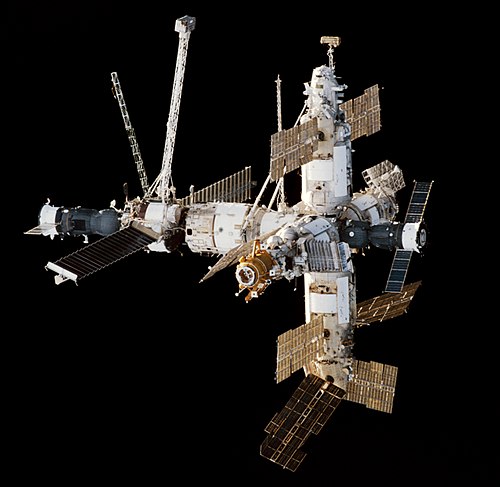
Mir Space Station / Landing in Kazakhstan
Space
Records
Astronomy
4 min read
Updated By: History Editorial Network (HEN)
Published:
Updated:
On 22/03/1995, Russian cosmonaut Valeri Polyakov returned to Earth after completing a continuous 437-day, 17-hour, and 58-minute mission aboard the Mir space station, setting the longest single spaceflight by a human. His mission began on 08/01/1994 with the launch of Soyuz TM-18 and concluded with his return aboard Soyuz TM-20.
During his time on Mir, Polyakov orbited Earth more than 7,000 times and traveled an estimated 187 million miles. A trained physician, he participated in a wide range of biomedical experiments designed to study the effects of prolonged weightlessness on the human body. His work focused on cardiovascular health, muscle atrophy, bone density loss, and psychological endurance under extended isolation and confinement in space.
Polyakov’s mission was specifically designed to simulate the duration and conditions of a potential human journey to Mars. Unlike shorter missions that relied heavily on post-flight rehabilitation, Polyakov maintained a strict exercise regimen throughout his stay to preserve his physical condition. Upon landing, he was able to exit the spacecraft with minimal assistance, demonstrating that humans could remain functional after long-duration spaceflight.
The mission provided a large dataset on human adaptation to microgravity over extended periods, contributing to planning for future deep-space missions. The findings influenced life-support strategies, exercise protocols, and crew health monitoring systems used in later programs, including the International Space Station.
Why This Moment Matters:
Polyakov’s mission offered direct evidence that humans can endure spaceflight durations comparable to interplanetary travel, supporting the feasibility of future long-distance crewed missions.
#mooflife
#MomentOfLife
#ValeriPolyakov
#LongestSpaceflight
#MirSpaceStation
#SpaceMedicine
#HumanSpaceflight
Primary Reference
Mir

Explore the Life Moments of
 AI Twin