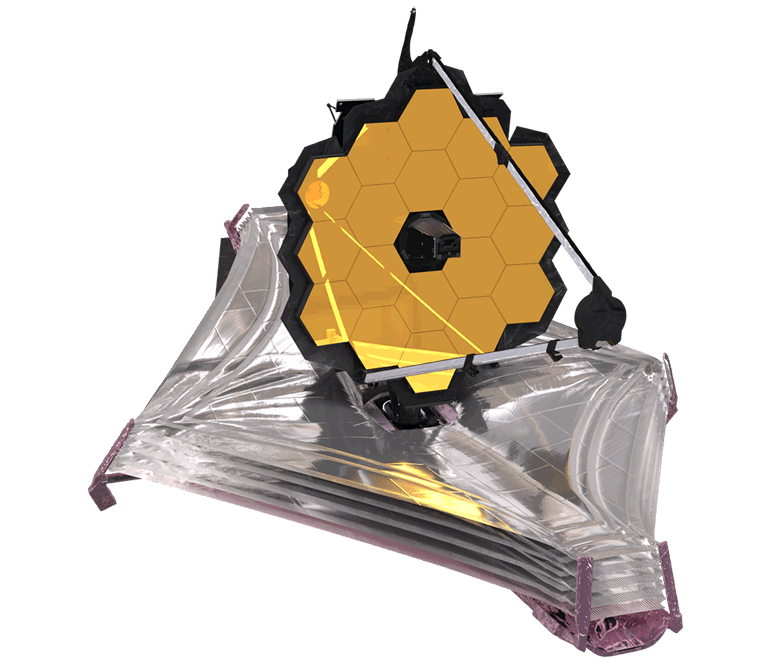
Launch of the largest space telescope to date
Guiana Space Center, Kourou, French Guiana, France
Space Exploration
Astronomy
Technology
5 min read
Updated By: History Editorial Network (HEN)
Published:
Updated:
On 25/12/2021, the James Webb Space Telescope (JWST) launched at 12:20 UTC from Europe’s Spaceport at the Guiana Space Center in Kourou, French Guiana, aboard an Ariane 5 rocket operated by Arianespace. The mission represented a joint partnership between NASA, the European Space Agency (ESA), and the Canadian Space Agency (CSA). After liftoff, the observatory separated from the rocket about 27 minutes later and began a planned journey toward the Sun Earth L2 Lagrange point, approximately 1.5 million kilometers from Earth. The launch marked the start of a carefully sequenced deployment phase designed to unfold the telescope’s mirror and sunshield during its transit.
The observatory features a 6.5 meter primary mirror composed of 18 hexagonal gold plated beryllium segments, giving it more than six times the light collecting area of the Hubble Space Telescope. Webb also carries a five layer sunshield roughly the size of a tennis court, designed to block heat from the Sun, Earth, and Moon and allow the telescope to operate at cryogenic temperatures required for infrared observations. These components were folded to fit inside the Ariane 5 fairing and gradually deployed during the weeks following launch. The mission architecture relied on the L2 orbit to maintain a stable thermal environment and continuous communication with Earth.
JWST was designed to conduct infrared astronomy with goals that include observing some of the earliest galaxies formed after the Big Bang, studying star and planet formation, and analyzing atmospheres of exoplanets. Its instrument suite includes contributions from NASA, ESA, and CSA, such as the Near Infrared Camera, Mid Infrared Instrument, Near Infrared Spectrograph, and Fine Guidance Sensor with Near Infrared Imager and Slitless Spectrograph. These instruments enable imaging and spectroscopy across a broad infrared range to detect faint distant objects and probe dust obscured regions of space.
Following launch, Webb completed a complex deployment sequence including sunshield tensioning, mirror unfolding, and instrument cooldown. The telescope reached its halo orbit around the Sun Earth L2 point on 24/01/2022, concluding the primary deployment phase and beginning months of alignment and calibration before scientific observations commenced later in 2022. The launch and deployment sequence proceeded without major anomalies, allowing the mission to move into commissioning as planned.
#mooflife
#MomentOfLife
#JamesWebbSpaceTelescope
#Nasa
#Esa
#SpaceExploration
#Astronomy
Primary Reference
James Webb Space Telescope

Explore the Life Moments of
 AI Twin