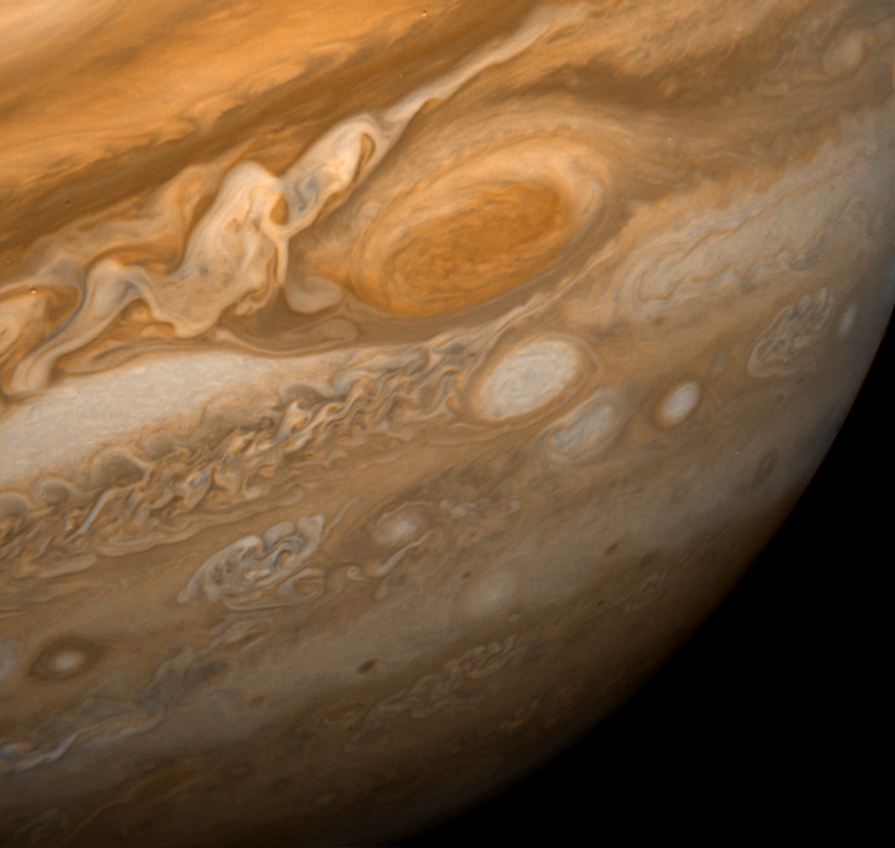
Jupiter flyby and discovery of volcanism on Io
Jupiter flyby, outer Solar System
Space Exploration
Planetary Science
Astrophysics
4 min read
Updated By: History Editorial Network (HEN)
Published:
Updated:
On 05/03/1979, NASA’s Voyager 1 spacecraft made its closest approach to Jupiter, passing within approximately 280,000 kilometers of the planet’s cloud tops and delivering detailed observations of the largest planet in the Solar System. This flyby was a central milestone in the Voyager mission, which aimed to explore the outer planets through a series of close encounters.
During the encounter, Voyager 1 transmitted high-resolution images and scientific data that revealed new details about Jupiter’s atmosphere, including complex cloud formations, powerful storms, and the structure of the Great Red Spot. The spacecraft also detected a faint ring system surrounding Jupiter, marking the first confirmation that the gas giant possesses rings, though much less prominent than those of Saturn.
One of the most significant discoveries from the flyby was made while observing Jupiter’s moon Io. Voyager 1 detected active volcanic eruptions on Io’s surface, identifying plumes rising hundreds of kilometers above the moon. This marked the first time active volcanism had been observed beyond Earth. The findings indicated that Io is geologically active due to tidal heating caused by gravitational interactions with Jupiter and neighboring moons.
Voyager 1 also conducted observations of other Galilean moons, including Europa, Ganymede, and Callisto, providing new insights into their surfaces and compositions. The mission’s data expanded understanding of planetary systems and demonstrated that moons could be dynamic worlds with ongoing geological processes.
#mooflife
#MomentOfLife
#JupiterFlyby
#Voyager1
#IoVolcanism
#Nasa
#PlanetaryExploration
Primary Reference
Voyager 1

Explore the Life Moments of
 AI Twin