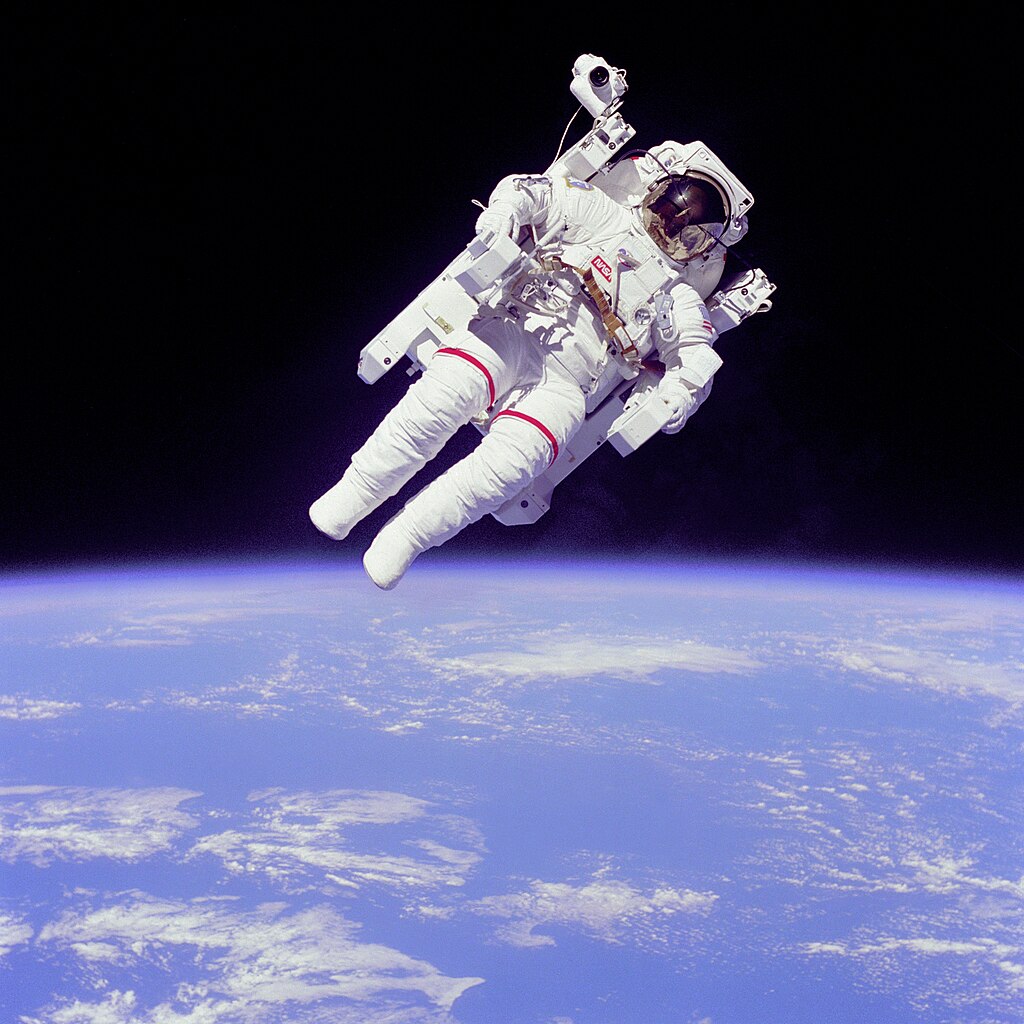
First Untethered Spacewalk by Bruce McCandless II
Low Earth Orbit, aboard Space Shuttle Challenger
Space
NASA
4 min read
Updated By: History Editorial Network (HEN)
Published:
Updated:
On 07/02/1984, NASA astronaut Bruce McCandless II carried out the first untethered spacewalk in history during the STS-41-B mission aboard the Space Shuttle Challenger. The extravehicular activity (EVA) took place in low Earth orbit and marked a new phase in human spaceflight by demonstrating that astronauts could maneuver freely outside a spacecraft without being physically connected by a safety tether.
McCandless used a propulsion device known as the Manned Maneuvering Unit (MMU), a nitrogen gas-powered backpack designed to allow controlled movement in space. During the spacewalk, he traveled up to approximately 100 meters away from the shuttle, maintaining stability and direction using hand controls on the MMU. The EVA lasted about 5 hours and 55 minutes, during which McCandless was joined by fellow astronaut Robert L. Stewart, who also tested the maneuvering unit.
The mission STS-41-B launched on 03/02/1984 and focused on satellite deployment and testing new technologies for space operations. The successful demonstration of the MMU showed that astronauts could perform tasks such as satellite retrieval, repair, and inspection without relying on tethers or robotic arms. However, despite its success, the MMU was used only on a limited number of missions before being retired, with later spacewalks relying on tether systems and other safety measures.
The images of McCandless floating freely against the backdrop of Earth became some of the most recognizable photographs of the Space Shuttle era, illustrating the capabilities and risks associated with human activity in space.
#mooflife
#MomentOfLife
#BruceMccandlessIi
#UntetheredSpacewalk
#NasaSts-41-b
#MannedManeuveringUnit
#SpaceExploration
Primary Reference
Bruce McCandless II

Explore the Life Moments of
 AI Twin