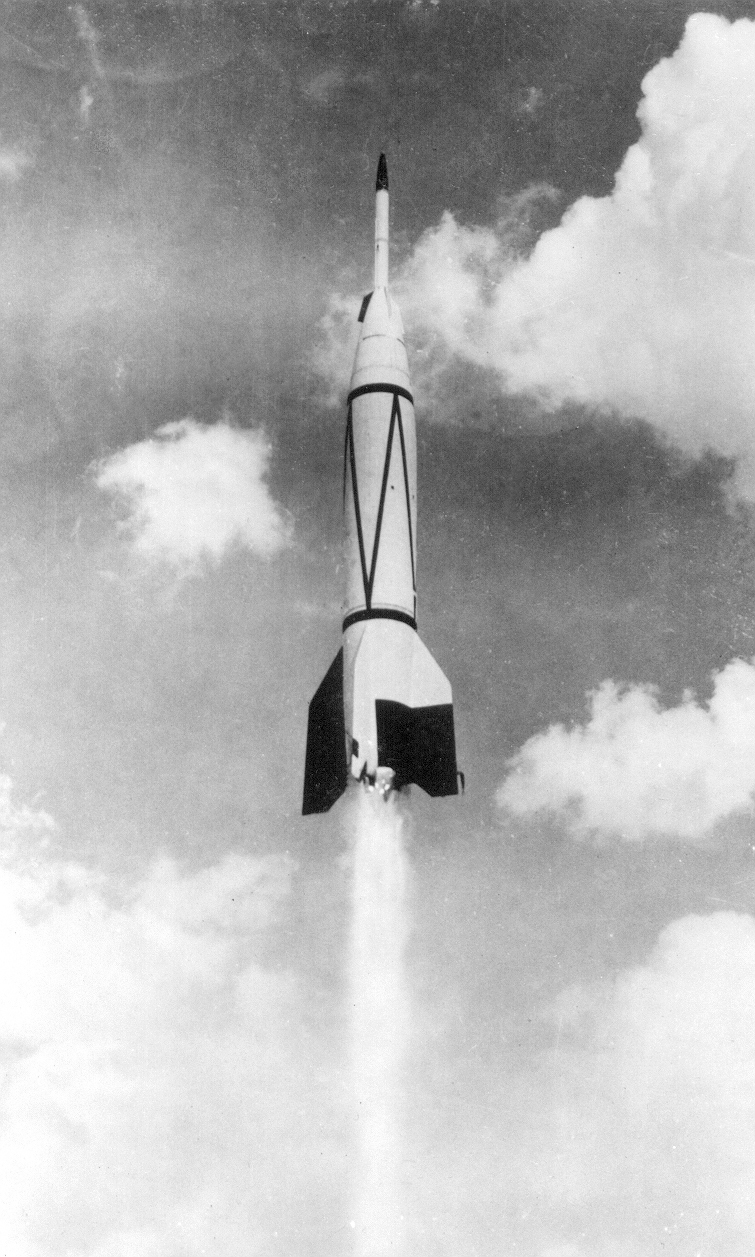
First Two-Stage Liquid-Fueled Rocket Achieves Record Altitude
United States of America
Aerospace
Technology
4 min read
Updated By: History Editorial Network (HEN)
Published:
Updated:
The development of the first two-stage liquid-fueled rocket marked a pivotal advancement in aerospace technology. The Bumper-5 rocket, which was a combination of a V-2 rocket and a WAC Corporal upper stage, achieved a record altitude of 244 miles (393 kilometers). This achievement was significant as it demonstrated the potential of liquid-fueled rockets to reach higher altitudes compared to their solid-fueled counterparts. The Bumper-5 was part of a series of tests aimed at exploring the upper atmosphere and gathering data on cosmic radiation and other atmospheric phenomena. The successful launch of Bumper-5 not only showcased the capabilities of two-stage rockets but also laid the groundwork for future developments in space exploration and satellite technology.
The impact of the Bumper-5's record altitude was profound, influencing subsequent rocket designs and missions. It provided valuable insights into the performance of liquid fuels in multi-stage configurations, which became a standard in later rocket designs. The achievement also contributed to the United States' growing interest in space exploration during the early years of the space race. As the technology evolved, it led to the development of more advanced rockets capable of reaching even greater altitudes and velocities, ultimately paving the way for human spaceflight and satellite deployment. The Bumper-5's success is a testament to the innovative spirit of the era and the relentless pursuit of knowledge beyond Earth's atmosphere.
#mooflife
#MomentOfLife
#RocketTechnology
#Liquid-fueledRockets
#SpaceExploration
#Bumper-5
#AerospaceAdvancements
Primary Reference
https://en.wikipedia.org/wiki/RTV-G-4_Bumper

Explore the Life Moments of
 AI Twin