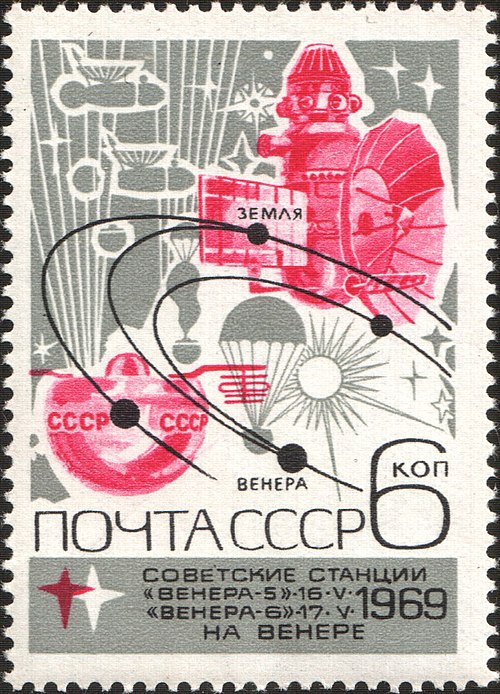
First spacecraft to parachute in Venus's atmosphere
Baikonur Cosmodrome, Kazakhstan; Earth orbit; Venus atmosphere
Space Exploration
Planetary Science
Aerospace Engineering
5 min read
Updated By: History Editorial Network (HEN)
Published:
Updated:
On 15/01/1969, the Soviet Union launched Soyuz 5, a crewed spacecraft that became part of the first successful docking between two manned vehicles in Earth orbit. The mission lifted off from the Baikonur Cosmodrome with cosmonaut Boris Volynov aboard. One day later, on 16/01/1969, Soyuz 5 docked with Soyuz 4, which had been launched on 14/01/1969 carrying Vladimir Shatalov. The docking allowed for the transfer of crew members Yevgeny Khrunov and Aleksei Yeliseyev via spacewalk from Soyuz 5 to Soyuz 4, marking the first time humans moved between spacecraft in orbit. This operation tested procedures that would later be used in space station missions.
Soyuz 5’s return to Earth on 18/01/1969 involved a critical malfunction during reentry when the service module failed to separate properly. The spacecraft entered the atmosphere in an incorrect orientation, subjecting Volynov to intense forces and heat before the modules eventually separated. Despite a rough landing in Kazakhstan, Volynov survived without fatal injury, and the mission provided valuable data on spacecraft docking and emergency reentry conditions.
Earlier in the same month, on 05/01/1969, the Soviet Union had launched Venera 5 as part of its planetary exploration program targeting Venus. The spacecraft was designed to study the planet’s atmosphere and was equipped with instruments to measure pressure, temperature, and chemical composition. After a journey of several months, Venera 5 entered the atmosphere of Venus on 16/05/1969, transmitting data for approximately 53 minutes before being destroyed by the extreme conditions. The probe recorded atmospheric pressures up to about 27 atmospheres and temperatures around 320°C, contributing to a clearer understanding of Venus’s harsh environment.
These missions illustrate the Soviet Union’s simultaneous focus on both crewed orbital operations and interplanetary exploration during the late 1960s, with Soyuz 5 advancing human spaceflight techniques and Venera 5 expanding knowledge of conditions on Venus.
#mooflife
#MomentOfLife
#Venera5
#VenusExploration
#SpacecraftHistory
#UssrSpaceProgram
#PlanetaryScience
Primary Reference
Venera 5

Explore the Life Moments of
 AI Twin