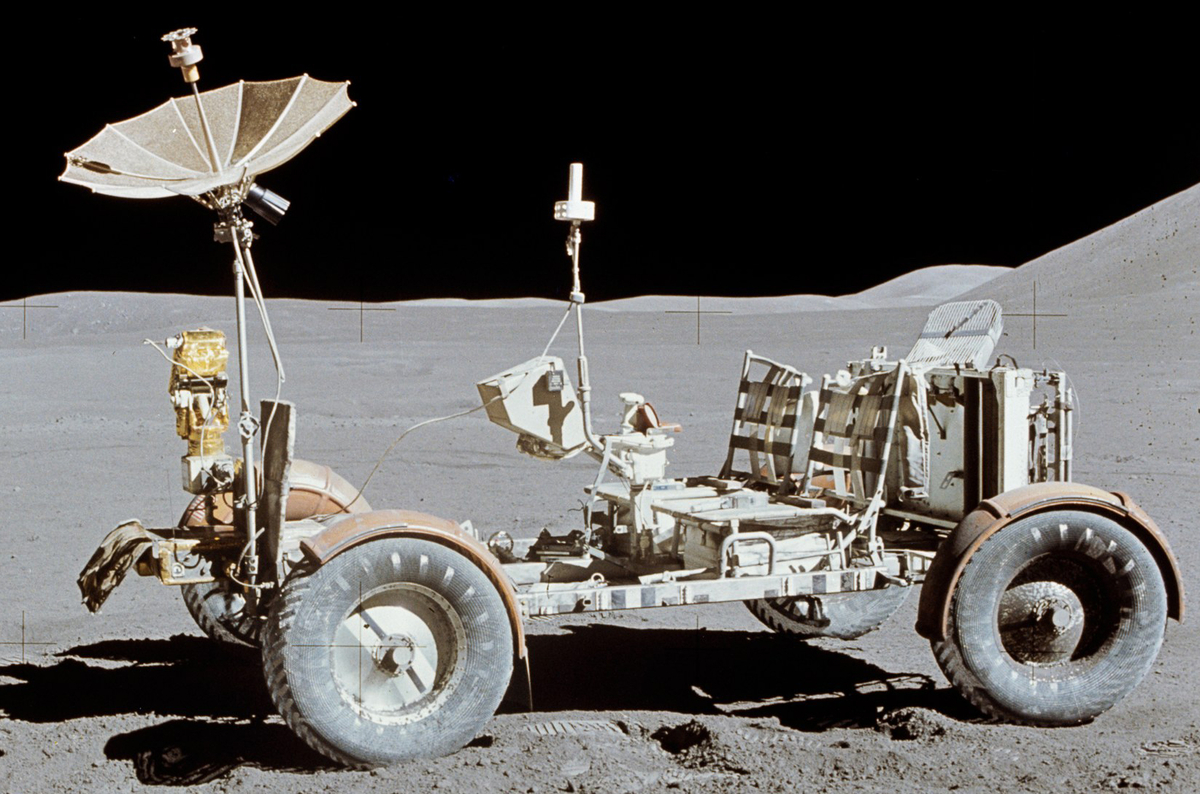
The Apollo 15 mission
Kennedy Space Center, Florida, USA; Hadley–Apennine region, Moon
Space Exploration
Lunar Missions
Automotive Technology
4 min read
Updated By: History Editorial Network (HEN)
Published:
Updated:
On 26/07/1971, NASA launched Apollo 15 from Kennedy Space Center in Florida, marking the beginning of the fourth crewed mission to land on the Moon and the first of the program’s more science-focused expeditions. The mission introduced new technologies and objectives aimed at expanding the scope of lunar exploration beyond earlier landings.
The crew consisted of Commander David R. Scott, Command Module Pilot Alfred M. Worden, and Lunar Module Pilot James B. Irwin. After reaching lunar orbit, Scott and Irwin descended to the Moon’s surface in the Hadley–Apennine region on 30/07/1971, an area selected for its geological diversity. Meanwhile, Worden remained in lunar orbit aboard the command module, conducting scientific observations.
Apollo 15 was the first mission to use the Lunar Roving Vehicle (LRV), allowing astronauts to travel greater distances across the Moon’s surface than on previous missions. Over three extravehicular activities (EVAs), Scott and Irwin collected approximately 77 kilograms of lunar samples and conducted experiments to study the Moon’s composition and geological history. One of the notable findings was the “Genesis Rock,” a sample believed to be part of the Moon’s early crust.
The mission also carried a suite of scientific instruments in the command module, known as the Scientific Instrument Module (SIM), which gathered data on the Moon’s surface, magnetic field, and subsurface structure. Apollo 15 concluded with a successful return to Earth on 07/08/1971.
#mooflife
#MomentOfLife
#Apollo15
#LunarRovingVehicle
#Nasa
#SpaceExploration
#CelestialBodies
Primary Reference

Explore the Life Moments of
 AI Twin