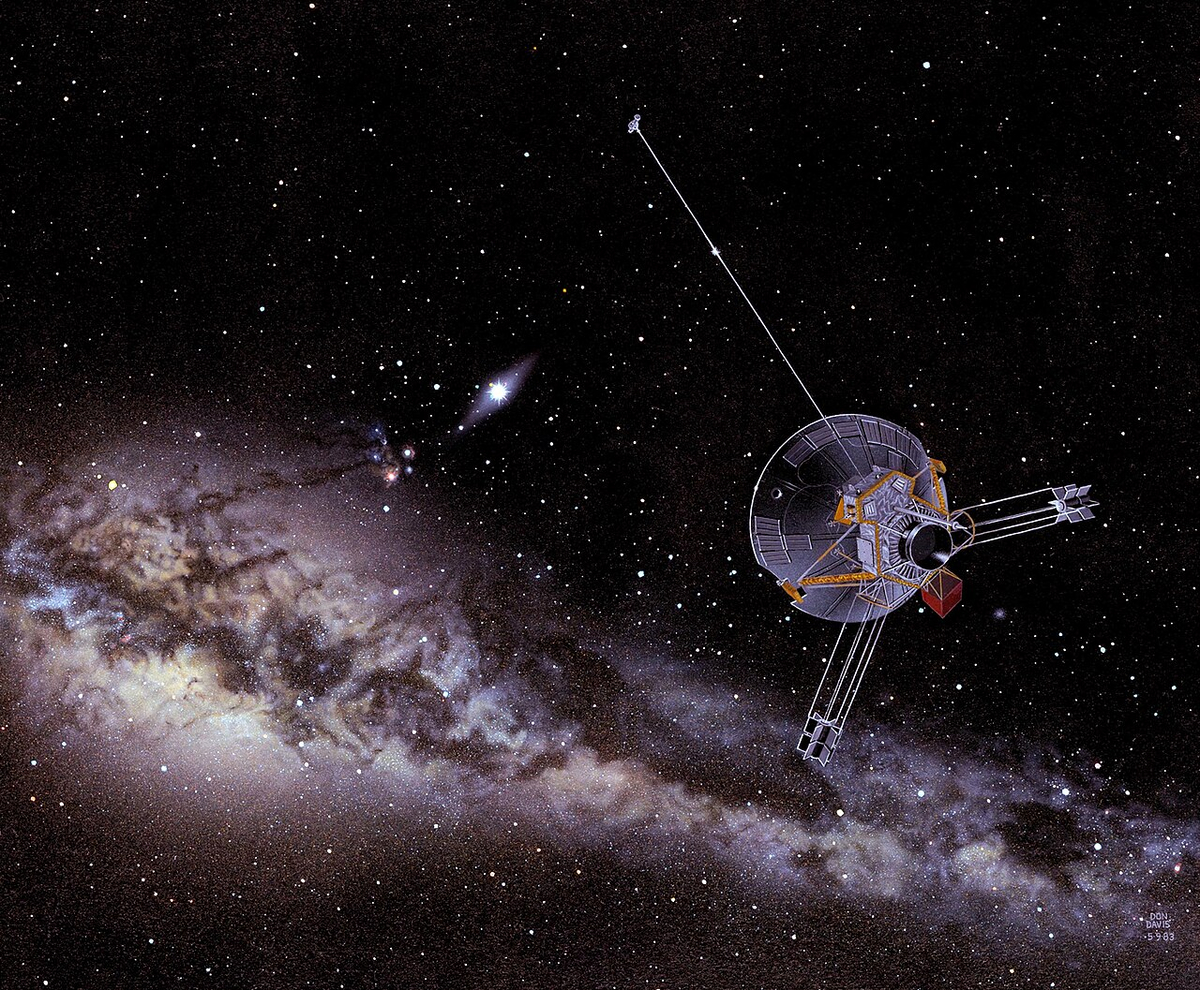
First Spacecraft Beyond Neptune's Orbit
Beyond Neptune’s orbit, outer Solar System
Space Exploration
NASA
Astronomy
4 min read
Updated By: History Editorial Network (HEN)
Published:
Updated:
On 13/06/1983, NASA’s Pioneer 10 spacecraft became the first human-made object to pass beyond the orbit of Neptune, marking its departure from the region of the Solar System occupied by the major planets. Launched on 02/03/1972, Pioneer 10 had already achieved several milestones, including becoming the first spacecraft to travel through the asteroid belt and the first to conduct a close flyby of Jupiter in December 1973.
By mid-1983, Pioneer 10 had traveled billions of kilometers from Earth, moving on a trajectory that would carry it out of the planetary region of the Solar System. Crossing Neptune’s orbital distance represented a clear transition into deep space, beyond the outermost major planet. At this stage of its mission, the spacecraft continued to transmit scientific data about cosmic rays, solar wind, and interstellar conditions, contributing to the study of the space environment far from the Sun.
Pioneer 10 was equipped with instruments designed to measure charged particles, magnetic fields, and radiation levels, providing insight into how the influence of the Sun changes with distance. It also carried a gold-anodized plaque designed to communicate basic information about humanity and Earth’s location, intended for any potential future encounter with extraterrestrial intelligence.
The spacecraft remained in communication with Earth until 2003, long after its primary mission objectives had been completed. Its journey beyond Neptune’s orbit marked one of the earliest steps in humanity’s exploration of interstellar space, demonstrating that spacecraft could operate far beyond the boundaries of the known planetary system.
#mooflife
#MomentOfLife
#Pioneer10
#Nasa
#SpaceExploration
#Neptune
#InterstellarSpace
Primary Reference
Pioneer 10

Explore the Life Moments of
 AI Twin