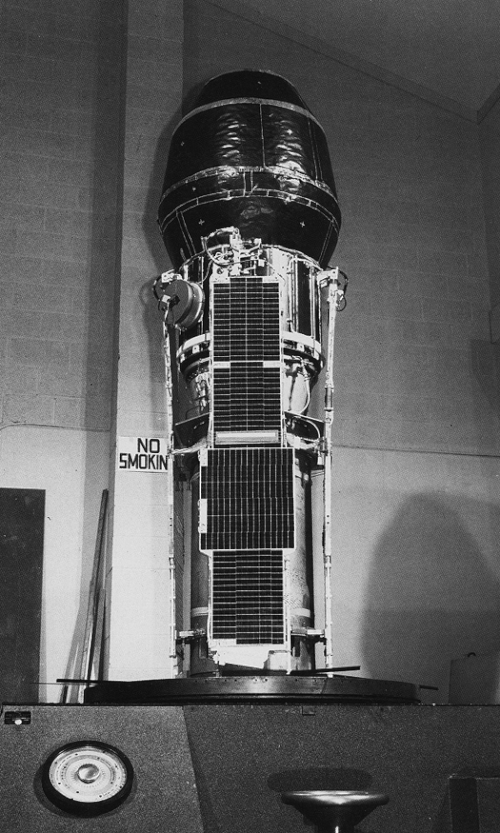
First orbital gamma ray observatory
Low Earth Orbit
Space Exploration
Astrophysics
Satellite Technology
4 min read
Updated By: History Editorial Network (HEN)
Published:
Updated:
On 15/11/1972, NASA launched the Small Astronomy Satellite 2 (SAS-2), also known as Explorer 48, marking the first dedicated mission designed to observe the universe in gamma rays. The spacecraft was launched into low Earth orbit to study high-energy radiation that cannot penetrate Earth’s atmosphere, making space-based observation essential.
SAS-2 was equipped with instruments specifically designed to detect and measure gamma rays, the most energetic form of electromagnetic radiation. Over the course of its mission, which lasted until June 1973, the satellite conducted the first detailed survey of the gamma-ray sky. It identified regions of intense gamma-ray emission, particularly along the plane of the Milky Way, providing early evidence that high-energy processes were occurring throughout the galaxy.
The mission also detected discrete gamma-ray sources and helped establish methods for mapping and analyzing these emissions. These observations contributed to the understanding of cosmic phenomena such as supernova remnants, pulsars, and interactions between cosmic rays and interstellar matter. Although SAS-2 operated for only about seven months, it significantly expanded knowledge of the high-energy universe.
SAS-2 demonstrated the importance of gamma-ray astronomy and laid the groundwork for future missions, including more advanced space observatories designed to study cosmic radiation across a wider range of energies. Its success marked the beginning of systematic exploration of the universe using gamma-ray detection from orbit.
Why This Moment Matters
SAS-2 initiated gamma-ray astronomy from space, enabling the study of high-energy cosmic processes that are invisible to traditional telescopes.
#mooflife
#MomentOfLife
#GammaRayObservatory
#NasaSas2
#Astrophysics
#SpaceScience
#High-energyAstronomy
Primary Reference
Small Astronomy Satellite 2

Explore the Life Moments of
 AI Twin