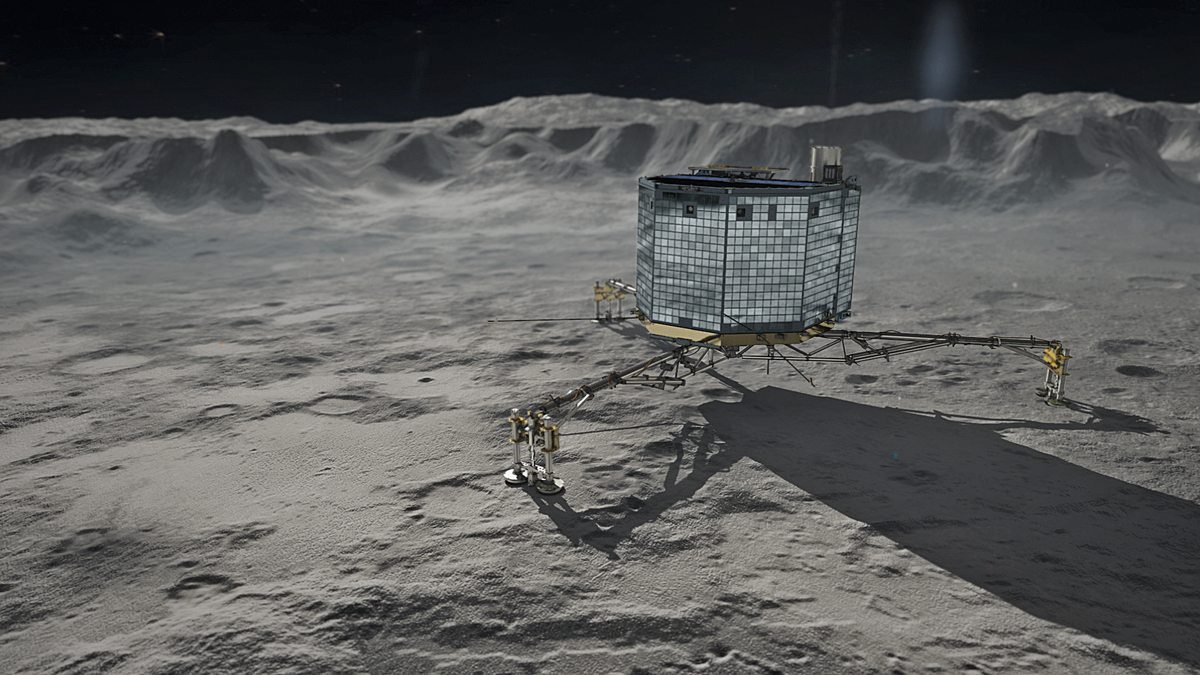
First soft landing on a comet
Comet 67P/Churyumov–Gerasimenko
Space Exploration
Astrophysics
Cometary Science
4 min read
Updated By: History Editorial Network (HEN)
Published:
Updated:
On 12/11/2014, the European Space Agency’s Philae lander made the first soft landing on the surface of a comet when it touched down on comet 67P/Churyumov–Gerasimenko. The landing was part of ESA’s Rosetta mission, which launched in March 2004 and arrived at the comet in August 2014 after a ten year journey through the inner solar system. Philae separated from the Rosetta orbiter at 08:35 UTC and began a passive descent lasting about seven hours toward the comet’s surface. The target body, 67P/Churyumov–Gerasimenko, is a bilobed comet often described as having a rubber duck shape.
Philae first contacted the surface at approximately 15:34 UTC, but its anchoring harpoons failed to fire and the hold down thruster did not activate. Because the comet’s gravity is extremely weak, the lander rebounded from the surface and drifted for nearly two hours before touching down again. A second bounce followed before the spacecraft finally came to rest at 17:31 UTC. The final landing site, later named Abydos, was located in a shadowed region where the lander rested in a tilted position near surrounding terrain features.
Despite the unstable landing, Philae transmitted images and scientific measurements from the comet’s surface. The lander operated on battery power for about 60 hours, performing experiments that analyzed surface composition, mechanical properties, and local environment. Limited sunlight at the final resting location prevented long term operations, causing the lander to enter hibernation after its primary battery was depleted. The data returned provided the first in situ measurements from a comet nucleus and complemented observations from the Rosetta orbiter.
#mooflife
#MomentOfLife
#CometLanding
#Philae
#Esa
#SpaceExploration
#RosettaMission
Primary Reference
Philae (spacecraft)

Explore the Life Moments of
 AI Twin