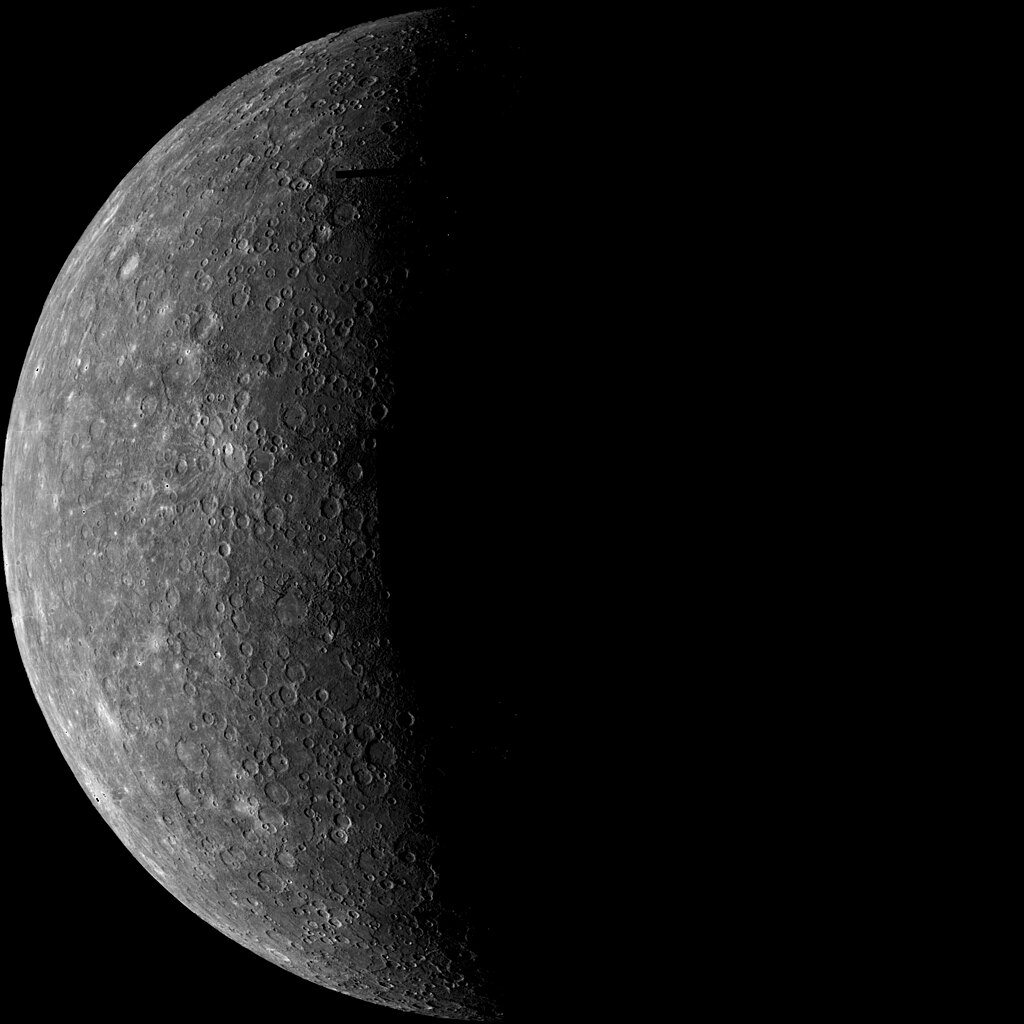
First Flyby of Mercury by Mariner 10
Mercury flyby, inner Solar System
Space Exploration
NASA
Mariner 10
4 min read
Updated By: History Editorial Network (HEN)
Published:
Updated:
On 29/03/1974, NASA’s Mariner 10 spacecraft became the first human-made probe to reach Mercury, carrying out the first close flyby of the innermost planet in the Solar System. Launched on 03/11/1973, the mission used a gravity-assist maneuver at Venus in February 1974 to redirect its trajectory toward Mercury, demonstrating a new navigation technique for interplanetary travel.
During its closest approach, Mariner 10 passed within approximately 703 kilometers of Mercury’s surface and transmitted the first detailed images of the planet. Prior to this encounter, Mercury had been difficult to observe from Earth due to its proximity to the Sun. The spacecraft revealed a heavily cratered surface resembling that of the Moon, along with large impact basins such as the Caloris Basin, one of the largest known impact structures in the Solar System.
The mission also discovered that Mercury possesses a global magnetic field, an unexpected finding for a planet of its size. Instruments onboard measured surface temperatures and analyzed the planet’s thin atmosphere, or exosphere, composed of trace elements such as helium. These observations provided new insights into Mercury’s internal structure and its interaction with the solar wind.
Mariner 10’s first flyby marked the beginning of direct exploration of Mercury and laid the groundwork for future missions. The spacecraft would go on to perform two additional flybys in 1974 and 1975, allowing scientists to study the planet from multiple perspectives and over time.
#mooflife
#MomentOfLife
#Mariner10
#MercuryFlyby
#Nasa
#SpaceExploration
#PlanetaryScience
Primary Reference
Mariner 10

Explore the Life Moments of
 AI Twin