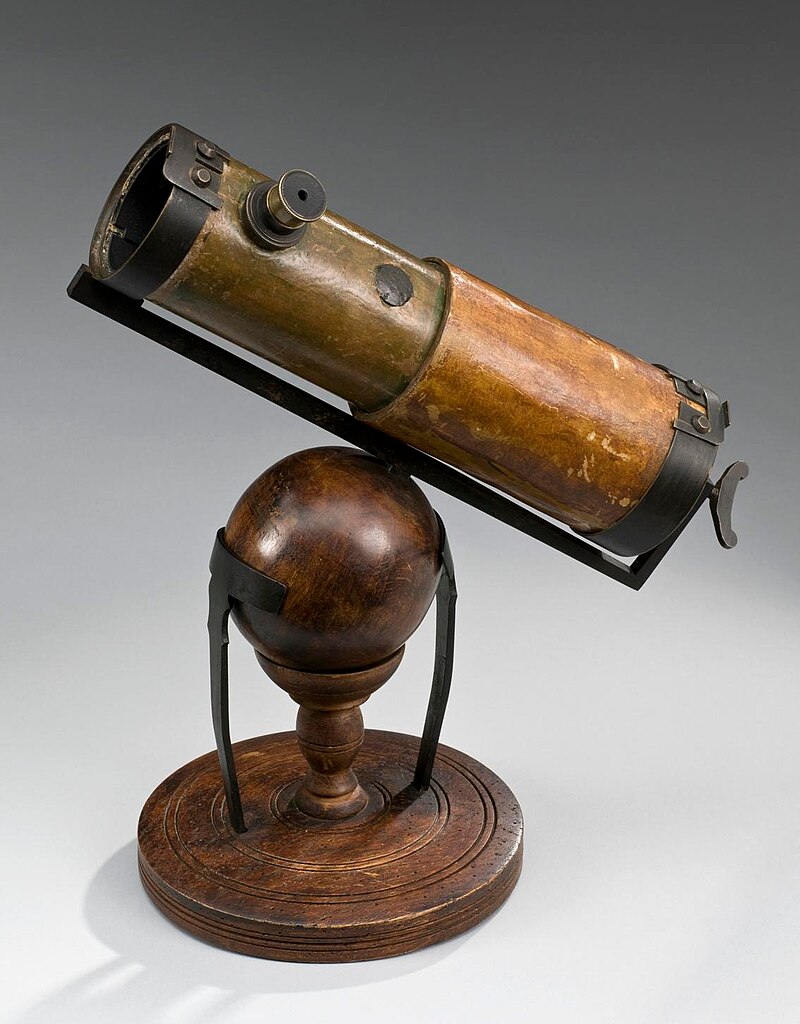
First Reflecting Telescope by Isaac Newton
Cambridge, United Kingdom
Science
Astronomy
4 min read
Updated By: History Editorial Network (HEN)
Published:
Updated:
In 1668, Isaac Newton constructed the first practical reflecting telescope, introducing a new design that addressed major limitations of existing optical instruments. At the time, refracting telescopes relied on glass lenses, which produced chromatic aberration, a distortion that caused colored fringes and blurred images because different wavelengths of light did not focus at the same point.
Newton’s solution was to replace the primary lens with a curved mirror made from speculum metal, an alloy of copper and tin. Unlike lenses, mirrors reflect all wavelengths of light uniformly, eliminating the color distortion inherent in refractors. His design, later known as the Newtonian reflector, used a concave primary mirror to collect and focus light, along with a small flat diagonal mirror positioned at an angle to redirect the image to an eyepiece on the side of the telescope.
The first working model built by Newton was compact, measuring about 15 centimeters (6 inches) in length, yet it achieved magnification of up to 40 times. Despite its small size, it performed comparably to much longer refracting telescopes of the period, demonstrating the efficiency of the reflective design. In 1671, Newton presented an improved version of this telescope to the Royal Society in London, where it attracted significant attention and helped establish his reputation in the scientific community.
Newton’s reflecting telescope provided a practical solution to optical limitations and influenced the future development of astronomical instruments. The fundamental principles of his design remain in use in modern telescopes, including large ground-based observatories and space telescopes that rely on mirrors for high-resolution imaging.
#mooflife
#MomentOfLife
#IsaacNewton
#ReflectingTelescope
#Astronomy
#TelescopeTechnology
#ScientificInnovation
Primary Reference
Newton’s Reflecting Telescope

Explore the Life Moments of
 AI Twin