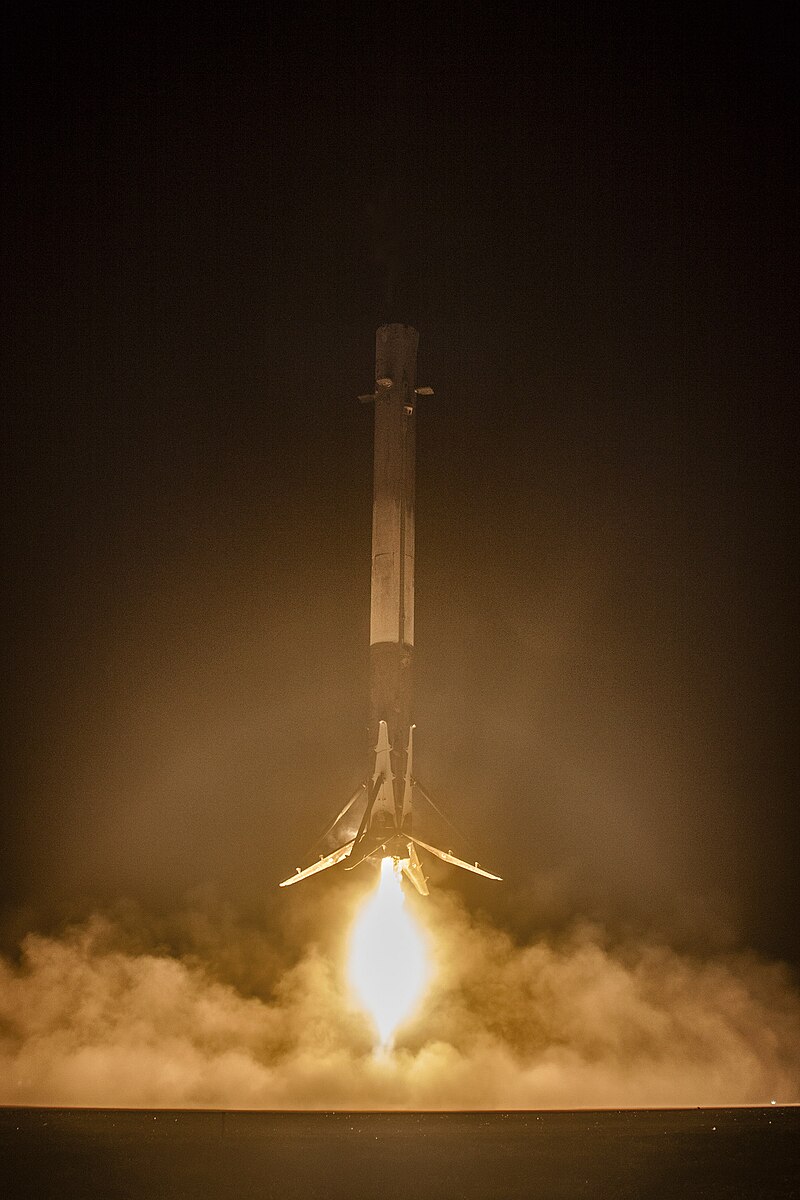
First propulsive landing of an orbital rocket
Landing Zone 1, Cape Canaveral, Florida, United States
Aerospace
Space Exploration
Rocket Technology
4 min read
Updated By: History Editorial Network (HEN)
Published:
Updated:
On 21/12/2015, SpaceX successfully performed the first propulsive vertical landing of an orbital class rocket booster during the Orbcomm OG2 Mission 2. The Falcon 9 Full Thrust rocket lifted off at 8:29 p.m. EST from Cape Canaveral Air Force Station in Florida, carrying 11 ORBCOMM communications satellites into low Earth orbit. After stage separation and payload deployment, the first stage booster, designated B1019, executed a controlled return to Earth. Approximately ten minutes after launch, the booster touched down upright at Landing Zone 1, a former missile testing site at Cape Canaveral.
The landing sequence involved a boostback burn to reverse course, followed by atmospheric reentry using grid fins for guidance and a final landing burn using a single Merlin engine. The Falcon 9 first stage deployed landing legs shortly before touchdown and landed vertically on the prepared concrete pad. This marked the first time an orbital class rocket booster had returned intact after delivering payloads to orbit. Previous attempts earlier in 2015 had targeted drone ship landings but ended in hard landings or tip overs.
The mission used the upgraded Falcon 9 Full Thrust version, which featured densified propellants, improved engines, and increased performance. These enhancements provided enough margin to allow the booster to reserve fuel for the return and landing sequence. The recovered booster B1019 demonstrated that large rocket stages could be reused, supporting SpaceX’s long term goal of reducing launch costs through reusability.
Following the landing, the booster was secured and later inspected to evaluate structural integrity and refurbishment requirements. The successful recovery on 21/12/2015 became a key demonstration of reusable launch vehicle technology and was followed by additional landings on both ground pads and autonomous drone ships in subsequent missions.
#mooflife
#MomentOfLife
#Spacex
#Falcon9
#PropulsiveLanding
#OrbitalRocket
#ReusableRockets
Primary Reference
Falcon 9 flight 20

Explore the Life Moments of
 AI Twin