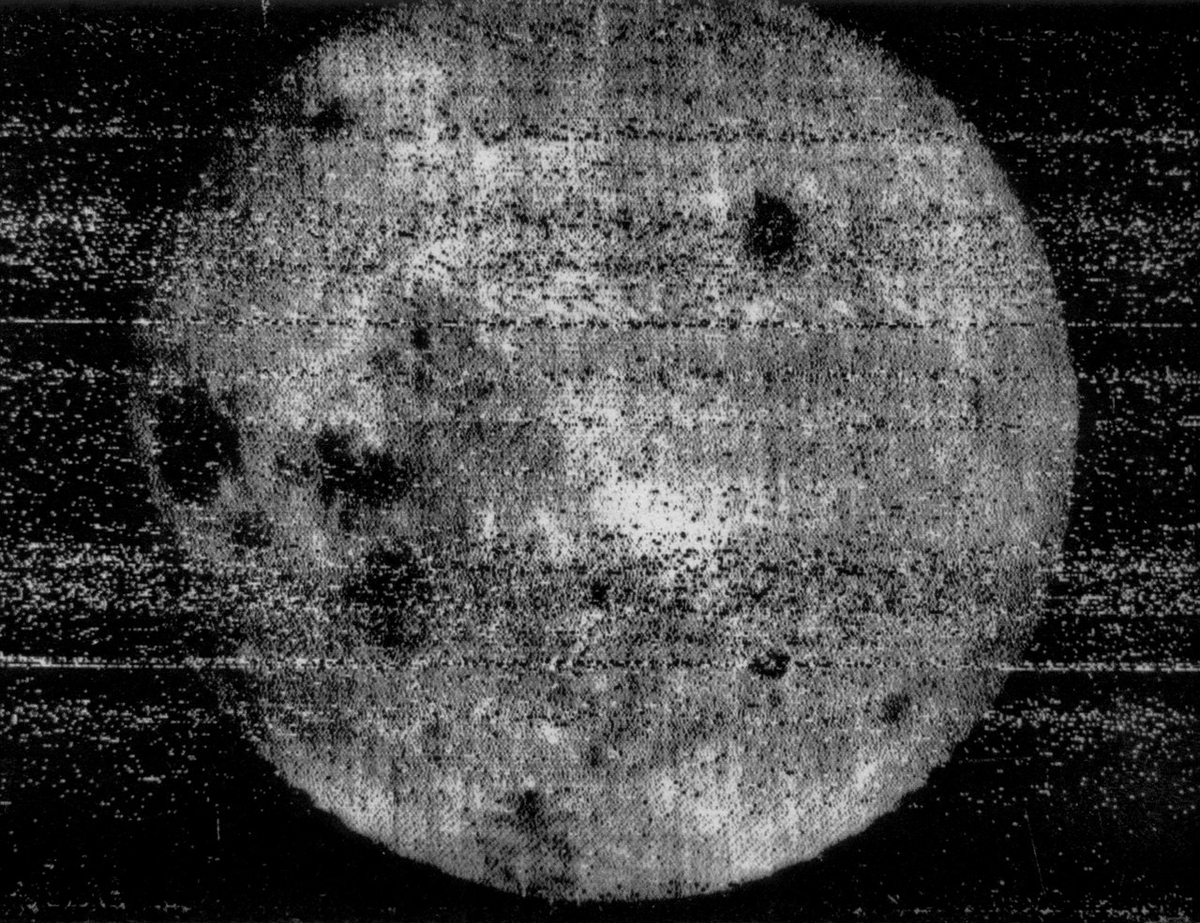
First photos of the Moon's far side
Baikonur Cosmodrome, Kazakhstan (launch); Lunar orbit and far side of the Moon
Space Exploration
Lunar Missions
Historical Achievements
4 min read
Updated By: History Editorial Network (HEN)
Published:
Updated:
On 04/10/1959, the Soviet Union launched Luna 3, also known as Lunik 3, marking a key development in early space exploration as it became the first spacecraft to photograph the far side of the Moon. The mission was conducted under the Soviet space program during the height of the Cold War-era space race. Luna 3 was launched from the Baikonur Cosmodrome aboard a Vostok-L rocket, with the primary objective of capturing images of the Moon’s hemisphere that is permanently turned away from Earth due to tidal locking.
During its flight, Luna 3 passed behind the Moon on 07/10/1959 at a distance of approximately 6,200 kilometers from the lunar surface. Equipped with a dual-lens camera system, the spacecraft captured 29 photographs of the far side. These images were developed onboard using an automated chemical process and then scanned and transmitted back to Earth via radio signals between 08/10/1959 and 18/10/1959. Although the image quality was relatively low by modern standards, they revealed a surface markedly different from the near side, with fewer large maria and a more rugged terrain.
The data returned by Luna 3 allowed Soviet scientists to produce the first atlas of the Moon’s far side and led to the naming of several newly observed features, including Mare Moscoviense and Tsiolkovskiy crater. The mission demonstrated the feasibility of deep-space imaging and communication, laying groundwork for future lunar and planetary exploration missions by both the Soviet Union and other spacefaring nations.
#mooflife
#MomentOfLife
#Luna3
#MoonExploration
#SpacePhotography
#GravityAssist
#SovietSpaceProgram
Primary Reference
Luna 3

Explore the Life Moments of
 AI Twin