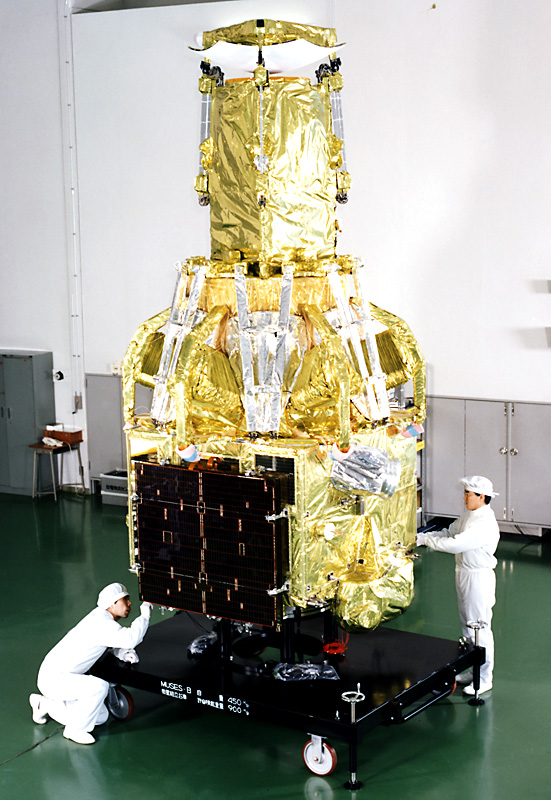
First Orbital Radio Observatory Launched by Japan
Uchinoura Space Center, Japan
Space
Technology
Astronomy
4 min read
Updated By: History Editorial Network (HEN)
Published:
Updated:
On 12/02/1997 at 04:50 UTC, Japan successfully launched HALCA (Highly Advanced Laboratory for Communications and Astronomy), the world’s first dedicated orbital radio observatory for Very Long Baseline Interferometry (VLBI). The spacecraft was launched from the Uchinoura Space Center, then known as Kagoshima Space Center, aboard the maiden flight of the M-V solid-fuel rocket.
HALCA was part of the VLBI Space Observatory Programme (VSOP) and was also known by other names, including MUSES-B and Haruka, a Japanese word meaning “far away.” The mission extended radio astronomy observations beyond Earth by combining signals from the space-based antenna with those from ground-based radio telescopes. This technique significantly increased the effective baseline distance between instruments, allowing for much higher angular resolution in observations of distant cosmic radio sources.
The spacecraft’s primary instrument was an 8-meter diameter deployable wire-mesh antenna, designed to observe radio emissions from astronomical objects such as quasars, active galactic nuclei, and other high-energy phenomena. By operating in conjunction with global networks of radio telescopes, HALCA enabled astronomers to study fine structural details that could not be resolved using Earth-based arrays alone.
The mission marked a step forward in international radio astronomy collaboration and demonstrated the feasibility of space-based VLBI systems. HALCA operated for several years, contributing observational data that supported studies of compact radio sources and the structure of distant galaxies.
Why This Moment Matters:
HALCA expanded the scale of interferometry into space, enabling sharper observations of distant astronomical objects and laying the groundwork for future space-based radio astronomy missions.
#mooflife
#MomentOfLife
#Halca
#Japan
#OrbitalRadioObservatory
#Isas
#SpaceExploration
Primary Reference
HALCA

Explore the Life Moments of
 AI Twin