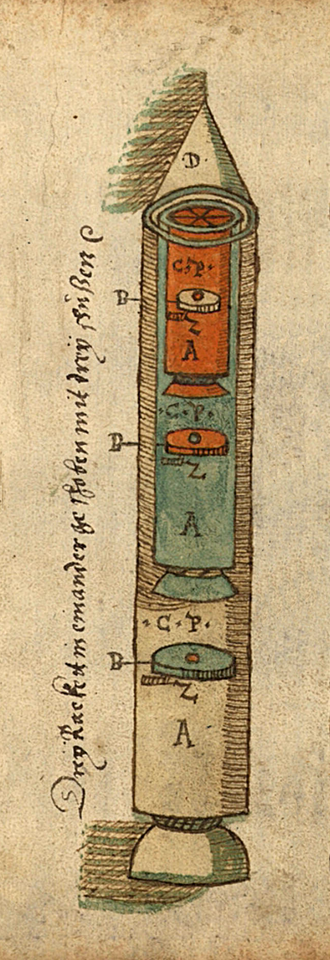
First exposition of the rocket equation
United Kingdom
Physics
Aerospace Engineering
History of Science
3 min read
Updated By: History Editorial Network (HEN)
Published:
Updated:
In 1813, British mathematician William Moore published A Treatise on the Motion of Rockets, presenting one of the earliest formal mathematical analyses of rocket propulsion. At a time when rockets were primarily used for military and signaling purposes, Moore’s work aimed to explain their motion using the principles of physics and mathematics rather than empirical observation alone.
The treatise examined how forces act on a rocket during flight, including the effects of thrust, gravity, and air resistance. Moore applied Newtonian mechanics to describe the trajectory of rockets, offering equations and theoretical frameworks to predict their motion. This approach marked a departure from earlier practices, where rocket performance was largely based on trial and error rather than systematic calculation.
Moore’s work contributed to the gradual development of rocketry as a scientific discipline. By introducing mathematical modeling into the study of rocket behavior, the treatise provided a foundation for later researchers who expanded on propulsion theory in the 19th and 20th centuries. Although practical advancements in rocket technology would not accelerate significantly until much later, Moore’s publication represents an early step toward understanding controlled flight beyond the atmosphere.
#mooflife
#MomentOfLife
#RocketEquation
#WilliamMoore
#Newton'sThirdLaw
#SpaceExploration
#AerospaceEngineering
Primary Reference
Early rockets in the Russian Empire

Explore the Life Moments of
 AI Twin