First confirmed quake on another planet
Elysium Planitia, Mars
Space Exploration
Planetary Science
Seismology
5 min read
Updated By: History Editorial Network (HEN)
Published:
Updated:
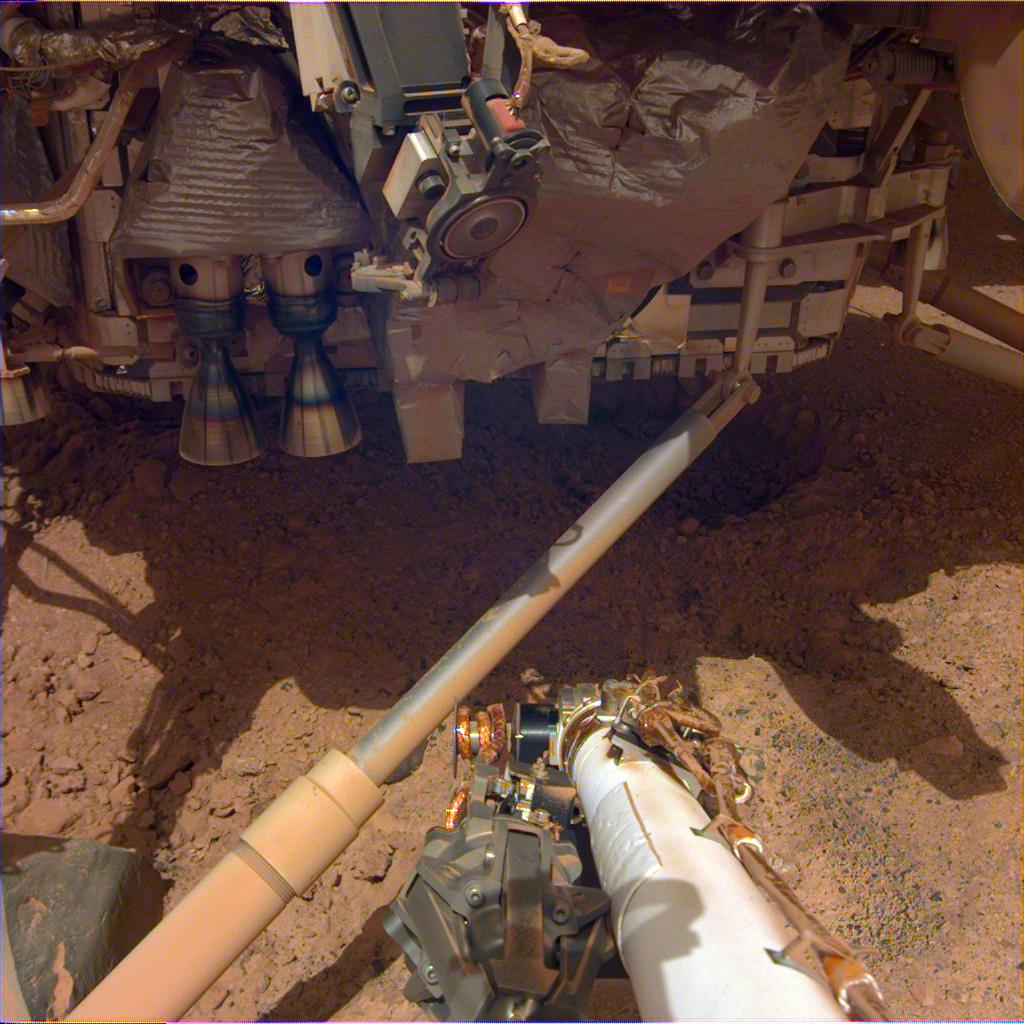
On 06/04/2019, NASA’s InSight lander recorded the first likely seismic event on Mars, marking the first time a quake signal was detected on the surface of another planet. The signal was measured by InSight’s Seismic Experiment for Interior Structure (SEIS), a highly sensitive seismometer placed directly on the Martian surface after the lander’s arrival at Elysium Planitia in November 2018. The recorded vibration was faint and brief, but its characteristics matched expectations for a marsquake rather than wind or lander related activity. NASA scientists later confirmed that the signal originated from within the planet, providing the first direct evidence of ongoing seismic activity on Mars.
The detection allowed researchers to begin studying Mars’s internal structure using seismic waves, similar to how earthquakes are used to analyze Earth’s interior. By measuring how seismic signals travel through the crust, mantle, and core, scientists can estimate layer thickness and composition. The 06/04/2019 event was followed by additional detections, enabling researchers to build a growing catalog of marsquakes. These measurements helped determine that Mars is seismically active, though at lower levels than Earth, and provided constraints on crustal thickness and mantle properties.
On 06/04/2021, NASA announced the detection of two stronger marsquakes previously recorded by InSight in the Cerberus Fossae region. These events had magnitudes of approximately 3.3 and 3.1 and were among the most powerful seismic signals observed on Mars at the time. The Cerberus Fossae area, located about 1,600 kilometers from the lander, emerged as a key source of seismic activity. The stronger signals provided clearer data on wave propagation, improving understanding of the Martian interior and confirming that the region remains geologically active.
The InSight mission’s seismic observations marked the first sustained effort to study another planet’s interior using seismology. The detection of marsquakes, beginning with the 06/04/2019 event, established that Mars continues to experience internal geological processes and provided data for modeling its crust, mantle, and core.
#mooflife
#MomentOfLife
#Marsquake
#NasaInsight
#PlanetaryScience
#SeismicActivity
#SpaceExploration
Primary Reference
InSight

Explore the Life Moments of
 AI Twin