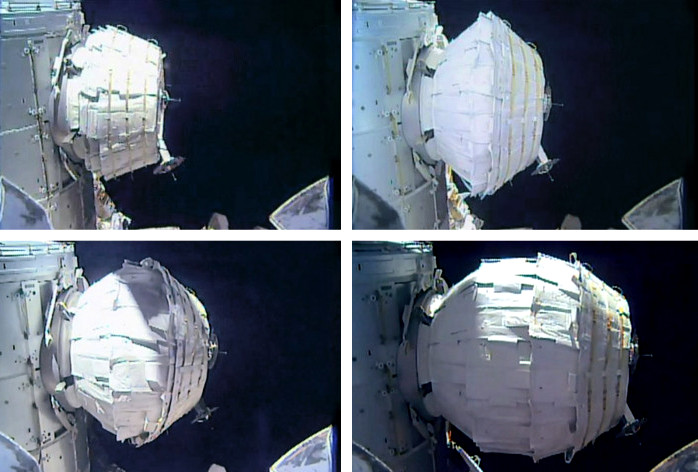
BEAM attached to the ISS
International Space Station, Low Earth Orbit
Space Habitats
Space Technology
International Space Station
5 min read
Updated By: History Editorial Network (HEN)
Published:
Updated:
On 16/04/2016, the Bigelow Expandable Activity Module (BEAM) was successfully attached to the International Space Station, marking the first time a human rated expandable habitat was installed on a crewed spacecraft. The module was delivered to orbit aboard SpaceX’s CRS-8 Dragon cargo mission, which launched on 08/04/2016 and arrived at the station on 10/04/2016. On installation day, ground controllers at NASA’s Johnson Space Center used the Canadarm2 robotic arm to extract BEAM from Dragon’s unpressurized trunk and maneuver it into position. The module was then berthed to the aft port of the Tranquility node, also known as Node 3, with the operation concluding at approximately 5:36 a.m. EDT after about four hours.
Following attachment, teams prepared the module for expansion. An initial inflation attempt on 26/05/2016 was halted after the structure did not expand as expected. A second attempt on 28/05/2016 successfully expanded the module to its full size and allowed it to be pressurized. Once inflated, BEAM measured roughly 4 meters in length and about 3.2 meters in diameter, significantly larger than its stowed configuration. The module’s multi layered flexible walls were designed to test resistance to micrometeoroids, radiation, and thermal variations in orbit.
Originally planned as a two year technology demonstration, BEAM was used periodically for internal inspections and environmental monitoring. Data collected evaluated structural performance, air retention, and radiation levels compared with rigid station modules. Based on positive results, NASA extended the mission and began using BEAM for cargo storage. The expandable structure demonstrated that compact modules can be launched in a small volume and expanded in space for additional habitable or storage capacity.
As of late 2025, BEAM remains attached to the International Space Station and continues to be used for storage and long term monitoring. The module provided operational experience with expandable habitat technology that may support future space stations and deep space missions.
#mooflife
#MomentOfLife
#Beam
#Iss
#ExpandableHabitat
#SpaceExploration
#HumanHabitation
Primary Reference
Bigelow Expandable Activity Module

Explore the Life Moments of
 AI Twin