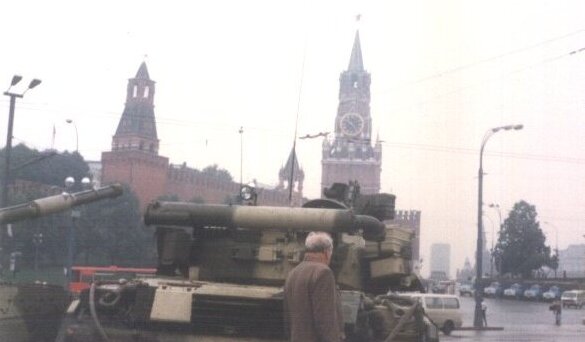
Soviet Coup Attempt Against Gorbachev Fails
United States of America and Russia
Politics
4 min read
Updated By: History Editorial Network (HEN)
Published:
In a pivotal event in Soviet history, hardline members of the Communist Party attempted a coup against Mikhail Gorbachev, who was the General Secretary of the Communist Party and the President of the Soviet Union. The coup was orchestrated by a group of conservative officials who opposed Gorbachev's reforms, which included policies of glasnost (openness) and perestroika (restructuring). These reforms aimed to modernize the Soviet economy and society but faced significant resistance from hardliners who feared the loss of their power and the potential collapse of the Communist regime. The coup was marked by the detention of Gorbachev and the declaration of a state of emergency, but it ultimately failed due to widespread public opposition and the decisive actions of Boris Yeltsin, the President of the Russian Republic. Yeltsin's defiance, including his famous stand atop a tank outside the Russian White House, galvanized support among the populace and military, leading to the coup's rapid disintegration.
The failure of the coup had profound implications for the Soviet Union and the world. It not only marked the beginning of the end for Communist rule in the USSR but also accelerated the process of disintegration of the Soviet state. Following the coup's collapse, Gorbachev's authority was severely weakened, and the momentum shifted towards independence movements within the various Soviet republics. This culminated in the eventual dissolution of the Soviet Union into 15 independent republics, with Russia emerging as the successor state. The events surrounding the coup highlighted the fragility of the Soviet system and the growing desire for democratic governance among its citizens, leading to a significant shift in global politics and the end of the Cold War era.
#mooflife
#MomentOfLife
#SovietUnion
#Gorbachev
#Yeltsin
#CoupAttempt
#CommunismCollapse

Explore the Life Moments of
 AI Twin