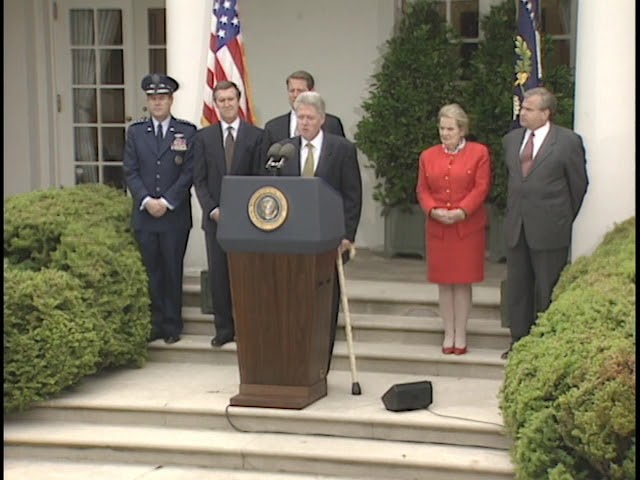
President Bill Clinton Comments on the NATO–Russia Founding Act Signed in Paris
Paris, France
Politics
International Relations
Security
5 min read
Updated By: History Editorial Network (HEN)
Published:
Updated:
United States President Bill Clinton addressed the signing of the NATO–Russia Founding Act, an agreement intended to establish a framework for cooperation between the North Atlantic Treaty Organization and the Russian Federation following the end of the Cold War. The document, formally titled the Founding Act on Mutual Relations, Cooperation and Security between NATO and the Russian Federation, was signed in Paris, France, by leaders from NATO member states and Russian President Boris Yeltsin.
During remarks connected to the agreement, President Clinton described the act as an effort to build a cooperative relationship between NATO and Russia while NATO continued preparations to admit new members from Central and Eastern Europe. The agreement created the NATO–Russia Permanent Joint Council, a forum designed for consultation and coordination on security issues including peacekeeping operations, arms control, non proliferation, and crisis management. Clinton stated that the document aimed to promote transparency and communication between the alliance and Russia during a period of European security restructuring in the 1990s.
The Founding Act outlined several commitments and principles. NATO and Russia agreed to respect sovereignty, independence, and territorial integrity of states, as well as peaceful resolution of disputes in accordance with international law and the United Nations Charter. The agreement also declared that NATO had no intention, plan, or reason to deploy nuclear weapons on the territory of new member states. This provision was included amid discussions surrounding NATO’s planned enlargement, which would later bring Poland, Hungary, and the Czech Republic into the alliance in 1999.
President Clinton’s comments emphasized that the agreement was not a veto mechanism for Russia over NATO decisions. Instead, it was designed to institutionalize dialogue and reduce tensions between former Cold War adversaries. Following the signing, the Permanent Joint Council began meeting regularly to discuss security matters, marking a formalized channel for cooperation between NATO and Russia during the late 1990s.
#mooflife
#MomentOfLife
#Russia
#Nato
#Euro-atlanticPartnershipCouncil
#SecurityCooperation
#Post-coldWarRelations
Primary Reference
Russia–NATO relations

Explore the Life Moments of
 AI Twin